
TL;DR
A 100–300 piece mechanic’s tool set from a mid-range brand like Tekton, GearWrench, or Husky covers nearly all DIY auto repair for $150–$400. Modern vehicles need metric sockets, Torx bits, and an OBD2 scanner — not SAE wrenches. Jack stands, safety glasses, and a torque wrench are non-negotiable safety items, and any work on brakes, airbags, or high-voltage EV systems should go to a certified mechanic.
The average shop labor rate at US dealerships has climbed past $150 an hour in many cities. Suddenly, that $30 oil change your dad did in the driveway doesn’t sound so old-fashioned. A decent auto repair tool set pays for itself the first time you swap your own brake pads or replace a battery terminal.

Get business pricing on garage and car supplies
- Business-only prices and quantity discounts
- Tax-exempt purchasing
- Multiple users, one account, clear invoices
But walk into a hardware store and you’ll face a wall of options — 50-piece starter kits to 300-piece monster sets, prices from $60 to $6,000. Most people either buy too little and get stranded mid-repair, or buy too much and own 40 sockets they’ll never touch. The reason this decision feels hard is that piece count and price are terrible proxies for usefulness — what actually matters is whether the set contains the right fastener sizes for your vehicle, whether the tools survive the torque you’ll apply, and whether the missing pieces are cheap add-ons or expensive dealbreakers.
Here’s what you’ll learn: the core components of a quality set and why each one earns its spot, which brands are worth their price and what you’re really paying for at each tier, what modern vehicles demand that older sets lack, and where the tradeoffs between capability, cost, and safety should stop you cold.
A 100–300 piece mid-range set (Tekton, GearWrench, Husky) at $150–$400 covers roughly 95% of DIY auto repair — professional brands like Snap-on cost 5–10x more…
Modern vehicles demand metric sockets (8mm–19mm), Torx/hex bits, a 1/4"–3/8"–1/2" drive trio, and a $25–$50 Bluetooth OBD2 scanner; SAE tools mainly serve pre-…
Never work under a car supported only by a jack — pair jack stands with wheel chocks, and check older Harbor Freight Pittsburgh jack stands against the 2020 re…
Use a torque wrench on lug nuts and brake hardware; guesswork torque warps rotors or leaves wheels loose.
Leave brake ABS-module work, airbag service, and high-voltage EV systems to a certified mechanic, and check NHTSA.gov for free recall repairs before doing any…
What Belongs in Every Auto Repair Tool Set (The Non-Negotiables)
Every functional auto repair tool set is built on four pillars: sockets and ratchets, combination wrenches, screwdrivers, and pliers. This isn’t arbitrary — these four cover the physics of automotive fastening. Nearly every fastener on a car is either a hexagonal nut/bolt (sockets and wrenches), a threaded screw head (screwdrivers), or a clamp, clip, or hose that needs grip and leverage (pliers). Everything else — torque wrenches, breaker bars, diagnostic scanners — builds on this foundation, which is why buying a set missing any pillar means you’ll end up buying it separately at full price anyway.
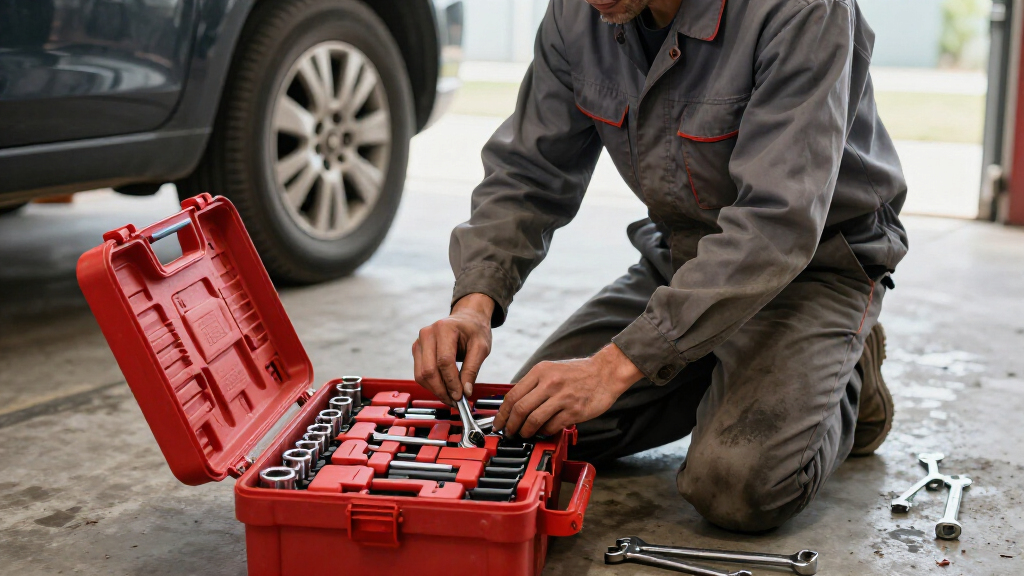
Sockets come in three drive sizes, and each exists because of a torque tradeoff: smaller drives reach into tight spaces but can’t handle high torque without stripping their internal gears; bigger drives transmit more force but won’t fit in confined engine bays. A 1/4-inch drive ratchet handles small fasteners in tight spots — sensors, trim screws, interior work. The 3/8-inch drive is your daily workhorse — most passenger car bolts live here, which is why sets skimping on 3/8-inch sockets to inflate piece counts should be avoided. A 1/2-inch drive delivers the muscle for lug nuts and suspension hardware, where using a smaller drive risks rounding off the bolt head or breaking the ratchet. Add deep sockets for spark plugs and bolts threaded onto studs — a shallow socket physically can’t reach a nut sitting halfway down a stud.
Combination wrenches fill in where sockets can’t reach, and the reason is simple geometry: a ratchet head needs clearance above the fastener, but many automotive fasteners sit against firewalls, frame rails, or alongside hoses. Picture a fuel line fitting buried behind the engine — no ratchet fits, but a boxed-end wrench slides right on and can be flipped to reposition in fractions of a turn. The open end handles speed; the box end handles torque without rounding. Grab both metric and a small SAE set if you drive anything older than 1990, because mixing systems means a metric wrench on an SAE bolt feels tight right up until it slips and strips the fastener.
Screwdriver-wise, flathead and Phillips cover the classics, but Torx bits (T20 through T47) are now mandatory — modern cars use them for brake calipers, interior panels, and headlight housings, largely because Torx heads resist cam-out (the bit slipping out under torque) better than Phillips, letting manufacturers torque fasteners precisely on assembly lines. The implication for you: showing up to a brake job without Torx bits doesn’t slow you down, it stops you entirely. Hex bits handle seat rails and throttle bodies for the same reason.
Products Worth Considering

Chemical Guys TORQX Random Orbital Polisher Kit, 9-Piece

Autel MaxiCharger AC Home Level 2 EV Charger, 50A, J1772, Wi-Fi, Hardwired, 25 ft

Chemical Guys 10-Piece Car Wash Kit with Foam Gun
As an affiliate, we earn on qualifying purchases.
Brand Tiers Compared: Where Your Money Actually Goes
Tool quality breaks into three clear tiers, and understanding why the pricing gaps exist tells you where your money goes. Tool price is driven by three things: metallurgy (how the steel is forged and heat-treated), tolerances (how precisely the socket fits the fastener), and service model (warranty handling and replacement logistics). Budget tools use adequate steel with looser tolerances — they work, but sloppy socket fit transfers force to the fastener’s corners, which is why cheap tools round off bolts that quality tools remove cleanly. The jump from budget to mid-range buys precision fit and consistent hardening, which is where a rounded-off bolt stops being a risk. The jump from mid-range to professional mostly buys extreme durability and warranty logistics — valuable if you use tools 60 hours a week, marginal if you use them 60 hours a year. That’s why a $200 mid-range set handles 95% of home mechanic work; a $2,000 Snap-on set mostly buys service life a home mechanic will never consume.
| Tier | Brands | Typical Set Price | Best For |
|---|---|---|---|
| Budget | Husky, Pittsburgh (Harbor Freight), Craftsman | $60–$150 | Occasional oil changes, battery swaps |
| Mid-range | GearWrench, Tekton, Sunex | $150–$400 | Regular DIY repair — the sweet spot |
| Professional | Snap-on, Matco, Mac Tools, SK | $1,500–$6,000+ | Daily professional abuse, fine tolerances |
Here’s the part most people miss: warranty matters more than brand badge, because the realistic failure mode for a home mechanic isn’t tool breakage under daily abuse — it’s a ratchet mechanism failing years later on a stubborn bolt. Craftsman, Husky, and Tekton all offer lifetime warranties on hand tools — Tekton even honors theirs with no receipt required — meaning a warranty claim costs you a store trip, not a tool replacement. Snap-on is famously durable, but you’re paying 5–10x mid-range prices for chrome polish and truck-door service a home mechanic will never use.
The honest rule: buy mid-range hand tools, and reserve your budget for the specialty items — a good torque wrench and jack stands — where cheap really hurts. A rounded bolt costs you an extractor set and an afternoon; a failed jack stand costs you a hospital visit. The consequences aren’t symmetric, so your spending shouldn’t be either.
One Big Set or Piece-by-Piece? The Answer Depends on Your Patience
Pre-packaged 200–300 piece sets from Craftsman, Husky, DeWalt, and GearWrench beat piecemeal buying on cost per tool — usually by 30–50%. The reason is distribution economics: manufacturers bundle high-margin specialty pieces with commodity sockets, so the set price amortizes everything. The tradeoff is that you don’t choose the contents. Buying individually wins only when you already know exactly which tools your car needs and want zero duplicates — knowledge most beginners don’t have yet, which is precisely why the bundled route makes sense at the start: it guarantees coverage while you’re still learning what your car demands.
My neighbor bought a 218-piece Husky set for around $180 and has done brake jobs, alternator replacement, and a thermostat swap with it — adding only a torque wrench and jack stands along the way. That’s the hidden strength of bundles: they convert a research problem into a purchase decision. The catch is that bundle sets pad their piece counts with duplicate 12-point sockets and screwdriver bits you’ll never use. This isn’t fraud — it’s marketing physics — but it means a “300-piece” set might contain 200 tools you’ll actually touch. Judge sets by the socket range and wrench coverage, not the number on the box.
The piecemeal route suits someone upgrading, and the reason is failure-driven specificity: you only truly know which tool deserves an upgrade after the cheap version fails you. If your ratchet just stripped its gears rounding off a stubborn bolt, replace it with a 90-tooth or higher ratchet — the finer swing arc matters in cramped engine bays where a cheap 36-tooth ratchet barely moves five degrees per click, meaning you may not be able to swing it at all in a confined space. More teeth also engage more of the gear at once, so the ratchet transmits more torque without skipping. Direct-to-consumer brands like Tekton and Harbor Freight’s Icon line have made quality individual tools affordable enough that hybrid buying — a core set plus selective upgrades — is now the smartest play: you get bundle economics on the commodity tools and targeted spending where precision actually pays.
4 Tools Modern Cars Force You to Own (That Old Sets Don’t Have)
Modern vehicles need metric fasteners, Torx and hex bits, electronic diagnostics, and cordless impact power — four things a 1990s tool set completely lacks. The common thread is that cars have changed in two directions at once: mechanically, global manufacturing standards pushed everything to metric; electronically, computerized systems turned diagnosis into the first step of most repairs rather than guesswork. If you’re inheriting grandpa’s toolbox, budget for these additions before anything else.
- Metric sockets and wrenches (8mm–19mm) — metric fasteners dominate every modern vehicle, domestic or import, because global parts sharing demands one standard. SAE sizes mostly serve pre-1990 American cars. The practical implication: an SAE socket “almost” fits a metric bolt, and “almost” is exactly how fasteners get stripped — the wrong-standard tool engages the corners loosely and chews them off under torque.
- Torx and hex bit set — brake caliper bolts, seat bolts, and body panels increasingly use Torx because the star pattern resists cam-out at assembly-line torque levels. A $25 bit set saves hours of frustration — or saves the repair entirely, since a stripped Torx head on a caliper bolt can turn a Saturday brake job into a machine-shop extraction.
- OBD2 scanner — since 1996, every US car reports trouble codes through a standard port. This changed the economics of diagnosis: what used to require a shop’s knowledge now costs a $20–$50 smartphone-connected scanner and ten minutes. Reading the code yourself means you can decide whether it’s a loose gas cap or a failing catalytic converter before anyone charges you $150 an hour to find out.
- Cordless 1/2-inch impact wrench — modern battery impacts deliver 700+ ft-lbs of torque, letting DIYers skip air compressors entirely for lug nuts and suspension bolts. The significance is spatial and financial: a compressor needs garage space, hoses, and maintenance; a battery impact fits in a drawer. For rusted Midwest suspension bolts that a breaker bar would just bend, an impact’s hammering action breaks the corrosion bond without shocking the whole assembly.
Two more modern musts: thin-profile ratchets with flex heads for today’s packed engine bays, where the barrier isn’t torque but access — a fat ratchet head simply doesn’t fit between the strut tower and the battery box; and impact-rated sockets (black, chrome-moly) if you use that cordless impact. The metallurgy explains why: chrome sockets are hardened to resist wear, which makes them brittle, so impact hammering can shatter them into shrapnel. Impact sockets trade hardness for toughness — softer steel that flexes instead of fracturing. Ask anyone who’s picked chrome shards out of a wheel well: that’s a mistake you make once.
Safety Gear That Isn’t Optional (and One Recall You Should Know)
The safety core of any home garage is jack stands rated above your vehicle’s weight, wheel chocks, safety glasses, and mechanic’s gloves. These cost under $100 combined and prevent the failures that actually hurt people. The reason this list is short and cheap is that DIY injuries follow predictable patterns: a car falling off a jack is the classic horror story, and it happens because a hydraulic jack is a lifting device, not a holding device — its seals weep pressure over hours, so a car that was stable at noon can be on your chest at 12:45. Jack stands are mechanical, not hydraulic, which is why they’re the only thing qualified to hold the load.
Case in point: in 2020, Harbor Freight recalled roughly 1.7 million Pittsburgh 3-ton and 6-ton jack stands due to a casting flaw that could cause sudden collapse under load — one of the largest tool recalls in recent memory. The lesson isn’t “avoid Harbor Freight”; it’s that safety-critical gear deserves a manufacturer’s rating you trust and a recall check you actually perform. If you own older Pittsburgh stands, check the model numbers against the recall notice. It’s a five-minute check; do it.
Never work under a car supported only by a jack. Hydraulic jacks bleed down; jack stands and wheel chocks are the only things between you and two tons of steel.
Also add a torque wrench to your safety list, because torque is a safety spec, not a preference. Fasteners are springs — they clamp parts together by stretching a precise amount, and both extremes fail differently. Lug nuts over-tightened by guesswork warp brake rotors (the clamping force distorts the rotor, causing pedal pulsation) and cold-weld themselves to the hub; under-tightened ones can leave a wheel on the highway. The tradeoff is calibration: a beam-style wrench never needs recalibrating but is harder to read under a car; a click-type is easier to use but should be recalibrated every few years. Either costs $40–$100 and lasts decades.
Finally, know your limits — and understand why they exist. Brake work involving ABS module bleeding, any airbag service, and all high-voltage EV battery systems belong with a certified mechanic. ABS bleeding often requires scan-tool activation of pump valves that consumer scanners can’t do; airbags deploy with explosive force and can trigger during what looks like unrelated electrical work; and the orange cabling in an EV can carry 400+ volts, which doesn’t forgive contact the way 12-volt systems do — a mistake there isn’t a burned finger, it’s a fatality. Check NHTSA.gov for open recalls on your vehicle before any DIY work; some recall repairs are done free at dealers anyway, which makes skipping that check a pure loss.
Build Your Starter Kit in 5 Steps (By Budget)
The smartest build order starts with a core hand-tool set, then adds safety gear, then specialty tools as real jobs demand them. The sequence matters for two reasons: it front-loads the items where cheap versions are merely inconvenient (hand tools) and reserves spending for items where cheap versions are dangerous or diagnostic dead-ends; and it lets actual repair jobs — not hypothetical ones — justify each purchase, so you never own a tool you can’t explain.
- Buy a 100–200 piece mid-range mechanic’s set ($150–$300) — this is the documented sweet spot for beginners, covering metric sockets, wrenches, and screwdrivers. Starting here matters because every later purchase assumes this foundation exists; buying specialty tools first means owning an impact wrench with nothing to remove.
- Add safety gear immediately: 3-ton jack stands, wheel chocks, and a floor jack ($100–$180 total). “Immediately” is the operative word — the gap between owning lifting tools and owning holding tools is when the classic accident happens, and it can be a window of weeks.
- Add a torque wrench ($40–$100) before your first wheel or brake job. Timing it this way means the tool arrives when the consequence of not having it becomes real.
- Add diagnostics: a $25–$50 Bluetooth OBD2 scanner and a free phone app. This is the cheapest capability-per-dollar item on the list — it converts check-engine panic into a code you can look up, before you’ve bought a single other tool for the repair.
- Upgrade selectively: a 90-tooth ratchet, a cordless impact wrench, and Torx bits as specific jobs require them. Waiting until jobs demand them isn’t frugality — it’s targeting, because only a real stuck bolt tells you whether your usage pattern justifies a $200 impact wrench.
Total investment for a genuinely capable home setup: roughly $400–$600 spread over a few months. Framed against the alternative — dealership labor at $150+ an hour — that’s less than four hours of shop time, and unlike labor, the tools stay yours and work on every vehicle you’ll ever own. The spreading-over-months part isn’t just budgeting comfort; it’s how the upgrade path stays honest.
Frequently Asked Questions
What’s the minimum tool set needed for basic car maintenance?
For oil changes, battery swaps, and air filters you need a 3/8-inch drive socket set (metric, 8mm–19mm), a basic combination wrench set, a few screwdrivers, and pliers. A 100–150 piece starter set covers all of this. Add jack stands, wheel chocks, and a floor jack before doing anything that requires getting under the car.
Metric or SAE — which do I actually need?
Metric, full stop, for any vehicle built after roughly 1990 — domestic and import alike. SAE (inch-sized) fasteners live mainly in older American cars and some classic restoration work. If you drive anything modern, buy metric first and add a small SAE set only if a specific project demands it.
Are expensive brands like Snap-on worth it for home mechanics?
Usually not. Snap-on, Matco, and Mac Tools build tools for technicians who use them 40+ hours a week for decades, and their prices reflect that service life. For home use, mid-range brands like Tekton, GearWrench, and Husky offer lifetime warranties at 10–20% of the cost. Spend the savings on safety gear and specialty tools instead.
Do I really need a torque wrench?
Yes, for anything involving wheels or brakes. Over-tightened lug nuts warp brake rotors and make roadside tire changes miserable; under-tightened ones can work loose at highway speed. A quality click-type torque wrench costs $40–$100 and lasts decades when stored at its lowest setting.
What’s the difference between chrome and impact sockets?
Chrome sockets are for hand ratchets — they’re harder and shinier but brittle under impact loads. Impact sockets are made from softer, tougher chrome-moly steel with thicker walls, built to absorb impact-wrench hammering. Using chrome sockets on an impact wrench risks shattering — always match black impact sockets to your impact tools.
Conclusion
Buy the mid-range set, add the safety gear, and let real repair jobs tell you what specialty tool comes next. That’s the whole strategy — $400–$600 spread over a few months buys a garage that handles almost anything your daily driver throws at it.
The best auto repair tool set isn’t the biggest one on the shelf. It’s the one that’s already in your trunk the night a check-engine light appears — with a scanner plugged in before the tow truck is even a thought.