TL;DR

Get garage and car supplies delivered free — and shop member deals
- Fast, free delivery on millions of items
- Access to Prime Big Deal Days deals on October 6–7
- Prime Video, Amazon Music and more included
Rustam Kocher told Charged EVs that public Type 2 charging is widespread at European business parks and shopping centers, though drivers may need to navigate many separate charging apps. He described app access failures and QR-code scams, while saying roaming cards and network partnerships have made it easier to use multiple providers. The interview offers a personal account, not a comprehensive measurement of charging access across Europe.
EV expert Rustam Kocher told Charged EVs that public Type 2 chargers are common at many European business parks and shopping centers, but drivers can still face a confusing patchwork of charging apps and payment systems. In an interview published October 1, 2026, Kocher described both the inconvenience of app-dependent charging and signs of improvement as roaming agreements let some drivers use one card or service across multiple networks.
Kocher, who worked for years on electric trucks before retiring to Europe, said he has lived there for four years. He described Type 2 charging as “ubiquitous” in many large business parks and shopping centers. Drivers generally need to bring their own cable, he said, and the charging is often relatively inexpensive because it uses lower power. His account reflects his experience; the interview does not provide a Europe-wide inventory or price comparison.
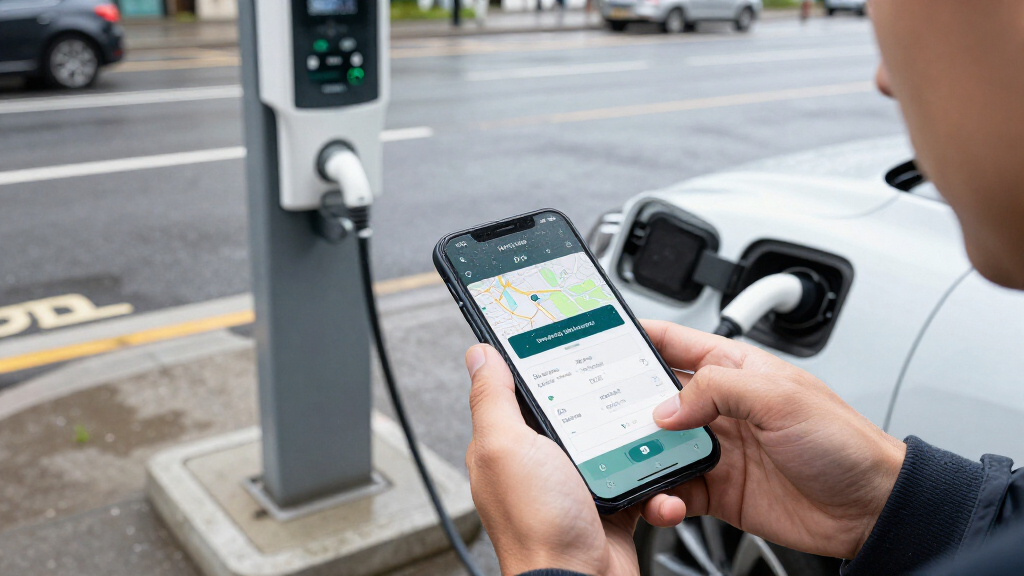
Access can still depend on an operator’s app. Kocher said that in Spain he has encountered chargers requiring a new app for a particular location or city, and estimated that he has 50 charging apps on his phone. In one example, he arrived at a charger in an underground parking garage without cellular service or Wi-Fi. He had to go upstairs to download the operator’s app, then coordinate with his wife to connect the cable before the charging session timed out.
Kocher also warned about QR-code sticker scams, in which a fraudulent sticker placed over a charger’s payment code can send a driver to a spoofed site. Charged EVs’ Charles Morris connected the garage incident to a wider question about how charging performance is measured: a unit can be technically online yet difficult for a driver to use. The article cited ChargerHelp CEO Kameale Terry’s view that first-time charge success rate better reflects the driver’s experience than uptime alone.
App Access Shapes Charging Reliability
The interview highlights a difference between a charger being installed and a driver being able to start a session. App requirements, weak connectivity and session timeouts can turn a working charger into an unusable one for someone who has not prepared in advance. For drivers, that can mean delays and uncertainty; for operators and site hosts, it can mean low use even when equipment is technically available.
Kocher’s account also points to a practical security risk: payment QR codes should be checked for signs of tampering before scanning. At the same time, he reported that roaming cards and agreements between providers have reduced the need to carry separate payment options for every network in some places. The account is useful as a description of user experience, but it does not establish how common these problems are across European charging sites.
As an affiliate, we earn on qualifying purchases.
From Separate Apps to Roaming
Charged EVs framed the interview around changing expectations for public charging. Its report contrasts an earlier model in which free, low-power chargers were installed at retail locations with a newer focus on paid DC fast charging. The article’s writer described seeing public Level 2 chargers become less common in Florida as fast-charging stations expanded, and asked Kocher whether he had observed a similar pattern in Europe, where the comparable AC charging is commonly called Type 2.
Kocher’s answer was that his experience in Europe differed: Type 2 chargers remained widespread at the business parks and shopping centers he visited, usually for a fee. For longer trips, he said, access has improved through network partnerships. He recalled traveling to Spain’s Basque Country for the August eclipse and using an Octopus Energy or Chargemap card without difficulty at the stations he tried. That does not mean every charger accepts every card; access depends on the agreements attached to a particular service.
“I literally have 50 apps on my phone.”
— Rustam Kocher, speaking to Charged EVs
How Widely Do Problems Occur?
The interview does not quantify how many European chargers require proprietary apps, how often connectivity prevents a session, or how widespread QR-code tampering is. Kocher’s examples describe his own experiences and do not establish the frequency of those issues across countries or networks. The report also gives no consistent data comparing Type 2 availability in Europe with public Level 2 availability in the United States.
It is also unclear which roaming agreements apply at any specific site and whether they cover every charger operated by a participating provider. Charged EVs’ writer said they could not sign up for Octopus Charge in the United States because of problems with the app, while Kocher said he had been happy with Octopus in his own experience. The article provides no further details about the signup failure or a resolution.
Roaming and App Access Ahead
The report does not identify a scheduled policy change, product fix or follow-up date. For now, drivers can check which networks a roaming card or app supports before traveling and confirm payment options for a specific charging location. Kocher’s account suggests that partnerships can simplify access, but it does not remove the need to verify coverage.
For charging providers, the issues raised point to practical measures that could make sessions easier to start, including more reliable connectivity, payment options that do not depend on downloading a new app at the charger, and attention to first-time charge success as well as uptime. Whether operators will adopt such changes, and whether roaming access will expand across Europe and the United States, remains to be seen.
Key Questions
What did Rustam Kocher say about public EV charging in Europe?
Kocher said Type 2 chargers are common at many large business parks and shopping centers he has visited. He described them as generally paid, low-power chargers for which drivers bring their own cable.
Why did Kocher criticize charging apps?
He said drivers may need separate apps for different charging operators or locations. In one underground parking garage, he had to go upstairs to find a cellular signal so he could download an app and start charging before the session timed out.
What are QR-code charging scams?
Kocher warned that someone may place a fraudulent sticker over a charger’s payment QR code. Scanning it could take a driver to a spoofed site rather than the charging provider’s payment page. The interview did not say how frequently this happens.
Do roaming cards work at every European charger?
No such guarantee was given. Kocher said cards with many network agreements worked at the chargers he used during a trip in Spain, but coverage depends on the specific provider, agreement and station.
Does the interview show that European charging is better than U.S. charging?
No. It presents Kocher’s personal observations and the writer’s account of Florida, not a systematic comparison of charging availability, cost or reliability across Europe and the United States.
Source: rss
Fall Picks
fall essentials
As an affiliate, we earn on qualifying purchases.