
TL;DR

Get business pricing on garage and car supplies
- Business-only prices and quantity discounts
- Tax-exempt purchasing
- Multiple users, one account, clear invoices
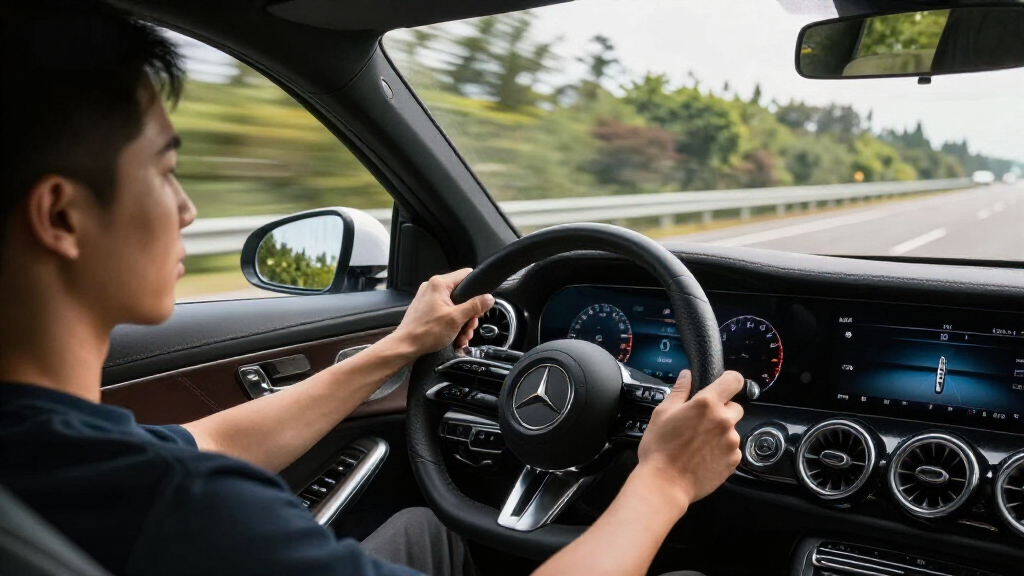
Mercedes plans to offer MB.Drive Assist Pro on many electric and combustion models early next year, with an over-the-air option for eligible vehicles already on the road. The Level 2 system can drive to a destination and park, but requires a hand on the wheel on surface streets; whether that makes it safer or less appealing than Tesla’s supervised FSD depends on driver expectations and system performance.
Mercedes plans to add MB.Drive Assist Pro, a destination-based driver-assistance system, to many of its electric and gasoline models early next year. The system can drive to a chosen destination and park, but it requires drivers to keep a hand on the wheel on surface streets—a key difference from Tesla’s supervised Full Self-Driving that could shape whether drivers see Mercedes’ approach as a safety measure or a limitation.
Mercedes says the system will be available on a broad range of its electric and internal-combustion vehicles, including the new CLA, with eligible cars already sold able to add it through an over-the-air update. Like Tesla’s supervised FSD, the system is designed to handle a trip after the driver enters a destination. The report says it can also park at the end of that trip.
The main operating distinction is where the driver must keep a hand on the wheel. MB.Drive Assist Pro allows hands-free operation on controlled-access highways, but requires a hand on the wheel on surface streets. Mercedes describes the system as Level 2 Plus Plus, meaning the driver remains responsible for supervising the vehicle. Tesla’s system is also classified as supervised Level 2 assistance, though its surface-street operation does not impose the same hand-on-wheel requirement described in the report.
Mercedes says its system uses cameras alongside five radar sensors and 12 ultrasonic sensors, with computing powered by Nvidia hardware. That differs from Tesla’s camera-based approach, according to the report. The sensor mix is a design distinction, not by itself evidence that one system is safer or performs better; the source does not provide comparative safety results.
The Trade-Off Behind Hands-On Driving
The difference matters to drivers weighing a point-to-point system against the freedom they associate with Tesla’s FSD. Keeping a hand on the wheel may feel like a practical safety buffer on busy urban streets, where pedestrians, cyclists, parked vehicles and changing traffic create more variables. But for people who want a system to take over more of the driving task, the requirement may make Mercedes’ offering feel less autonomous, even though the driver remains responsible with either Level 2 system.
The distinction also reflects competing ideas about what a driver-assistance feature should promise. Mercedes is emphasizing the boundary between a supervised Level 2 system and Level 3 automation, where responsibility shifts to the vehicle in defined conditions. Buyers considering the feature will need to weigh that cautious framing, the car’s performance in real use, and the value they place on Mercedes vehicles’ design and interiors against the more hands-off experience some Tesla drivers report.
Those user reports are individual experiences, not controlled comparisons. The article includes drivers who say they use Tesla FSD hands-free on streets, but those accounts do not establish that the feature is safe to use that way or that every driver and vehicle will behave similarly. Neither the reported sensor count nor a driver’s confidence should be treated as a substitute for official operating instructions.
Products Worth Considering

VIOFO A329S 4K 60FPS Front and 2K Rear Dash Cam

VIOFO A229 Plus Front and Rear Dash Cam with Dual 2K HDR

Vantrue N5S 4-Channel 360° Dash Cam with Front, Rear, and Cabin Cameras
As an affiliate, we earn on qualifying purchases.
Mercedes’ Level 2 Position
Mercedes’ stated reasoning centers on the Society of Automotive Engineers’ automation levels. CTO Jörg Burzer told InsideEVs that the dividing line is responsibility: with Level 2 Plus Plus, the driver remains responsible; in Level 3, the vehicle’s system is responsible within its operating conditions. He said controlled-access highways present fewer variables than surface streets, which informs Mercedes’ requirement that drivers keep a hand on the wheel in city driving.
The report also describes a difference in customer expectations. Mercedes cited research suggesting European drivers prefer some form of hand-on-wheel requirement in cities, while Burzer said he did not yet know how U.S. customers would respond. Los Angeles-area Tesla owners interviewed by InsideEVs expressed mixed views: some valued hands-free street driving, while one said he might still prefer a better-appointed Mercedes but would probably not switch if the hand-on-wheel rule applied.
Mercedes’ approach is arriving as Tesla’s supervised system expands into Europe, according to the report. The comparison is therefore not only about technical capability: it also involves regulatory expectations, driver responsibility and how brands describe systems that still require supervision.
“There is a very important borderline between the levels. That borderline is that with Level 2 Plus Plus, you are responsible. At Level 3, the machine, the car, the software stack, is responsible.”
— Jörg Burzer, Mercedes chief technology officer, speaking to InsideEVs
Availability and Performance Questions
The report does not give a precise launch date, identify every eligible model or specify which existing vehicles will receive the over-the-air option. It also does not detail the system’s geographic availability, pricing, operating limits or the conditions under which it can complete a trip and park.
Mercedes has not supplied comparative test results establishing whether its camera, radar and ultrasonic sensor combination performs better or is safer than Tesla’s approach. Nor is there evidence in the source that hands-on operation on surface streets produces better outcomes. Tesla drivers’ accounts of hands-free use describe personal behavior and experience, not an endorsement of that behavior by regulators or proof that the system is autonomous.
Burzer’s comments also leave the U.S. customer response unresolved. How Mercedes will communicate driver monitoring and responsibility, and whether those details vary by market, remains unclear from the report.
Launch Details to Watch
Mercedes is expected to provide further details as it prepares to add MB.Drive Assist Pro to eligible vehicles early next year. Drivers will need model-specific confirmation of availability, any required software update or equipment, pricing, and the system’s operating boundaries before deciding whether it fits their needs.
Once the feature reaches customers, its real-world behavior and the clarity of its driver-supervision requirements will be central to comparisons with Tesla. Until Mercedes publishes those details and independent comparative evidence is available, the clearest confirmed distinction is the operating rule: hands-free on controlled-access highways, but a hand on the wheel on surface streets.
Key Questions
What is Mercedes MB.Drive Assist Pro?
It is a planned point-to-point driver-assistance system that can drive toward a destination and park while the driver supervises. Mercedes calls it Level 2 Plus Plus, meaning the driver remains responsible.
Does Mercedes’ system require hands on the wheel everywhere?
No. According to the report, MB.Drive Assist Pro permits hands-free driving on controlled-access highways, but requires a hand on the wheel on surface streets.
When and where will it be available?
Mercedes plans to add the system to many electric and internal-combustion models early next year. Eligible vehicles already purchased are expected to be able to add it through an over-the-air update, but the full model list and exact launch date have not been reported.
Is Mercedes’ system safer than Tesla FSD?
The source does not establish that. Mercedes says the system uses cameras, five radar sensors and 12 ultrasonic sensors, but sensor configuration alone does not prove a safety advantage, and the report includes no comparative test results.
Is either system fully autonomous?
The systems discussed are described as supervised Level 2 assistance, with the driver responsible. Mercedes says Level 3 differs because responsibility shifts to the vehicle within defined conditions; MB.Drive Assist Pro is not presented as Level 3.
Source: insideevs.com