
TL;DR

Get business pricing on garage and car supplies
- Business-only prices and quantity discounts
- Tax-exempt purchasing
- Multiple users, one account, clear invoices
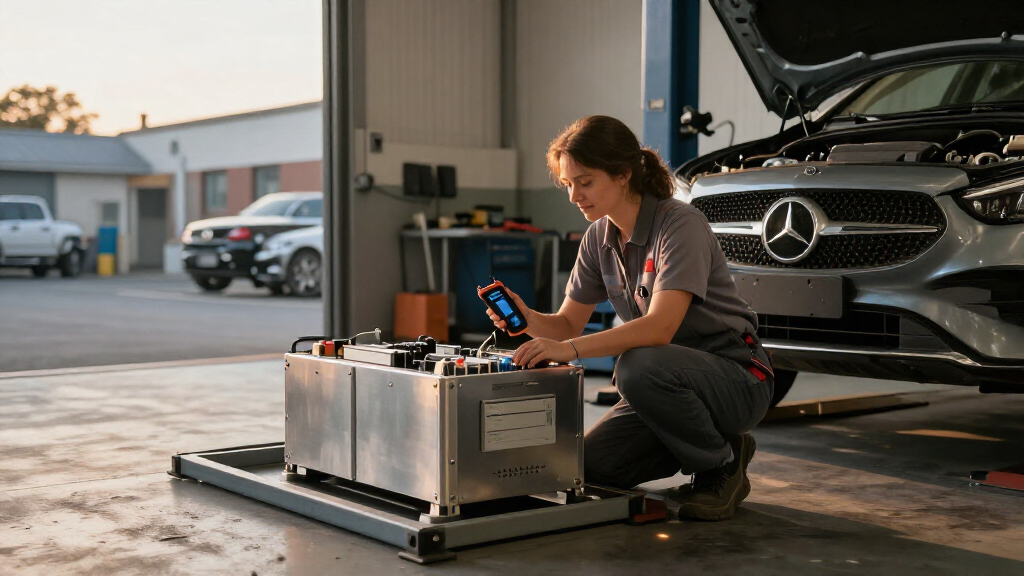
Mercedes-Benz is developing a Power Converter system that could control the charging and discharging of individual battery cells or cell groups. The company says the technology could support longer battery life, mixed cell chemistries and bidirectional charging, but it remains in development and its cost, reliability and production timeline are unknown.
Mercedes-Benz is developing a Power Converter that could control the charging and discharging of individual cells or cell groups in an electric-vehicle battery, rather than treating the pack as a single unit. The company says the approach could improve battery life and allow different cell chemistries to operate in one pack, but the technology remains under development and no production schedule has been announced.
Most EV batteries contain many cells arranged in groups or modules. As described in an InsideEVs report, existing systems can monitor cell or module voltage, but generally manage charging and discharging across the pack rather than independently directing power through every cell. Mercedes-Benz’s proposed system would use programmable micro-converters to regulate energy flow at cell or group level.
That control could let the system isolate a cell that can no longer maintain the voltage of its neighbors, instead of requiring the entire pack to operate around it. The report describes this as a possible way to keep a vehicle running with some loss of capacity. It is a proposed capability, not a confirmed repair outcome or a demonstrated result in production vehicles.
The design could also manage cells with different chemistries or ages by charging them at different power levels. Mercedes’ concept would make pack output less dependent on the number of cells connected in series, with software and converters controlling voltage. The report also says the company is exploring bidirectional charging and handling AC and DC conversion through the micro-converters.
How Cell-Level Control Could Help
If the system works as intended, it could give automakers more options for designing and using battery packs. Cell-level control may allow a battery to continue operating when an individual cell weakens, and to manage mixed cells without requiring every cell to behave identically. That could affect repairability, pack design and useful capacity, though Mercedes has not provided test data showing how much battery life or range the system might add.
The approach could also change how a vehicle uses a large battery day to day. The InsideEVs report says the pack could keep some capacity in standby when a driver does not need it, then make that capacity available for a longer trip. This is a potential operating strategy, not a confirmed feature or a stated range improvement for a specific vehicle.
There is a reliability trade-off to examine. Replacing larger power-electronics components with many micro-converters may create more individual components that could fail. The overall benefit will depend on their durability, cost, serviceability and the performance of the control software. Those details have not been disclosed.
Products Worth Considering

DEWALT 20V MAX 5-Tool Cordless Combo Kit with Drill, Impact Driver, Saws, Oscillating Multi-Tool, Batteries, Charger, and Bag (DCK551D1M1)

Autel MaxiCOM MK900BT Bidirectional Automotive Diagnostic Scanner

DEWALT 20V MAX 3-Tool Brushless Power Tool Combo Kit with Drill, Impact Driver, Oscillating Tool, 3 Batteries, and Charger (DCK360D3)
As an affiliate, we earn on qualifying purchases.
From Pack-Level to Cell-Level Control
EV traction batteries typically combine thousands of cells into larger groups or modules. A vehicle’s battery-management system monitors electrical conditions, including voltage, to keep the pack within operating limits. In the system described by InsideEVs, Mercedes would add converters that can direct energy at a more granular level than conventional pack-wide control.
The proposed design is not simply a different battery chemistry. It is a change to the power electronics and control architecture around the cells. Mercedes says the technology could also reduce the need for some bulky conversion hardware, while supporting bidirectional energy flow. The report does not establish that these potential component reductions or functions have been validated in a production-ready battery.
“The new technology has the potential to boost the driving range and efficiency of future plug-in models.”
— Mercedes-Benz, as quoted in the InsideEVs report
Reliability and Production Details Remain Open
Mercedes-Benz has not released details on when the Power Converter might enter production, which vehicles could use it, or how it would affect battery cost and pack size. The available source material also gives no independent test results, durability figures, repair procedures or measured changes in driving range and efficiency.
It remains unclear how the system would respond to converter failures, whether individual components could be serviced, and how many converters a finished pack would require. The potential to isolate a weak cell is not evidence that a whole-pack replacement would no longer be needed in specific cases. Those outcomes depend on engineering and service details that have not been made public.
Evidence Needed Before Production
The next meaningful milestones would be Mercedes-Benz sharing test results, technical specifications and a timeline for vehicle use. Details on converter durability, pack-level safety, service access and the cost of manufacturing the system will help show whether its flexibility can outweigh the added component count.
Until the company provides those details, the Power Converter should be treated as a development-stage technology with potential benefits, not a confirmed feature of an upcoming Mercedes EV. No specific vehicle, launch date or production commitment is identified in the source report.
Key Questions
What is Mercedes-Benz’s Power Converter?
It is a development-stage battery system using programmable micro-converters to control charging and discharging for individual cells or cell groups.
Could it make an EV battery last longer?
Mercedes says the technology could help prolong battery life, including by managing cells individually. No measured improvement or production-vehicle result has been provided in the source material.
Would it let a car keep running if a cell weakens?
The proposed system could disable a cell that cannot maintain the required voltage, according to the report. That could reduce available capacity, but Mercedes has not confirmed how this would work in a production vehicle or in every failure scenario.
When will Mercedes use the technology in a car?
No production date or vehicle application has been announced in the available reporting. Mercedes-Benz’s Power Converter remains under development.
What is the main concern with the design?
The system could place thousands of micro-converters inside a battery pack, creating many components whose reliability and serviceability would need to be established. Cost and durability details remain unavailable.
Source: insideevs.com