
For most home workshops, I’d make the DEWALT 25-Gallon Vertical Portable Electric Air Compressor my best overall pick: its larger tank offers more capacity than pancake models without committing to a permanent 60-gallon installation. The Klutch 20-Gallon Portable Air Compressor is a strong middle-ground choice for buyers who want a portable tank, while the California Air Tools 8010A stands out for quieter operation. The main tradeoffs are airflow and recovery for demanding tools, noise and space in a shared garage, and portability versus tank capacity. I’ve compared all 13 models by their intended garage tasks, power requirements, and practical limitations; read on for the full breakdown and guidance on choosing the right size.

Get business pricing on garage and car supplies
- Business-only prices and quantity discounts
- Tax-exempt purchasing
- Multiple users, one account, clear invoices
Complete the kit


Key Takeaways
- The DEWALT 25-gallon vertical model is the most balanced pick for buyers who need more reserve than a small pancake tank but do not want to install a stationary compressor.
- The two 60-gallon models are the capacity leaders, but their 230V requirements and fixed-installation fit make them poor matches for casual, space-limited garages.
- The California Air Tools 8010A prioritizes a quieter workspace; its 8-gallon tank is a different compromise from larger, louder options built around greater capacity.
- Small tanks suit intermittent tasks, not sustained air demand: the 0.5-, 2-, and 2.5-gallon options are easier to store or move but have less air in reserve.
- Tank size alone does not establish tool compatibility; compare a tool’s required CFM at its stated pressure with the compressor’s delivered airflow before buying.


| garage air compressor | Tank capacity | Maximum pressure | Noise level | Motor power |
|---|---|---|---|---|
| DEWALT 60-Gallon 175 PSI Stati | 60 gallons | 175 PSI | 70 dB | 5 hp |
| CRAFTSMAN 0.5-Gallon Wall-Moun | 0.5 gallons | 125 PSI | 65 dB | 1.5 HP |
| CRAFTSMAN 6-Gallon 150 PSI Oil | 6 gallons | 150 PSI | 82 dB | — |
| DEWALT 25-Gallon Vertical Port | 25 gallons | 200 PSI | 79 dB | 2 hp |
| Campbell Hausfeld 60-Gallon Tw | 60 gallons | 175 PSI | 65 dB | — |
| CRAFTSMAN 2-Gallon Portable Oi | 2 gallons | 125 PSI | 78 dB | 1/3 HP |
| Klutch 20-Gallon Portable Air | 20 gallons | 175 PSI | 80 dB | 2 HP |
| DEWALT DWFP55130 Portable Air | 2.5 gallons | 200 PSI | 71.5 dBA | — |
| VEVOR 13-Gallon Oil-Free Air C | 13 gallons | 125 PSI | 66 dB | 2 HP |
| RyanTek 15-Gallon Oil-Free Air | 15 gallons | 125 PSI | 66 dB at 4 m | 2 HP |
| Klutch 29-Gallon Oil-Free Air | 29 gallons | 175 PSI | 81 dB | 2.5 HP |
| California Air Tools 8010A 1.0 | 8 gallons | 120 PSI | 60 dB | 1.0 HP |
| ECOMAX 6-Gallon 150 PSI Portab | 6 gallons | 150 PSI | 75 dB | 1.5 HP |
More Details on Our Top Picks
DEWALT 60-Gallon 175 PSI Stationary Electric Air Compressor
The 60-gallon tank and 14.6 SCFM at 90 PSI make this the strongest fit here for a garage running air-hungry tools or several tasks in succession. Compared with the Campbell Hausfeld 60-Gallon Two-Stage Air Compressor, it supplies substantially more airflow at 90 PSI, a useful difference for work such as sanding and cutting. Its 175 PSI maximum and vertical tank also suit a dedicated shop where floor space matters. The tradeoff is the installation: this compressor needs 240 V power and a 30-amp double-pole breaker, and the power cord is not included. I would rank it ahead of portable options for sustained shop work, but it is a poor match for casual inflation or a garage without the required electrical supply.
Pros:- 14.6 SCFM at 90 PSI supports sustained, higher-air-demand work.
- 60-gallon tank and 175 PSI maximum suit a dedicated shop setup.
- Vertical design uses less floor area than a horizontal tank of similar capacity.
- 70 dB noise rating is lower than the DEWALT 25-Gallon Portable Electric Air Compressor’s 79 dB rating.
Cons:- Requires 240 V service and a 30-amp double-pole breaker.
- Power cord is not included.
- Stationary 60-gallon design is excessive for occasional inflation or small jobs.
Best for: Garage owners running air-hungry pneumatic tools who have room for a stationary vertical tank and suitable 240 V electrical service.
Not ideal for: DIYers who need a compressor they can move or plug into a standard outlet, or anyone without a 30-amp double-pole breaker and a plan for the missing power cord.
- Tank capacity:60 gallons
- Maximum pressure:175 PSI
- Airflow:14.6 SCFM at 90 PSI
- Motor power:5 hp
- Voltage:240 V AC
- Maximum current:20 A
- Noise level:70 dB
- Electrical installation:Requires a 30-amp double-pole breaker
Our verdict“Choose this DEWALT for a properly wired garage where high airflow matters more than portability or simple installation.”
CRAFTSMAN 0.5-Gallon Wall-Mount Air Compressor with 30-Foot Retractable Hose and 8-Piece Accessory Kit
This CRAFTSMAN makes the most sense when the goal is a wall-mounted inflation and cleanup station, not a substitute for a shop compressor. Its 30-foot retractable hose keeps reach handy without leaving a long hose sprawled across the floor, and the included accessories cover tire inflation and blow-off jobs. At 1.8 CFM and just a 0.5-gallon tank, it has far less reserve than the CRAFTSMAN 6-Gallon Pancake Air Compressor, so repeated or sustained pneumatic-tool use will be a tougher fit. The oil-free motor reduces routine pump maintenance, while the corded design still ties it to an outlet. I would pick it over a portable tank when wall storage and quick access matter most, but skip it for projects that need steady airflow.
Pros:- Wall mounting frees floor and workbench space.
- 30-foot retractable hose offers broad reach and stores neatly.
- Oil-free motor avoids routine pump-oil changes.
- Includes inflation and blow-gun accessories for common garage jobs.
Cons:- 0.5-gallon tank provides little reserve for sustained air demand.
- 1.8 CFM limits its usefulness with demanding pneumatic tools.
- Corded electric operation requires access to a suitable outlet.
Best for: Garage owners who mainly inflate tires, blow away light debris, and want a permanently handy hose without taking up floor space.
Not ideal for: People using air-hungry tools for extended periods or buyers who need a portable compressor with a larger air reserve.
- Tank capacity:0.5 gallons
- Maximum pressure:125 PSI
- Airflow:1.8 CFM
- Motor power:1.5 HP
- Hose length:30 feet
- Pump type:Oil-free
- Noise level:65 dB
- Mounting:Wall mount
Our verdict“Choose this compact CRAFTSMAN for convenient tire inflation and light garage cleanup, not continuous tool operation.”
CRAFTSMAN 6-Gallon 150 PSI Oil-Free Pancake Air Compressor with 25-Foot Hose
For a first garage compressor, this pancake model balances useful tank capacity with a familiar 120 V power supply. Its 2.6 SCFM at 90 PSI is suited to intermittent jobs such as nailing, tire inflation, and woodworking; the 25-foot hose also gives more reach than the CRAFTSMAN wall-mount model’s compact tank-and-hose setup. Dual quick couplers let two compatible tools connect at once, though that does not turn its modest airflow into a source for continuous high-demand work. The oil-free pump keeps upkeep simpler, but at 82 dB it is notably louder than the wall-mount CRAFTSMAN’s 65 dB. At 30.8 pounds, it is movable, not effortless to carry. I would choose it for occasional projects; serious sanding calls for a larger compressor.
Pros:- Six-gallon tank provides more reserve than the 0.5-gallon CRAFTSMAN wall-mount model.
- Oil-free pump requires no external lubrication.
- Dual universal quick couplers allow two compatible tools to be connected.
- Includes a 25-foot hose, regulator, gauges, and moisture drain valve.
Cons:- At 82 dB, it is loud compared with the wall-mount CRAFTSMAN.
- Its 2.6 SCFM at 90 PSI limits sustained use of air-hungry tools.
- The 30.8-pound body may be cumbersome to carry regularly.
Best for: New DIYers who need a portable 120 V compressor for intermittent nailing, inflation, and small woodworking jobs.
Not ideal for: Garage users who need quiet operation, frequent carrying, or sustained airflow for high-demand pneumatic tools.
- Tank capacity:6 gallons
- Maximum pressure:150 PSI
- Airflow:2.6 SCFM at 90 PSI
- Motor:1 HP, 120 V
- Pump type:Oil-free
- Hose length:25 feet
- Noise level:82 dB
- Weight:30.8 pounds
Our verdict“Pick this CRAFTSMAN for portable, intermittent DIY work when a standard 120 V outlet and simple maintenance matter.”
DEWALT 25-Gallon Vertical Portable Electric Air Compressor
This DEWALT occupies the middle ground between a small portable compressor and a stationary shop tank: its 25-gallon capacity and 6.2 CFM at 90 PSI offer more working reserve than the CRAFTSMAN 6-Gallon Pancake Compressor, while its pneumatic wheels make relocation possible. The 120 V supply also avoids the dedicated 230/240 V service required by the Campbell Hausfeld 60-Gallon Two-Stage model. Its 200 PSI maximum gives pressure headroom, but airflow at 90 PSI—not the maximum-pressure figure—is the better guide to tool compatibility. This unit uses an oil-lubricated belt-drive pump, so it needs more upkeep than the oil-free CRAFTSMAN. At 79 dB, it also produces noticeable noise. I’d favor it for a garage that needs stronger output and occasional movement, not frequent lifting or quiet operation.
Pros:- 25-gallon tank and 6.2 CFM at 90 PSI outpace the CRAFTSMAN 6-Gallon Pancake Compressor for tool work.
- 120 V operation avoids the dedicated 230/240 V supply required by the Campbell Hausfeld 60-Gallon model.
- 10-inch pneumatic wheels help move the compressor around a garage or job area.
- High-flow regulator supports air delivery to compatible pneumatic tools.
Cons:- Oil-lubricated pump requires routine lubrication maintenance.
- 79 dB operating noise is noticeable in an enclosed garage.
- Its large, 49-inch-tall frame is less convenient to store than a small portable compressor.
Best for: DIY mechanics and workshop owners who need more air reserve than a pancake compressor, with wheels for occasional repositioning.
Not ideal for: Buyers seeking low-maintenance oil-free operation, quiet running, or a lightweight compressor that is easy to move often.
- Tank capacity:25 gallons
- Maximum pressure:200 PSI
- Airflow at 90 PSI:6.2 CFM
- Airflow at 40 PSI:7.7 CFM
- Motor power:2 hp
- Voltage:120 V
- Drive and pump:Belt drive, oil-lubricated
- Noise level:79 dB
Our verdict“Choose this DEWALT when you want a wheeled, mid-size compressor with more reserve than a pancake unit and can manage its maintenance and noise.”
Campbell Hausfeld 60-Gallon Two-Stage Air Compressor, 175 PSI, 230V
The Campbell Hausfeld pairs a 60-gallon vertical tank with a two-stage cast-iron pump, making it a substantial stationary choice for a garage where longer work sessions matter. Its 65 dB noise rating is much lower than the DEWALT 60-Gallon 175 PSI Stationary Electric Air Compressor’s 70 dB, which may matter when the compressor sits near a work area. The difference is airflow: Campbell Hausfeld provides 7.6 SCFM at 90 PSI, well below the DEWALT’s 14.6 SCFM, so buyers should match output to their tools rather than compare tank size alone. The two-stage pump and ASME tank suit a permanent shop installation, but the 255-pound unit is not portable and needs a dedicated 230/240 V supply. I’d favor it for quieter, moderate-demand shop use, not maximum airflow.
Pros:- 65 dB noise rating is lower than the DEWALT 60-Gallon model’s 70 dB.
- Two-stage cast-iron pump is designed for long service life.
- 60-gallon vertical ASME tank supports extended work between refills.
- 23-by-23-inch footprint helps conserve floor space for a large stationary compressor.
Cons:- 7.6 SCFM at 90 PSI is substantially lower than the DEWALT 60-Gallon model’s 14.6 SCFM.
- Requires a dedicated 230/240 V electrical supply.
- At 255 pounds, it is a stationary installation rather than a movable garage compressor.
Best for: Garage workshop owners who want a large stationary tank, lower stated noise, and enough airflow for moderate-duty sanding, grinding, painting, and inflation.
Not ideal for: Users whose tools need very high sustained airflow, or anyone without dedicated 230/240 V service and a permanent installation location.
- Tank capacity:60 gallons
- Tank type:Vertical ASME
- Maximum pressure:175 PSI
- Airflow at 90 PSI:7.6 SCFM
- Airflow at 175 PSI:6.9 SCFM
- Pump:Oil-lubricated, two-stage cast iron
- Motor:3.7 HP induction motor
- Voltage:230 V; requires dedicated 230/240 V supply
- Noise level:65 dB
Our verdict“Choose the Campbell Hausfeld for a quieter permanent shop setup, but choose the DEWALT 60-Gallon model if your tools demand much higher airflow.”
CRAFTSMAN 2-Gallon Portable Oil-Free Air Compressor, 1/3 HP, 125 PSI, with 10-Piece Accessory Kit
The CRAFTSMAN 2-Gallon is the light-duty choice here: its 19-pound listed weight, reinforced handle, and included fittings make it easier to carry and put away than the larger Klutch 20-Gallon or VEVOR 13-Gallon. The 10-piece accessory kit gives a new garage setup useful starting points for tire inflation, blowing off a workbench, and other occasional jobs. Its oil-free pump avoids routine lubrication, while overload protection adds a safeguard during use. The tradeoff is the small reservoir and 1/3 HP motor; this is not the pick for sustained spray work or air-hungry tools. It also runs at 78 dB, louder than the DEWALT DWFP55130. Choose it for portability and basic chores, not long runs.
Pros:- Compact 2-gallon tank and reinforced handle make it easier to carry and store than the larger tank models.
- Oil-free pump reduces routine maintenance.
- 10-piece accessory kit covers common inflation and workshop tasks.
- Overload protection and heat-dissipation design support day-to-day use.
Cons:- Small tank limits stored air for extended or high-demand work.
- The listed 78 dB noise level may be noticeable in a garage.
- The 1/3 HP motor is less suited to demanding pneumatic tools than the 2 HP models.
Best for: Garage owners who mainly inflate tires, use a blow gun, or handle occasional low-demand pneumatic tasks and want a compact unit with accessories included.
Not ideal for: DIYers who regularly run spray guns or other tools needing sustained airflow; the 2-gallon tank and 1/3 HP motor limit runtime and capacity.
- Tank capacity:2 gallons
- Motor power:1/3 HP
- Maximum pressure:125 PSI
- Pump:Oil-free
- Power:120 V corded electric
- Noise level:78 dB
- Weight:19 lb (description; item specifications list 11.11 kg)
- Included accessories:10-piece kit with hose, tire gauge, blow gun, air chuck, fittings, and other accessories
Our verdict“Choose this CRAFTSMAN for portable, occasional garage chores with a useful starter kit, but skip it for sustained tool use.”
Klutch 20-Gallon Portable Air Compressor, 2 HP, 120V
Among these five, the Klutch 20-Gallon offers the largest tank, making it a sensible fit when a garage needs more stored air for intermittent spraying or repeated nailing than the compact DEWALT DWFP55130 can provide. Its 4.2 SCFM at 90 PSI and 2 HP motor give it a more capable working profile than the small CRAFTSMAN, while the oil-free pump keeps routine upkeep simple. Wheels and an ergonomic handle help with repositioning, though at 90 pounds this is portable in the roll-around sense, not easy to lift. The 80 dB operating level is also relatively loud, and its 175 PSI maximum does not by itself guarantee suitability for every air-hungry tool. I’d choose it for a garage with floor space and moderate ongoing tool use.
Pros:- 20-gallon tank stores more air than the smaller CRAFTSMAN and DEWALT options.
- Delivers 4.2 SCFM at 90 PSI for moderate garage tool use.
- Oil-free pump reduces routine maintenance.
- Rubber wheels, ergonomic handle, and foot stabilizers support repositioning and reduce vibration.
Cons:- At 90 pounds, it is difficult to lift or carry.
- The 80 dB operating level may be disruptive in an attached garage.
- Its larger footprint needs more storage space than compact compressors.
Best for: Home mechanics and DIYers who want a rollable 20-gallon reserve for intermittent nailing or spraying and have room to keep a large compressor.
Not ideal for: People who need to lift a compressor into a vehicle, store it in a tight space, or work near others who are sensitive to compressor noise.
- Tank capacity:20 gallons
- Motor power:2 HP
- Air delivery:4.2 SCFM at 90 PSI
- Maximum pressure:175 PSI
- Pump:Oil-free
- Power:120 V corded electric; 14 A maximum current
- Noise level:80 dB
- Weight and dimensions:90 lb; 19.1 × 17.5 × 41.5 in
Our verdict“Pick the Klutch if tank reserve and rollable mobility matter more than easy lifting, quiet operation, or compact storage.”
DEWALT DWFP55130 Portable Air Compressor, 2.5-Gallon, 200 PSI
The DEWALT DWFP55130 takes a different approach from the bigger Klutch and VEVOR models: it favors a compact footprint and quieter operation over a large air reserve. At 71.5 dBA, it is the quietest option in this group with a listed noise figure, and its 2.5-gallon tank is easier to fit into a crowded garage than a 13- or 20-gallon unit. The stated 3.0 SCFM at 90 PSI, quick recovery, and two universal couplers make it a practical match for nailers, including setups with two tools connected. Its 200 PSI maximum is the highest here, but tank size still limits sustained airflow; that figure should not be mistaken for long-run capacity. Compared with the CRAFTSMAN 2-Gallon, it offers stronger tool support and quieter operation, but weighs more and lacks the same accessory bundle.
Pros:- Quiet 71.5 dBA operation compared with the louder listed alternatives.
- Two universal quick couplers can connect two nailers.
- Compact design stores vertically or horizontally.
- Provides 3.0 SCFM at 90 PSI with stated quick recovery.
Cons:- The 2.5-gallon tank limits runtime for sustained airflow applications.
- Requires a corded 120 V power source.
- At 36 lb as listed in the description, it is heavier than the compact CRAFTSMAN.
Best for: Finish carpenters and garage DIYers who run nailers, value lower operating noise, and need a compressor that stores in a limited space.
Not ideal for: Users who need a large air reserve for continuous spraying or other sustained-flow work, or who want a complete inflation accessory kit in the box.
- Tank capacity:2.5 gallons
- Air delivery:3.0 SCFM at 90 PSI
- Maximum pressure:200 PSI
- Noise level:71.5 dBA
- Pump:Oil-free
- Power:120 V corded electric; 12 A maximum current
- Couplers:Two universal quick couplers
- Weight and dimensions:36 lb (description); 21.38 × 17.38 × 13 in
Our verdict“Choose the DEWALT for quieter, space-conscious nailing work, not for jobs that need a long, uninterrupted air supply.”
VEVOR 13-Gallon Oil-Free Air Compressor, 2 HP, 4.6 CFM at 90 PSI, 125 PSI Maximum
The VEVOR 13-Gallon balances a useful air reserve with a notably low listed noise level: 66 dB, below the 71.5 dBA DEWALT DWFP55130 and 80 dB Klutch 20-Gallon. Its 2 HP motor and 4.6 CFM at 90 PSI give it more airflow than the compact DEWALT, while the 13-gallon tank supports a broader mix of inflation, nailing, woodworking, and intermittent spray tasks. The steel-and-aluminum construction and rubber wheels make it a garage-oriented roll-around unit, though its 71-pound weight means moving it still takes effort. Its 125 PSI ceiling is lower than the Klutch’s 175 PSI and the DEWALT’s 200 PSI, so buyers should match pressure and airflow demands to their tools rather than relying on tank size alone. This is the quieter middle ground, not a lightweight compressor.
Pros:- 13-gallon tank and 4.6 CFM at 90 PSI support a wider range of tasks than the small-tank options.
- Listed 66 dB operation is quieter than the DEWALT and Klutch models in this group.
- Oil-free pump avoids routine lubrication.
- Rubber wheels aid movement around a garage.
Cons:- At 71 pounds, it is difficult to lift or carry.
- 125 PSI maximum is lower than the DEWALT DWFP55130 and Klutch 20-Gallon.
- Requires a corded electrical connection.
Best for: Garage woodworkers and home mechanics who want moderate airflow for varied tasks, a larger reserve than a small portable unit, and quieter operation.
Not ideal for: Buyers who need a compressor that is easy to lift, require more than 125 PSI, or need extended high-demand output.
- Tank capacity:13 gallons
- Motor power:2 HP
- Air delivery:4.6 CFM at 90 PSI
- Maximum pressure:125 PSI
- Noise level:66 dB
- Pump:Oil-free
- Power:Corded electric
- Weight and dimensions:71 lb; 17.5 × 16.5 × 33.3 in
Our verdict“Choose the VEVOR for quieter, varied garage work with moderate airflow, provided its 125 PSI ceiling and 71-pound weight suit your setup.”
RyanTek 15-Gallon Oil-Free Air Compressor, 2 HP, 125 PSI
The RyanTek 15-Gallon is the vertical-tank alternative for garages that want more reserve than the DEWALT DWFP55130 without spreading a compressor across as much floor space. Its twin-cylinder 2 HP motor is listed at 4.5 CFM at 90 PSI, close to the VEVOR 13-Gallon’s 4.6 CFM, while its 15-gallon capacity provides a little more stored air. The stated 66 dB noise level also matches the VEVOR’s figure, making either a more appealing fit than the louder Klutch for nearby indoor work. This model includes wheels and foot pads, but at 68.3 pounds it is still a roll-and-position appliance rather than something to carry casually. Its 125 PSI maximum and corded 110 V power limit flexibility, so I’d match it to moderate garage tasks rather than continuous, high-demand tool use.
Pros:- Vertical 15-gallon tank uses floor space efficiently while offering more capacity than the DEWALT DWFP55130.
- Twin-cylinder 2 HP motor delivers 4.5 CFM at 90 PSI.
- Listed 66 dB operation is quieter than the Klutch 20-Gallon.
- Oil-free pump, wheels, and included foot pads support low-maintenance use and repositioning.
Cons:- At 68.3 pounds, it is heavy to lift or carry.
- The 125 PSI maximum may not meet the needs of tools requiring higher pressure.
- Requires a corded 110 V connection.
Best for: DIYers with limited floor space who want a vertical compressor for inflation, nailing, air brushing, or intermittent spraying.
Not ideal for: Users who need to carry a compressor between locations, require pressure above 125 PSI, or plan to run high-demand tools continuously.
- Tank capacity:15 gallons
- Motor power:2 HP
- Air delivery:4.5 CFM at 90 PSI
- Maximum pressure:125 PSI
- Noise level:66 dB at 4 m
- Pump:Oil-free, twin-cylinder
- Power:110 V corded electric
- Weight and design:68.3 lb; vertical tank
Our verdict“Choose the RyanTek if you want a quiet, vertical 15-gallon garage compressor for moderate tasks and can roll rather than carry it.”
Klutch 29-Gallon Oil-Free Air Compressor, 2.5 HP, 120V, 175 PSI
For a garage that needs more working capacity than a small pancake compressor can provide, I’d put the Klutch 29-Gallon near the top of the portable options. Its 5.1 CFM at 90 PSI and 29-gallon tank support steadier use for nailing, stapling, and some spraying or painting, while the 175 PSI maximum leaves headroom for compatible tools. Compared with the California Air Tools 8010A, it favors air delivery and tank capacity over quiet operation and easy lifting: this Klutch runs at 81 dB and weighs 127 pounds, while the 8010A is much lighter and quieter. The oil-free pump avoids routine oil changes, and flat-free tires help move it around a garage. The tradeoff is substantial weight, plus reliance on a corded 120 V outlet.
Pros:- 5.1 CFM at 90 PSI provides stronger airflow than the California Air Tools 8010A’s 2.20 CFM at 90 PSI.
- 29-gallon tank offers more reserve than compact 6- or 8-gallon garage compressors.
- Oil-free pump avoids routine oil changes.
- Flat-free tires and a brass quick-connect coupler support practical garage mobility and hose hookup.
Cons:- At 127 pounds, it is difficult to lift and awkward to transport despite its wheels.
- The 81 dB noise level is less suited to noise-sensitive indoor work than the California Air Tools 8010A.
- Requires access to a corded 120 V power source.
Best for: Garage owners who need a portable, larger-tank compressor for frequent nailing, stapling, and intermittent spraying or painting.
Not ideal for: People who need a quiet compressor, must carry equipment up stairs, or want sustained heavy spraying without checking the tool’s airflow requirements.
- Tank capacity:29 gallons
- Motor power:2.5 HP
- Voltage:120 V
- Maximum pressure:175 PSI
- Airflow:5.1 CFM at 90 PSI
- Pump:Oil-free
- Noise level:81 dB
- Weight:127 lb
- Dimensions:23.2 × 21.1 × 45.3 in
Our verdict“Choose this Klutch when you want higher airflow and a larger tank in a movable garage compressor and can accommodate its weight and noise.”
California Air Tools 8010A 1.0 HP Ultra-Quiet Oil-Free Air Compressor, 8-Gallon Aluminum Tank
I’d choose the California Air Tools 8010A when noise and easy movement matter more than long bursts of high-demand air. At 60 dB, it is a quieter fit for an attached garage or a shared workspace than the 81 dB Klutch 29-Gallon, and its 37.3-pound weight and wheels make it far easier to reposition. The 8-gallon aluminum tank, oil-free dual-piston pump, and 2.20 CFM at 90 PSI suit inflation and compatible finish or brad-nailing tasks, but the modest airflow limits sustained use with demanding tools. Unlike the larger Klutch, this model prioritizes a calmer, lighter setup over reserve capacity and output. It reaches 120 PSI and has a listed 60-second recovery from 90 to 120 PSI, though frequent tool use can still drain its smaller tank.
Pros:- 60 dB operation is quieter than the Klutch 29-Gallon’s 81 dB rating.
- 37.3-pound weight and wheels make it easier to move around a garage.
- Oil-free dual-piston pump avoids routine oil changes.
- Aluminum 8-gallon tank keeps capacity useful while limiting overall weight.
Cons:- 2.20 CFM at 90 PSI restricts sustained use with air-hungry tools.
- The 8-gallon tank offers less reserve than larger garage compressors.
- Maximum pressure is 120 PSI, below the Klutch 29-Gallon’s 175 PSI.
Best for: Home garage users who work near living spaces and mainly need a quiet, wheeled compressor for inflation and lighter pneumatic tasks.
Not ideal for: Buyers running high-air-consumption tools for extended periods or seeking the tank capacity and airflow of the Klutch 29-Gallon.
- Tank capacity:8 gallons
- Tank material:Aluminum
- Motor power:1.0 HP
- Airflow:3.10 CFM at 40 PSI; 2.20 CFM at 90 PSI
- Maximum pressure:120 PSI
- Noise level:60 dB
- Weight:37.3 lb
- Voltage:110 V
- Recovery time:60 seconds from 90 PSI to 120 PSI
Our verdict“Pick the 8010A if quiet operation and easy repositioning matter more to your garage work than high airflow or extended run time.”
ECOMAX 6-Gallon 150 PSI Portable Pancake Air Compressor with 10-Piece Accessory Kit
The ECOMAX 6-Gallon Pancake is the most accessory-focused choice here: its included 25-foot hose, tire chuck, gauge, blow gun, and other fittings give a new garage owner a ready starting point for inflation and cleanup. Its compact 34.17-pound body, flip-up handle, dual gauges, and dual quick couplers also make it easier to store and connect tools than the much larger Klutch 29-Gallon. It is a different kind of pick, though: the Klutch lists 5.1 CFM at 90 PSI, while ECOMAX’s stated airflow is only 3 cubic inches per minute at 90 PSI, an unusually low figure that buyers should verify before matching it to any air tool. The 150 PSI maximum and oil-free pump are useful on paper, but this is best treated as a light-duty kit, not a substitute for a higher-output garage compressor.
Pros:- Includes a 25-foot hose and accessories for inflation and blow-cleaning tasks.
- Compact pancake design and flip-up handle make storage and carrying easier than the Klutch 29-Gallon.
- Dual quick couplers allow two connections at the compressor.
- Oil-free pump avoids routine oil changes.
Cons:- The stated airflow of 3 cubic inches per minute at 90 PSI is unusually low and does not establish suitability for common pneumatic tools.
- A 6-gallon tank provides less reserve than the California Air Tools 8010A’s 8-gallon tank.
- Corded 120 V operation limits use to locations with a suitable outlet.
Best for: First-time garage compressor buyers focused on tire inflation and blow-cleaning who want a compact unit with a hose and basic accessories included.
Not ideal for: Owners planning to run air tools that need sustained airflow, or buyers who require a clearly established CFM rating for tool matching.
- Tank capacity:6 gallons
- Maximum pressure:150 PSI
- Motor power:1.5 HP
- Voltage:120 V
- Airflow:3 cubic inches per minute at 90 PSI (as stated)
- Pump:Oil-free
- Noise level:75 dB
- Weight:34.17 lb
- Included hose:25 ft, 0.25 in diameter
Our verdict“Choose the ECOMAX for basic inflation and cleanup when its included accessories matter, but verify the airflow specification before buying it for air tools.”
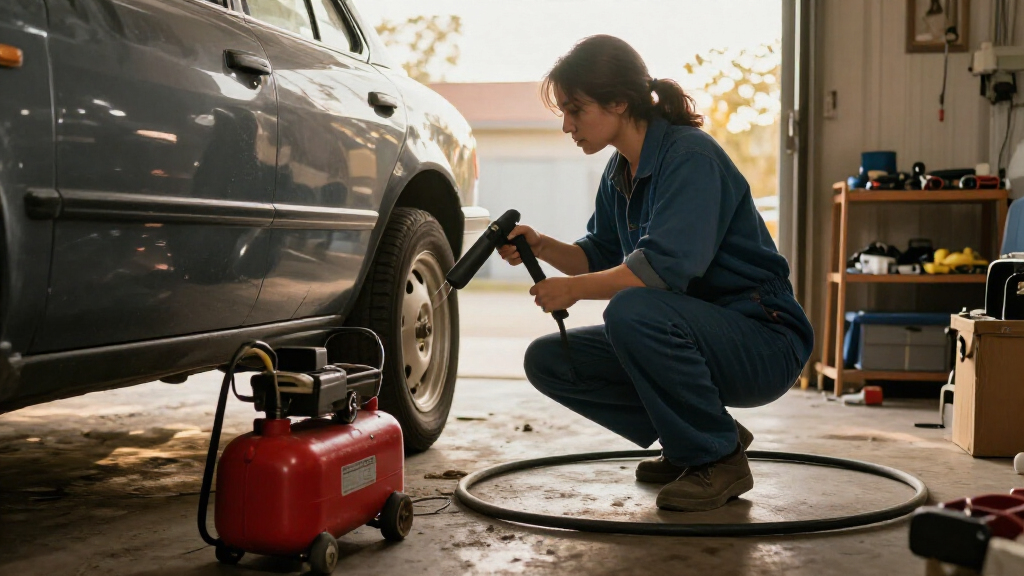
How We Picked
I ranked these garage air compressors by how well their stated design and specifications suit common garage work, from tire inflation and occasional nailing to longer tool sessions. I weighed tank capacity, listed pressure and airflow where supplied, power requirements, portability, oil-free or oil-lubricated design, and noise-related features. I also considered whether a compressor’s size and installation demands make sense for a typical home garage rather than assuming the largest tank is always best.
The ranking favors useful balance and clear task fit over a single standout specification. Larger stationary models rank lower for general buyers because they require more space and electrical planning, while compact units rank lower for sustained air use because their small tanks need more frequent recovery. Product listings do not provide comparable airflow figures for every model, so I do not treat tank size or maximum PSI as proof that a compressor can run a particular tool continuously.
| garage air compressor | Pump |
|---|---|
| DEWALT 60-Gallon 175 PSI Stati | — |
| CRAFTSMAN 0.5-Gallon Wall-Moun | — |
| CRAFTSMAN 6-Gallon 150 PSI Oil | — |
| DEWALT 25-Gallon Vertical Port | — |
| Campbell Hausfeld 60-Gallon Tw | Oil-lubricated, two-stage cast iron |
| CRAFTSMAN 2-Gallon Portable Oi | Oil-free |
| Klutch 20-Gallon Portable Air | Oil-free |
| DEWALT DWFP55130 Portable Air | Oil-free |
| VEVOR 13-Gallon Oil-Free Air C | Oil-free |
| RyanTek 15-Gallon Oil-Free Air | Oil-free, twin-cylinder |
| Klutch 29-Gallon Oil-Free Air | Oil-free |
| California Air Tools 8010A 1.0 | — |
| ECOMAX 6-Gallon 150 PSI Portab | Oil-free |
Factors to Consider When Choosing Garage Air Compressors
Before choosing a garage compressor, I’d start with the work you expect it to do and the setup your garage can support. The following factors help separate a convenient inflation unit from a compressor suited to regular tool use.
Match Airflow to the Tool, Not Just Maximum PSI
Many buyers compare maximum PSI because it is easy to spot, but a tool’s CFM requirement at a stated pressure is often the better guide to whether a compressor can keep up. Check the tool manual and compare its demand with the compressor’s delivered airflow at a similar pressure. A higher maximum PSI does not automatically mean more usable airflow or faster recovery. If you plan to run a tool in bursts, a small compressor may be workable; repeated or continuous use puts more pressure on its output and recovery rate. When the listing omits airflow at the pressure you need, treat compatibility as uncertain rather than filling in the gap from tank size. This check can prevent a compressor that inflates tires well from disappointing with an air-hungry tool.
Choose Tank Capacity Around Work Rhythm
A larger tank stores more compressed air, which can help handle short bursts and reduce how often the motor starts during light tasks. It does not replace adequate compressor output: during extended use, the pump still has to produce air at the tool’s rate. A small tank can be a sensible fit for tire inflation, occasional brad nailing, and quick cleanup, especially when storage space matters. For repeated tool use, look at both tank capacity and recovery performance rather than assuming a bigger tank solves everything. A common mistake is buying the largest tank available for occasional tasks, then giving up floor space and accepting installation demands without a practical benefit. Choose capacity based on how long your tasks run between pauses.
Check Your Garage’s Electrical Setup First
Compressor power requirements can shape the shortlist before tank size does. A 230V stationary unit may suit a dedicated workshop, but it can require electrical work if your garage lacks a compatible circuit. Portable 120V models are often easier to place in an existing setup, though buyers still need to check circuit capacity and the manufacturer’s instructions. Avoid relying on an extension cord unless the manual permits it and specifies suitable wiring; an undersized cord can cause operating problems. Also account for startup demands, which may differ from the steady running load. Confirm the electrical details before arranging delivery or installation, especially for a heavy stationary compressor.
Treat Noise as a Workspace and Neighbor Issue
Noise matters more when the garage is attached to a home, used for evening projects, or shared with other people. A quieter-design compressor can make routine work less disruptive, but “quiet” does not mean silent, so check the stated noise information when available. Noise also depends on where the compressor sits, how vibration reaches the floor, and how sound travels through doors and walls. Putting a unit in a separate space may help, but ventilation, access, and the manufacturer’s installation instructions still apply. Avoid placing a compressor in a tight enclosure just to muffle it; restricted airflow can create heat and maintenance concerns. Decide how much noise you can tolerate before paying for capacity you may not need.
Account for Space, Movement, and Installation
Tank shape affects how a compressor fits into a garage: a vertical tank can use less floor area, while a stationary model needs a lasting spot and room for service access. Portable units are easier to reposition, but a full-size compressor can still be awkward to move across thresholds or a cluttered floor. Measure the intended footprint, doorways, and clearance around the unit rather than checking only its listed dimensions. A wall-mounted option can free floor space, though it is best suited to light-duty needs and requires a suitable mounting surface. Plan for a dry, ventilated location and safe access to controls, drains, and connections. These details often matter more in daily use than a small difference in tank volume.
Weigh Oil-Free Convenience Against Maintenance Needs
Oil-free compressors appeal to buyers who want less routine oil maintenance, and they are common among compact portable designs. That convenience does not mean the unit needs no care: follow the manual for draining moisture, checking fittings, cleaning intake filters, and other service tasks. Oil-lubricated designs may suit some fixed workshop setups, but they add oil checks and can make placement and maintenance less convenient. Moisture management matters with either type because water can collect in the tank and affect air tools or work surfaces. If you paint or use moisture-sensitive tools, plan for appropriate filtration and drying rather than assuming the compressor alone supplies dry air. Choose the maintenance routine you are willing to follow, not just the pump label.
Frequently Asked Questions
Can a 6-gallon pancake compressor run an impact wrench?
It depends on the impact wrench’s airflow demand, the pressure it needs, and how long you use it. A pancake compressor may handle brief, intermittent bursts if its delivered CFM matches the tool, but the motor may need to recover between bursts. Tank capacity and maximum PSI by themselves cannot confirm compatibility. Compare the wrench’s stated CFM requirement with the compressor’s airflow rating at the relevant pressure. If the compressor listing does not provide a comparable airflow figure, I would not assume it can support sustained wrench use.
Should I choose a 60-gallon compressor for a home garage?
A 60-gallon compressor makes sense when you have regular, demanding air-tool work, enough room for a fixed installation, and compatible electrical service. The two 60-gallon choices here are 230V stationary models, so they are not simple plug-in substitutes for compact 120V units. For tire inflation, occasional nailing, or short cleanup tasks, that capacity may take up space without improving the jobs you actually do. Check installation requirements and service access before choosing one. If your work is intermittent, a portable model may be easier to live with.
Is a quieter compressor worth choosing over a larger tank?
For a garage attached to the house or used during noise-sensitive hours, a quieter design can improve daily comfort more than extra tank capacity. The California Air Tools 8010A is the lineup’s quiet-focused option, while larger models prioritize more stored air or higher-demand workshop use. A quieter compressor still has limits, and its tank and airflow must suit your tools. If you mostly inflate tires or work intermittently, sound may reasonably take priority. If you run air-hungry tools for longer stretches, confirm output first and treat noise as a separate tradeoff.
Do I need a 230V circuit for a garage air compressor?
Not for every model, but the 60-gallon DEWALT and Campbell Hausfeld options listed here require 230V. Several portable models are specified for 120V, which may fit more existing garage setups, subject to the manual’s electrical requirements. Check the compressor’s voltage, circuit needs, plug, and startup demands before purchase. If your garage does not have the required supply, factor in the cost and feasibility of electrical work before choosing a stationary unit. Do not assume an adapter makes an incompatible circuit suitable.
What should I prioritize if I only inflate tires and use a nailer occasionally?
For those tasks, I would prioritize convenient storage, straightforward operation, and enough airflow for the nailer over a very large tank. A compact pancake or small portable compressor can be easier to move and put away than a 20- or 60-gallon model. Check the nailer’s pressure and airflow requirements, since intermittent use does not remove the need for compatibility. If the compressor comes with a hose or accessories, confirm that the fittings suit your tools rather than assuming every kit connection will match. You likely do not need a permanent installation unless your workload expands.
Conclusion
For the broadest mix of home-garage jobs, I’d choose the DEWALT 25-Gallon Vertical Portable Electric Air Compressor as best overall: it offers a useful middle ground between small portable tanks and fixed 60-gallon systems. The best value in capability is the Klutch 20-Gallon Portable Air Compressor for buyers who want a larger portable tank, while the best premium fit for a dedicated, high-capacity shop is the Campbell Hausfeld 60-Gallon Two-Stage—provided its 230V installation suits your garage. For beginners handling basic tasks, I’d start with the CRAFTSMAN 6-Gallon Pancake Compressor; for a quieter workspace, pick the California Air Tools 8010A; and for minimal storage needs, consider the CRAFTSMAN 0.5-Gallon Wall-Mount. If your work involves sustained air-tool use, make the final choice by matching CFM at working pressure, not by tank size or maximum PSI alone.