Car battery testers can help separate a weak battery from a charging-system problem, but the right choice depends on your vehicles and how much guidance you want. I rank the KONNWEI KW208 as the best overall for its 12V battery-testing focus and broad CCA range; the FOXWELL BT705 stands out for 12V/24V coverage, while the Car Battery Tester with Next-Step Guidance is a strong fit for beginners who want help interpreting results. The main tradeoff is between compact digital analyzers that estimate battery condition and load testers that apply a heavier electrical demand. Compatibility, test method, and ease of reading results matter more than a long feature list. Read on for the full comparison and advice on choosing among all 15 options.

Get business pricing on garage and car supplies
- Business-only prices and quantity discounts
- Tax-exempt purchasing
- Multiple users, one account, clear invoices
Complete the kit


Key Takeaways
- The KW208 is the roundup’s best overall pick because it focuses on 12V automotive batteries and covers a wide 100–2000 CCA range without the added complexity of 24V testing.
- The BT705 and BT200 are the clearest choices for broader vehicle coverage, since both support 12V and 24V systems; buyers should verify the tester’s exact battery and vehicle compatibility before purchasing.
- Digital analyzers and traditional load testers serve different jobs: models such as the ANCEL BA101 report battery and charging information, while the Schumacher BT-100 and other 100A units put more emphasis on load testing.
- Beginner-friendly guidance is a meaningful differentiator: the tester with next-step guidance may help interpret results, while simpler displays can suit owners comfortable following battery-test procedures.
- Several picks are aimed at charging-system checks as well as batteries, including the FOXWELL BT705, QWORK 100A tester, ANENG BT172, and MOTOPOWER MP0514A; choose these when alternator diagnosis is part of the task.
| MOTOPOWER MP0515A 12V Automotive Battery Tester, 100–2000 CCA |  | Best for Broad 12V CCA Coverage | Brand and model: MOTOPOWER MP0515A | System voltage: 12V | CCA range: 100–2000 CCA | VIEW LATEST PRICE | See Our Full Breakdown |
| Car Battery Tester with Next-Step Guidance for 6V & 12V Automotive Batteries |  | Best for Guided Testing | Brand and model: VEHLIVE BT900 | Supported systems: 6V and 12V | Compatible battery chemistry: Lead-acid | VIEW LATEST PRICE | See Our Full Breakdown |
| KONNWEI KW208 12V Automotive Battery Tester |  | Best for Battery Condition Detail | Brand and model: KONNWEI KW208 | System voltage: 12V | CCA range: 100–2000 CCA | VIEW LATEST PRICE | See Our Full Breakdown |
| ANCEL BA101 12V Car Battery Tester |  | Best for Battery-Type and Standard Coverage | Brand and model: ANCEL BA101 | Battery voltage: 12V | CCA range: 100–2000 CCA | VIEW LATEST PRICE | See Our Full Breakdown |
| FOXWELL BT705 Car Battery Tester 12V/24V Alternator and Load Tester |  | Best for 12V and 24V Garage or Fleet Use | Brand and model: FOXWELL BT705 | Supported systems: 12V and 24V | Compatible vehicles: Cars, pickups, trucks, RVs, boats, motorcycles, fleet vehicles | VIEW LATEST PRICE | See Our Full Breakdown |
| FOXWELL BT301 12V Car Battery Tester with 2.8″ Color Screen and 6.5ft Cable |  | Best for Long-Reach Testing | Battery voltage: 12V | CCA range: 100–2000 CCA | Supported battery types: Flooded, AGM flat, AGM spiral, EFB, GEL | VIEW LATEST PRICE | See Our Full Breakdown |
| Schumacher Electric BT-100 Battery Load Tester, 6V/12V | 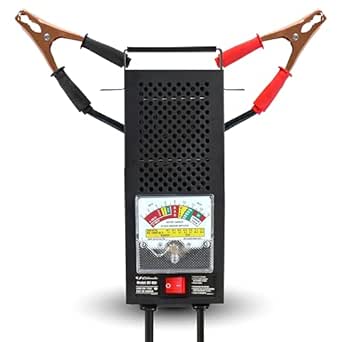 | Best for Traditional Load Testing | Battery voltage: 6V and 12V | Maximum capacity: 1,000 cranking amps | Load test at 6V: 50 amps | VIEW LATEST PRICE | See Our Full Breakdown |
| 100A Battery Load Tester 6V/12V Car Battery Tester 100-1000 CCA |  | Best Compact Analog Pick | Battery voltage: 6V and 12V | CCA range: 100–1000 CCA | Minimum operating voltage: 6V | VIEW LATEST PRICE | See Our Full Breakdown |
| Car Battery Tester BR502 – 6V/12V/24V Digital Analyzer for 100-2000 CCA Batteries |  | Best for Multi-Voltage Diagnostics | Battery voltage: 6V, 12V, and 24V | CCA range: 100–2000 CCA | Display: 1.8-inch HD screen | VIEW LATEST PRICE | See Our Full Breakdown |
| TOPDON BT100 12V Car Battery Tester |  | Best Compact Digital Tester | Battery voltage: 12V | Supported capacity: 100–2000 CCA | Supported battery types: Flooded, AGM flat plate, AGM spiral, EFB, GEL | VIEW LATEST PRICE | See Our Full Breakdown |
| TOPDON BT50 12V Car Battery Tester, 100–2000 CCA |  | Best for Straightforward Diagnostics | Battery voltage: 12V | CCA range: 100–2000 CCA | Compatible batteries: 12V lead-acid | VIEW LATEST PRICE | See Our Full Breakdown |
| QWORK 12V 100A Battery Load and Voltage Tester with Alternator Testing |  | Best for 6V and 12V Coverage | Battery compatibility: 6V and 12V | Maximum CCA: 1,000 | Alternator testing: Yes | VIEW LATEST PRICE | See Our Full Breakdown |
| ANENG BT172 12V Car Battery Tester and Alternator Analyzer |  | Best for Quick Voltage Checks | Model: BT172 | Voltage test range: 4–30V DC | Accuracy: Approximately 0.01V | VIEW LATEST PRICE | See Our Full Breakdown |
| TOPDON BT200 Car Battery Tester, 12V/24V, 100-2000 CCA Load Tester | 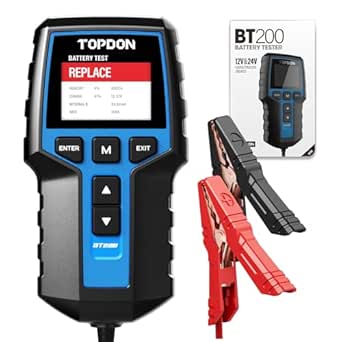 | Best Premium Diagnostic Range | Compatible voltage systems: 12V and 24V | CCA range: 100–2000 CCA | Supported battery types: Flooded, AGM, GEL, and deep-cycle | VIEW LATEST PRICE | See Our Full Breakdown |
| MOTOPOWER MP0514A 12V Digital Car Battery Tester and Charging System Analyzer |  | Best Compact Voltage and Alternator Checker | Compatible devices: Vehicles with 12V batteries | Testing voltage range: 4–20V DC | Voltage measurement accuracy: 0.01V | VIEW LATEST PRICE | See Our Full Breakdown |
| car battery tester | Weight | Dimensions | Display | CCA range |
|---|---|---|---|---|
| MOTOPOWER MP0515A 12V Automoti | 340 g | 5.91 x 0.91 x 3.35 inches | — | 100–2000 CCA |
| Car Battery Tester with Next-S | — | 6.38 x 3.35 x 0.98 inches | — | — |
| KONNWEI KW208 12V Automotive B | 230 g | 0.79 x 3.07 x 5 inches | — | 100–2000 CCA |
| ANCEL BA101 12V Car Battery Te | 5 ounces | 9.5 x 7 x 2 inches | Black-and-white screen with white backlight and adjustable contrast | 100–2000 CCA |
| FOXWELL BT705 Car Battery Test | 325 g | 13 x 3.2 x 9.1 inches | 2.8-inch LCD | — |
| FOXWELL BT301 12V Car Battery | — | — | — | 100–2000 CCA |
| Schumacher Electric BT-100 Bat | — | — | Analog meter | — |
| 100A Battery Load Tester 6V/12 | 2 lb | 11.8 × 6.7 × 3.2 in | Analog dial | 100–1000 CCA |
| Car Battery Tester BR502 | — | 4.72 × 0.79 × 2.56 in | 1.8-inch HD screen | 100–2000 CCA |
| TOPDON BT100 12V Car Battery T | 9 oz | 5.3 × 3 × 1 in | — | — |
| TOPDON BT50 12V Car Battery Te | 215 g | 4.9 × 2.6 × 0.7 inches | Backlit LCD | 100–2000 CCA |
| QWORK 12V 100A Battery Load an | — | — | — | — |
| ANENG BT172 12V Car Battery Te | 0.09 kg | — | LCD with LED indicators | — |
| TOPDON BT200 Car Battery Teste | 15.52 ounces | — | 2.4-inch sunlight-readable color LCD | 100–2000 CCA |
| MOTOPOWER MP0514A 12V Digital | 150 g | — | 4-digit digital LCD | — |
More Details on Our Top Picks
MOTOPOWER MP0515A 12V Automotive Battery Tester, 100–2000 CCA
The MOTOPOWER MP0515A earns its place for buyers who want a straightforward tester with a wide 100–2000 CCA range. It checks battery condition alongside cranking and charging systems, so it can help separate a weak battery from a problem elsewhere in a 12V vehicle. Compared with the KONNWEI KW208, its listed functions are less detailed: the KW208 reports internal resistance, capacity, and battery health, and supports several battery chemistries. The MP0515A’s simpler feature set may suit owners who want basic checks rather than a fuller diagnostic readout. Its main limitation is firm: it supports 12V car batteries only, so it is not the pick for 6V or 24V vehicles. The included storage bag helps keep the tester and manual together between occasional checks.
Pros:- Supports a broad 100–2000 CCA range for 12V testing.
- Checks cranking and charging systems as well as the battery.
- Compact 340 g design with a storage bag for keeping the kit together.
- Includes an instruction manual and a stated two-year manufacturer warranty.
Cons:- Limited to 12V car batteries, unlike the 6V/12V VEHLIVE BT900.
- The supplied product details do not list support for AGM, gel, or other specific battery types.
- Its feature list is less detailed than the KONNWEI KW208’s battery-health and capacity readouts.
Best for: Car owners who want a compact tester for routine 12V battery, cranking, and charging-system checks across a broad CCA range.
Not ideal for: Owners of 6V or 24V vehicles, or buyers who need detailed battery-health measurements and support for multiple battery chemistries.
- Brand and model:MOTOPOWER MP0515A
- System voltage:12V
- CCA range:100–2000 CCA
- Measurement type:Multimeter
- Power source:Battery powered
- Weight:340 g
- Dimensions:5.91 x 0.91 x 3.35 inches
- Included components:Battery tester, storage bag, instruction manual
- Warranty:2-year manufacturer warranty
Our verdict“Choose the MP0515A for compact, broad-range checks on 12V car batteries, but choose a more feature-rich model if you need broader compatibility or deeper diagnostics.”
Car Battery Tester with Next-Step Guidance for 6V & 12V Automotive Batteries
The VEHLIVE BT900 is the clearest fit for buyers who want instructions alongside the measurements. Its color-coded results and step-by-step guidance cover battery health, cranking voltage, and alternator output, which can make a basic diagnosis easier to follow than the MOTOPOWER MP0515A’s more limited listed readouts. The 8.2-foot cable is a practical distinction: it can let one person run a charging-system check from the driver’s seat, rather than moving back and forth between the battery and controls. It also supports both 6V and 12V lead-acid batteries across cars, motorcycles, ATVs, RVs, light trucks, and boats. That breadth does not extend to 24V systems or lithium batteries, and buyers with those needs should look elsewhere. The KW208 adds support for several 12V battery chemistries, while the BT900’s standout is guided, multi-vehicle testing.
Pros:- Supports 6V and 12V lead-acid batteries across several vehicle types.
- Color-coded results and step-by-step guidance clarify what to check next.
- 8.2-foot cable can support one-person charging-system tests from the driver’s seat.
- Measures voltage, CCA, internal resistance, cranking, charging, and ripple.
Cons:- Does not support 24V systems.
- Limited to lead-acid batteries rather than lithium chemistry.
- Its broad vehicle compatibility does not remove the need to match the tester to the battery’s chemistry and voltage.
Best for: DIY owners of 6V or 12V lead-acid vehicles who want guided results and enough cable length to perform charging checks alone.
Not ideal for: Owners of 24V vehicles or lithium batteries, and buyers who need a tester specifically verified for lithium chemistry.
- Brand and model:VEHLIVE BT900
- Supported systems:6V and 12V
- Compatible battery chemistry:Lead-acid
- Measurement types:Voltage, CCA, internal resistance, cranking voltage, charging voltage, ripple
- Operating voltage range:5–16V
- Cable length:8.2 ft
- Dimensions:6.38 x 3.35 x 0.98 inches
- Included components:Battery tester, battery clips, user manual
Our verdict“Pick the BT900 if guided testing and 6V/12V lead-acid compatibility matter more than 24V or lithium support.”
KONNWEI KW208 12V Automotive Battery Tester
For a buyer who wants more than a simple pass-or-fail check, the KONNWEI KW208 reports voltage, internal resistance, CCA, capacity, battery health, and charge status. It also checks starter cranking and alternator charging, giving a more detailed 12V picture than the MOTOPOWER MP0515A’s listed testing functions. Compatibility covers flooded, AGM flat plate, AGM spiral, and gel batteries, and it can test batteries in or out of a vehicle. That flexibility helps when a battery has been removed for charging or inspection. The tradeoff is voltage scope: this is a 12V-only tester, unlike the VEHLIVE BT900, which also handles 6V batteries. Its compact 230 g body is easy to store, though buyers seeking driver-seat testing guidance or a long cable should compare the BT900 instead.
Pros:- Reports voltage, internal resistance, CCA, capacity, health, and charge status.
- Supports flooded, AGM flat plate, AGM spiral, and gel 12V batteries.
- Checks starter cranking and alternator charging systems.
- Can test batteries in or out of the vehicle and supports up to eight languages.
Cons:- Compatible with 12V batteries only.
- Does not offer the BT900’s stated 8.2-foot cable and step-by-step guidance.
- The supplied data does not list a cable length or included storage case.
Best for: DIY mechanics who want detailed readings from common 12V flooded, AGM, or gel batteries and also need starter and alternator checks.
Not ideal for: Owners of 6V or 24V vehicles, or anyone who prioritizes long-cable, step-by-step testing from the driver’s seat.
- Brand and model:KONNWEI KW208
- System voltage:12V
- CCA range:100–2000 CCA
- Compatible batteries:Flooded, AGM flat plate, AGM spiral, gel
- Tests:Battery condition, cranking, charging, starter, alternator
- Power source:Battery powered
- Weight:230 g
- Dimensions:0.79 x 3.07 x 5 inches
- Languages:Up to eight
Our verdict“Choose the KW208 for detailed 12V battery-condition readings and broad lead-acid compatibility, but not for 6V testing or long-reach operation.”
ANCEL BA101 12V Car Battery Tester
The ANCEL BA101 suits buyers who need a tester that spells out compatibility across several common 12V lead-acid battery types and rating standards. It supports flooded, AGM, GEL, and EFB batteries over 30Ah, with CCA coverage from 100 to 2000 and standards including JIS, EN, DIN, SAE, and BCI. That makes it a more explicit fit for varied 12V battery specifications than the MOTOPOWER MP0515A, whose supplied details do not name compatible chemistries or standards. The backlit screen, adjustable contrast, and protective safeguards can also help during routine garage checks. Its limit is just as specific: it does not support lithium or non-12V batteries, and motorcycles below 30Ah are outside its stated fit. The FOXWELL BT705 is the better comparison for buyers who need 24V capability.
Pros:- Supports flooded, AGM, GEL, and EFB batteries over 30Ah.
- Covers 100–2000 CCA and multiple rating standards, including JIS, EN, DIN, SAE, and BCI.
- Backlit display with adjustable contrast aids reading in dim work areas.
- Includes protection against reverse polarity, short circuits, overcurrent, and overvoltage.
Cons:- Does not support lithium or non-12V batteries.
- Not suitable for motorcycles with batteries below 30Ah.
- Unlike the FOXWELL BT705, it does not cover 24V systems.
Best for: Owners or small repair shops checking 12V lead-acid batteries over 30Ah across common chemistries and international rating standards.
Not ideal for: Motorcycle owners with batteries below 30Ah, lithium-battery users, and anyone testing a 24V system.
- Brand and model:ANCEL BA101
- Battery voltage:12V
- CCA range:100–2000 CCA
- Compatible battery types:Flooded, AGM, GEL, EFB
- Minimum battery capacity:Over 30Ah
- Compatible standards:JIS, EN, DIN, SAE, BCI, GB, CA, MCA, IEC
- Display:Black-and-white screen with white backlight and adjustable contrast
- Weight:5 ounces
- Dimensions:9.5 x 7 x 2 inches
Our verdict“The BA101 is a strong match for varied 12V lead-acid batteries over 30Ah, but skip it for lithium, small motorcycle batteries, or 24V vehicles.”
FOXWELL BT705 Car Battery Tester 12V/24V Alternator and Load Tester
The FOXWELL BT705 is the lineup’s clearest choice for buyers who need one tester for both 12V and 24V systems. Its guided on-screen prompts and GOOD, RECHARGE, or REPLACE results make routine checks easier to interpret than the more measurement-focused MOTOPOWER MP0515A. The BT705 is also positioned for repeated use in home garages, repair shops, and fleet settings, with a protective housing and hard case. Its 5.9-foot cable supports one-person operation, though it is shorter than the VEHLIVE BT900’s 8.2-foot lead. The tradeoffs are that the BT705 requires a corded power source and its 2.8-inch screen may be harder to read in bright light. Buyers who only need straightforward 12V checks may find a simpler model like the KONNWEI KW208 a closer fit.
Pros:- Supports both 12V and 24V vehicle systems.
- Guided prompts and GOOD, RECHARGE, or REPLACE results make findings easy to interpret.
- 5.9-foot cable supports one-person operation.
- Protective housing and included hard carrying case suit repeated garage or fleet use.
Cons:- Requires a corded power source rather than operating as a battery-powered handheld unit.
- The 2.8-inch LCD may be difficult to read in bright lighting.
- Its cable is shorter than the VEHLIVE BT900’s 8.2-foot cable.
Best for: Garage operators, repair shops, and fleet maintainers who test both 12V and 24V lead-acid vehicle systems and want guided results.
Not ideal for: Drivers seeking a battery-powered compact tester for occasional 12V checks, or users who need a larger, easily read display in bright conditions.
- Brand and model:FOXWELL BT705
- Supported systems:12V and 24V
- Compatible vehicles:Cars, pickups, trucks, RVs, boats, motorcycles, fleet vehicles
- Compatible battery types:Flooded, AGM, GEL, EFB
- Display:2.8-inch LCD
- Cable length:5.9 ft
- Power source:Corded electric
- Weight:325 g
- Dimensions:13 x 3.2 x 9.1 inches
Our verdict“Choose the BT705 for guided 12V/24V testing in a garage or fleet setting, but choose a simpler battery-powered model for occasional 12V checks.”
FOXWELL BT301 12V Car Battery Tester with 2.8″ Color Screen and 6.5ft Cable
The FOXWELL BT301 pairs a broad lead-acid battery range with a 6.5-foot cable, making it a practical pick when the battery is hard to reach or the tester needs to sit near the driver’s seat. It checks battery health, cranking power, and charging performance, so it covers more than a basic voltage check. Its 2.8-inch color screen is also larger than the BR502’s 1.8-inch display, though the BR502 adds 6V and 24V support that this 12V-only model lacks. The BT301 handles 100–2000 CCA and several lead-acid chemistries, but it does not work with lithium batteries. It also draws power from the vehicle battery, so it is not a standalone tester for a removed battery.
Pros:- Long 6.5-foot cable can make testing easier from the driver’s seat
- Large 2.8-inch color display presents results clearly
- Checks battery health, cranking power, and charging system performance
- Supports flooded, AGM, EFB, and GEL lead-acid batteries
Cons:- Does not support lithium batteries
- Requires a connection to the vehicle battery for power
- Limited to 12V batteries
Best for: Drivers and DIY mechanics who test 12V lead-acid batteries in vehicles where extra cable reach makes setup easier.
Not ideal for: Owners of lithium batteries or buyers who need one tester for 6V and 24V systems.
- Battery voltage:12V
- CCA range:100–2000 CCA
- Supported battery types:Flooded, AGM flat, AGM spiral, EFB, GEL
- Screen:2.8-inch color display
- Cable length:6.5 ft
- Minimum operating voltage:6V
- Measurement type:Voltmeter
Our verdict“Choose the BT301 if cable reach and a larger screen matter more than lithium or multi-voltage support.”
Schumacher Electric BT-100 Battery Load Tester, 6V/12V
The Schumacher BT-100 suits buyers who prefer a direct load test and an analog meter over the diagnostic readouts of digital analyzers. It tests 6V and 12V batteries, plus charging-system performance and starter draw, giving it a useful role for older vehicles and mixed-voltage equipment. Its steel case and heavy-duty clamps suggest a more workshop-oriented tool than the compact BR502, which reports data such as state of health and internal resistance without the same load-test format. The tradeoff is that the BT-100’s analog display asks the user to interpret the reading, and its maximum capacity is 1,000 cranking amps. The supplied details do not specify supported battery chemistries, so buyers seeking a clearly listed match for a particular battery type may prefer a digital alternative with explicit compatibility.
Pros:- Tests both 6V and 12V batteries
- Checks battery condition, charging system, and starter motor draw
- Steel case and insulated carrying handle suit workshop use
- Simple analog meter and rocker-switch operation
Cons:- Analog readings require the user to interpret the meter
- Maximum capacity is 1,000 cranking amps
- Listed product details do not specify supported battery chemistries
Best for: DIY mechanics and vehicle owners who want a durable analog load tester for 6V or 12V batteries up to 1,000 cranking amps.
Not ideal for: Beginners who want guided digital results, or owners of batteries above 1,000 cranking amps.
- Battery voltage:6V and 12V
- Maximum capacity:1,000 cranking amps
- Load test at 6V:50 amps
- Load test at 12V:100 amps
- Display:Analog meter
- Case:Steel with baked enamel shell
- Included:Battery load tester and voltmeter; user manual
Our verdict“Pick the BT-100 for straightforward, rugged load testing rather than digital battery-health detail.”
100A Battery Load Tester 6V/12V Car Battery Tester 100-1000 CCA
This TOPDC analog load tester is aimed at buyers who want a portable, battery-free display and a familiar dial rather than a digital analyzer. It covers 6V and 12V systems and combines voltage, cranking, and charging-system checks, while color-coded clips help make connections easier to identify. At two pounds and under 12 inches long, it is easier to carry than a larger fixed workshop setup, though the Schumacher BT-100 offers a steel case and a similarly traditional load-test approach. The TOPDC’s main limit is its 100–1000 CCA range, which leaves out larger batteries that the FOXWELL BT301 and BR502 can handle. Its analog dial also lacks the detailed battery-health and internal-resistance figures available from digital models, so users need to interpret results themselves.
Pros:- Tests 6V and 12V batteries
- Combines voltage, cranking-power, and charging-system checks
- Color-coded heavy-duty clips support clear connections
- Portable design with rubber grips and a shock-resistant meter
Cons:- 100–1000 CCA range excludes higher-capacity batteries
- Analog dial offers less diagnostic detail than digital testers
- Manual readings require user interpretation
Best for: DIY vehicle owners who want a portable analog tester for common 6V and 12V batteries up to 1,000 CCA.
Not ideal for: Owners of high-capacity commercial batteries or buyers who need detailed digital readings and guided interpretation.
- Battery voltage:6V and 12V
- CCA range:100–1000 CCA
- Minimum operating voltage:6V
- Maximum operating voltage:13.8V
- Measurement type:Ammeter
- Display:Analog dial
- Weight:2 lb
- Dimensions:11.8 × 6.7 × 3.2 in
Our verdict“Choose this TOPDC model for portable, basic load testing, but move to the BR502 or BT301 for broader CCA coverage and more detailed diagnostics.”
Car Battery Tester BR502 – 6V/12V/24V Digital Analyzer for 100-2000 CCA Batteries
The OBDResource BR502 earns its place by covering 6V, 12V, and 24V batteries while reporting state of health, state of charge, voltage, CCA, and internal resistance. That combination makes it more useful for buyers with mixed vehicle types than the 12V-only FOXWELL BT301 or TOPDON BT100. Its compact digital format and stated two-second test time suit quick checks, and polarity-reverse protection adds a safeguard if clips are connected incorrectly. The smaller 1.8-inch screen, however, is less generous than the BT301’s 2.8-inch display. The BR502 is also limited to 100–2000 CCA, and its screen may flicker when the clamps are not secured firmly. It favors quick electronic readings over the physical load-test approach of the Schumacher BT-100.
Pros:- Supports 6V, 12V, and 24V batteries
- Reports SOH, SOC, CCA, internal resistance, and voltage
- Compact plug-and-play design with polarity-reverse protection
- Provides readings in a stated two-second test
Cons:- Small 1.8-inch screen is less spacious than the FOXWELL BT301 display
- Clips must be clamped securely to avoid screen flicker
- Limited to batteries in the 100–2000 CCA range
Best for: Owners or technicians who check 6V, 12V, and 24V lead-acid batteries and want several diagnostic readings in one compact tester.
Not ideal for: Buyers who prefer a large display, a traditional load test, or a tester for batteries outside the 100–2000 CCA range.
- Battery voltage:6V, 12V, and 24V
- CCA range:100–2000 CCA
- Display:1.8-inch HD screen
- Measurements:SOH, SOC, CCA, internal resistance, and voltage
- Measurement type:Voltmeter, ammeter, and ohmmeter
- Minimum operating voltage:6V
- Dimensions:4.72 × 0.79 × 2.56 in
Our verdict“Choose the BR502 if multi-voltage support and detailed digital readings matter more than a larger screen or analog load testing.”
TOPDON BT100 12V Car Battery Tester
The TOPDON BT100 keeps battery checks compact: at 9 ounces, it is easy to store in a glove box or tool bag while still checking battery health, cranking, and charging-system performance. It supports 100–2000 CCA across several lead-acid types, including flooded, AGM, EFB, and GEL, giving it broader battery coverage than the TOPDC analog tester’s 100–1000 CCA range. Color-coded LEDs and spark-proof, reverse-polarity-protected clamps help simplify routine connections, though this is less of a screen-led diagnostic tool than the BR502, which displays more detailed readings and also supports 6V and 24V systems. The BT100 is strictly for 12V batteries and has a stated minimum operating voltage of 12V, so it is a poor fit for owners who need to test lower-voltage systems.
Pros:- Lightweight 9-ounce design is easy to store and carry
- Tests battery health, cranking, and charging-system performance
- Supports 100–2000 CCA and several lead-acid battery types
- Color-coded LEDs and protected clamps simplify routine checks
Cons:- Works only with 12V batteries
- Minimum operating voltage is listed as 12V
- LED-based interface provides less displayed detail than the BR502
Best for: Drivers who want a lightweight 12V tester for routine checks across common lead-acid battery types and vehicle categories.
Not ideal for: Owners of 6V or 24V batteries, or buyers who want a large screen and multi-voltage diagnostics.
- Battery voltage:12V
- Supported capacity:100–2000 CCA
- Supported battery types:Flooded, AGM flat plate, AGM spiral, EFB, GEL
- Test functions:Battery health, cranking, charging system
- Minimum operating voltage:12V
- Weight:9 oz
- Dimensions:5.3 × 3 × 1 in
Our verdict“Pick the BT100 for a lightweight, practical 12V tester, but choose the BR502 if you need multi-voltage support and more diagnostic detail.”
TOPDON BT50 12V Car Battery Tester, 100–2000 CCA
The TOPDON BT50 is a good fit for drivers who want more than a voltage reading without stepping up to a more feature-dense tester. Its conductivity tests cover battery health, cranking performance, and charging systems, while historical test review can help track changes instead of relying on a single result. One-button operation and a backlit LCD keep the process approachable, and reverse-polarity protection reduces the risk of a connection mistake. Compared with the TOPDON BT200, the BT50 is limited to 12V lead-acid batteries and does not offer the same stated support for 24V systems or broader battery chemistries. That narrower fit is its main tradeoff: it is a practical choice for common 12V vehicles, but not for a mixed 12V/24V garage.
Pros:- Checks battery condition, cranking performance, and charging-system output
- 100–2000 CCA range covers a broad span of 12V lead-acid batteries
- Backlit LCD, one-button operation, and six language options
- Spark-free testing and reverse-polarity protection
Cons:- Does not support 24V systems or battery chemistries beyond 12V lead-acid
- No wireless connectivity is specified
Best for: Owners of 12V lead-acid cars, motorcycles, boats, or light trucks who want battery, cranking, and charging checks in one simple handheld tool.
Not ideal for: Shops or owners of 24V vehicles and non-lead-acid battery systems, since this model is specified for 12V lead-acid batteries only.
- Battery voltage:12V
- CCA range:100–2000 CCA
- Compatible batteries:12V lead-acid
- Minimum operating voltage:8V DC
- Display:Backlit LCD
- Languages:English, Spanish, French, German, Italian, Russian
- Weight:215 g
- Dimensions:4.9 × 2.6 × 0.7 inches
Our verdict“Choose the BT50 if you want accessible, multi-part diagnostics for common 12V lead-acid vehicles and do not need 24V support.”
QWORK 12V 100A Battery Load and Voltage Tester with Alternator Testing
The QWORK 100A tester earns its place for buyers who need one tool for older 6V equipment as well as standard 12V vehicles. Its load-test format differs from the conductivity approach of the TOPDON BT50: the QWORK applies a load, which can offer a direct check of battery response, but its listed maximum is 1,000 CCA, half the BT50’s upper range. It also checks alternator performance, and the steel case, copper-plated clamps, and carry handle suit a tool that may travel between a garage and several vehicles. The tradeoff is a less detailed feature set: no display details or warranty information are supplied, so buyers who want guided digital results or clear ownership support should compare it with the more diagnostic-oriented options.
Pros:- Supports both 6V and 12V vehicle batteries
- Checks alternator performance as well as battery response
- Steel case and heavy-duty copper-plated clamps suit regular garage handling
- Carry handle makes it easier to move between vehicles
Cons:- Maximum rating of 1,000 CCA is lower than the TOPDON BT50’s 2,000 CCA ceiling
- Warranty details are not specified
- Display and result-guidance details are not provided
Best for: Owners of mixed 6V and 12V fleets, including classic vehicles, golf carts, RVs, and trucks, who prefer a rugged load tester.
Not ideal for: Buyers who need testing above 1,000 CCA or want a specified digital display, detailed diagnostic guidance, or stated warranty coverage.
- Battery compatibility:6V and 12V
- Maximum CCA:1,000
- Alternator testing:Yes
- Case material:Steel
- Clamps:Heavy-duty copper-plated
- Power source:Battery powered
- Included components:Tester
Our verdict“Pick the QWORK if 6V compatibility and a rugged load-test design matter more than a high CCA ceiling or detailed digital readouts.”
ANENG BT172 12V Car Battery Tester and Alternator Analyzer
The ANENG BT172 is the simplest fit here for drivers who mainly want to read voltage and get a quick visual indication of battery or charging status. Its LCD pairs with LED status indicators, while the stated 0.01V accuracy and 4–30V DC measurement range provide useful detail for checking a 12V vehicle’s electrical system. Unlike the TOPDON BT50, the BT172 is described as a voltmeter rather than a conductivity tester, so it does not provide the same CCA-based battery-health and cranking assessment. That makes it a lighter-duty diagnostic choice, not a substitute for a full battery analyzer when a battery’s starting capacity is in doubt. Reverse-connection protection helps, but correct clamp placement still matters.
Pros:- LCD voltage reading paired with LED battery and charging indicators
- Stated accuracy of approximately 0.01V
- 4–30V DC test range offers broad voltage measurement coverage
- Reverse connection protection and included clamp adapter cable
Cons:- Limited to 12V battery testing
- Does not list CCA measurement or a conductivity-based battery-health test
- Correct positive and negative clamp connection is still required
Best for: Drivers and DIY owners who want an inexpensive-to-use style of quick voltage and alternator checks across several kinds of 12V vehicles.
Not ideal for: People diagnosing weak starting capacity or comparing CCA and battery-health results, since this model is specified as a voltmeter rather than a CCA analyzer.
- Model:BT172
- Voltage test range:4–30V DC
- Accuracy:Approximately 0.01V
- Measurement type:Voltmeter
- Display:LCD with LED indicators
- Protection:Reverse connection protection
- Weight:0.09 kg
- Included components:BT172 tester, alligator clamp adapter cable, user manual
Our verdict“Choose the BT172 for quick voltage and alternator checks, but pick the TOPDON BT50 if you need CCA-based battery diagnostics.”
TOPDON BT200 Car Battery Tester, 12V/24V, 100-2000 CCA Load Tester
The TOPDON BT200 is the most capable diagnostic option in this group for owners who work across different vehicles and battery types. Its 12V and 24V coverage, stated support for flooded, AGM, GEL, and deep-cycle batteries, and three-part testing for cranking, charging, and load give it a broader role than the 12V-only BT50. A sunlight-readable color screen and memory recall can also make repeat checks easier to compare, especially in a busy garage. The tradeoff is complexity: buyers who only need a quick voltage reading may find the BT200 more tool than they need, and its feature set may take longer to learn than the basic ANENG BT172. The supplied data also lists a 12V minimum operating voltage, so confirm the required test conditions for your setup.
Pros:- Supports 12V and 24V vehicle systems
- Specified for flooded, AGM, GEL, and deep-cycle batteries
- Combines cranking, charging, and load tests
- Color LCD, memory recall, and stated operating range from -4°F to 140°F
Cons:- More technical than a basic voltage tester such as the ANENG BT172
- Larger and heavier than compact options, at 15.52 ounces and 7 × 3.72 × 1.3 inches
- Listed minimum operating voltage is 12V, which may constrain testing conditions
Best for: DIY mechanics and multi-vehicle owners who need one tester for 12V and 24V systems, several battery chemistries, and repeat diagnostics.
Not ideal for: Beginners seeking a simple voltage-only checker or owners who only need basic 12V checks and do not need the BT200’s broader testing functions.
- Compatible voltage systems:12V and 24V
- CCA range:100–2000 CCA
- Supported battery types:Flooded, AGM, GEL, and deep-cycle
- Test functions:Cranking, charging, and load
- Display:2.4-inch sunlight-readable color LCD
- Minimum operating voltage:12V
- Operating temperature:-4°F to 140°F
- Weight:15.52 ounces
Our verdict“Choose the BT200 if you need broad 12V/24V diagnostics and multiple battery-chemistry support; skip it for occasional voltage checks.”
MOTOPOWER MP0514A 12V Digital Car Battery Tester and Charging System Analyzer
The MOTOPOWER MP0514A favors portability and quick interpretation over deeper battery diagnostics. Its four-digit LCD gives a numerical voltage reading, while eight colored LEDs make battery and alternator status easier to scan at a glance. At 150g, with a 50cm extension cable, it is a compact choice for keeping in a vehicle or toolbox. Compared with the TOPDON BT50, however, it is limited to voltage and charging-system checks rather than a stated CCA-based battery-health and cranking test. Its 4–20V range is suitable for 12V systems, but it does not cover 24V vehicles. Reverse-connection and over-voltage protection add useful safeguards; the remaining uncertainty is that the description does not specify how the tester is powered.
Pros:- Four-digit LCD provides a direct voltage reading
- Eight colored LEDs offer quick status cues
- 50cm extension cable and 30A alligator clips aid connection access
- Compact 150g design with reverse-connection and over-voltage protection
Cons:- Designed for 12V systems and does not provide stated 24V support
- No CCA, cranking, or load-testing function is specified
- The product description does not identify the tester’s power source
Best for: Drivers who want a lightweight 12V checker for routine voltage and alternator checks, especially those who value a clear display and simple status lights.
Not ideal for: Owners of 24V vehicles or anyone who needs CCA, cranking, or load-test results rather than voltage and charging checks.
- Compatible devices:Vehicles with 12V batteries
- Testing voltage range:4–20V DC
- Voltage measurement accuracy:0.01V
- Display:4-digit digital LCD
- Indicators:8 colored LEDs
- Cable length:50 cm
- Weight:150 g
- Safety features:Reverse-connection and over-voltage protection
Our verdict“Pick the MP0514A for compact 12V voltage and alternator checks, but choose the TOPDON BT50 when you need battery-health and cranking diagnostics.”

How We Picked
I compared the 15 testers by the jobs a buyer is likely to need them for: checking battery condition, estimating CCA-related performance, testing a charging system, and working across different vehicle voltages. I also weighed stated battery compatibility, whether a model uses a digital analyzer or a load-test approach, and how clearly its design appears suited to a home owner, DIY mechanic, or broader vehicle use. A wide CCA range can be useful, but it does not replace checking that the tester supports the battery type and voltage in the vehicle.
The order favors useful coverage and a clear fit for common automotive troubleshooting, then distinguishes specialized picks by their strengths. The KW208 leads as a focused 12V option; the BT705 ranks highly for 12V/24V versatility; and the guidance-oriented tester has a separate beginner role. Traditional load testers remain relevant, but they rank lower for buyers seeking a quick digital readout, while compact 12V analyzers may be less suitable for those who need 24V coverage or a direct load test. I treat stated specifications as selection criteria, not proof that any device can diagnose every battery fault.
Factors to Consider When Choosing Car Battery Testers
Before choosing a tester, match its test method and electrical range to the work you plan to do. The details that separate a useful tool from a frustrating one often involve the battery itself, the test conditions, and how you will use the result—not just the screen or cable length.
Match the Tester to Battery Voltage and Type
Start with the vehicle’s system voltage: many passenger cars use 12V, while some trucks and other vehicles may call for 24V testing. A tester that supports 12V and 24V offers wider coverage, but only helps if its instructions also support your battery’s chemistry and construction. Check whether your battery is conventional flooded, AGM, or another type, and confirm the tool lists it before relying on a reading. CCA range is another compatibility check; use the rating printed on the battery rather than guessing. A common mistake is buying by the vehicle model alone, since a replacement battery may differ from the original. If you only service one 12V car, paying for extra voltage coverage may add little practical value.
Choose Between an Analyzer and a Load Tester
Digital analyzers and load testers do not approach diagnosis in the same way. An analyzer estimates battery condition from electrical measurements and can often provide results without applying the kind of sustained load used by a traditional tester. A load tester places a demand on the battery, which can make it useful for checking performance under load but requires more attention to the tool’s procedure and duty limits. Neither method should be treated as a full substitute for a professional diagnosis when results are unclear. Think about where you will test: a quick analyzer may be easier for routine checks, while a load tester may suit a mechanically confident owner who wants that specific test method. Avoid assuming that the word “load” means the device can safely test every battery size or condition.
Decide Whether Charging-System Tests Matter
A battery can be healthy yet fail to stay charged because of an alternator or charging-system issue. If you want to investigate both possibilities with one tool, look for explicit alternator or charging-system test support rather than relying on a general battery-health feature. This matters most for owners troubleshooting repeated no-start problems or maintaining several vehicles. A dedicated battery tester can still be the better purchase if you only need to check a battery before replacing it. Keep in mind that charging-system readings depend on following the test sequence and vehicle conditions in the manual. A single result can point toward an issue, but it may not identify the underlying cause.
Prioritize Readability and Test Guidance
A result is only useful if you can interpret it correctly. Clear labels, readable displays, and instructions that explain the next step can reduce the chance of mistaking a low state of charge for a failed battery. Beginners may prefer guidance that translates a reading into a practical action; experienced DIY users may be comfortable with a simpler display and a manual. Check whether the screen and controls suit the place you will work, such as a dim garage or a crowded engine bay. Longer leads can make it easier to reach battery terminals, but they do not improve the accuracy of the measurement. Do not choose a tool based on display size alone if its compatibility or test method does not match your needs.
Understand What a CCA Range Can—and Cannot—Tell You
A stated CCA range indicates the battery ratings a tester is designed to handle, not a guarantee that it can diagnose every starting problem. Entering the wrong battery rating can lead to results that are difficult to interpret, so check the label and follow the device’s setup steps. A wide range can be useful for a household with different vehicles, but a narrower range may be perfectly adequate for one car. CCA is also not the same as reserve capacity or a measure of how long a battery will power accessories. If your concern is repeated discharge while parked, look beyond a basic battery-health reading and seek a test suited to parasitic draw diagnosis. Buying a wider CCA range does not remove the need for the right test procedure.
Balance Portability, Durability, and Frequency of Use
For occasional checks, a compact digital unit may be easier to store and carry than a heavier load tester. Frequent garage work can put more importance on sturdy clamps, cable reach, heat handling, and clear operating instructions. Traditional load testers may be less convenient to keep in a small glove box, while small analyzers may not offer the test approach a repair-focused buyer wants. Consider whether the tool will live in a vehicle, a home toolbox, or a workshop, and whether more than one person will use it. A tool with extra functions can be useful, but only if those functions match tasks you actually perform. Choose for your regular work rather than an occasional scenario that a simpler tester cannot address.
Frequently Asked Questions
Can a car battery tester tell me whether to replace the battery or check the alternator?
Some testers provide both battery-condition and charging-system checks, while others focus mainly on the battery. If the tool supports alternator testing, its results can help distinguish a battery concern from a charging concern, but they do not identify every possible fault. A weak battery reading may also reflect low charge rather than permanent damage, so follow the tester’s instructions and consider retesting after charging when appropriate. If the vehicle still has starting or charging problems despite reasonable readings, further diagnosis may be needed. Choose a model with explicit charging-system functions if that distinction is a regular part of your troubleshooting.
Do I need a 12V/24V tester if I only own a car?
For a single vehicle with a 12V system, a well-matched 12V tester is usually enough. A 12V/24V model becomes more useful if you also work on vehicles with 24V systems or expect your needs to expand. Wider voltage support does not automatically mean broader battery-chemistry compatibility, so check both specifications. If you buy extra capability, make sure you understand how to select the correct voltage before testing. Otherwise, a focused 12V model may be simpler to use and easier to match to your routine checks.
Should I choose a digital analyzer or a 100A load tester?
Choose based on the test you need rather than assuming one type is always more accurate. A digital analyzer is often more convenient for routine checks and may show several battery or charging measurements in a compact format. A 100A load tester applies an electrical demand, which suits buyers who specifically want a load-test approach and are comfortable following its procedure. Check each tool’s supported battery range and operating instructions before use. If you are unsure how to interpret a result or the battery may be damaged, avoid relying on a single test to make a replacement decision.
Will a battery tester work with an AGM battery?
It depends on the specific tester. Some models list support for AGM batteries, while others may be intended for a narrower set of battery types. Check the product’s supported chemistry and the battery’s label before testing, and select the correct setting if the device asks for one. A tester’s CCA range alone does not confirm AGM compatibility. If AGM support is not clearly stated, do not assume the reading will be meaningful; choose a model whose instructions explicitly cover your battery.
Why can a tester report a weak battery when the car still starts?
A battery can still start a vehicle while showing reduced capacity or a result near the tester’s decision threshold. Low charge, incorrect CCA entry, poor clamp contact, or test conditions can also affect the reading. Check the battery rating, clean and secure the connections as directed, and repeat the test under the conditions specified by the manufacturer. If the battery is discharged, charging it before another assessment may help distinguish low charge from a battery that can no longer perform well. Persistent weak results or starting trouble call for a closer diagnosis rather than an automatic replacement based on one reading.
Conclusion
For most owners seeking a focused 12V tool, I recommend the KONNWEI KW208 as the best overall choice in this lineup. The best value fit is a compact 12V analyzer such as the TOPDON BT100 for routine checks, while buyers who want broader vehicle coverage should look at the FOXWELL BT705 as the best premium-style pick for its 12V/24V support and charging-system focus. Beginners may prefer the Car Battery Tester with Next-Step Guidance for help interpreting what to do after a reading. For a traditional load-test approach, consider the Schumacher BT-100 or another 100A model; for a specific need to cover 24V systems, compare the BT705 and TOPDON BT200. Match the tester to your battery type and test method, and you will have a clearer basis for choosing among these 15 options.
Halloween Picks
halloween
As an affiliate, we earn on qualifying purchases.