
The best electric truck charging stations balance charging speed, circuit requirements, cable reach, and connector compatibility. My best overall pick is the Autel MaxiCharger 80 Amp for buyers whose truck and electrical service can use its higher output, while the EMPORIA Pro is a compelling 48-amp choice for managed home charging. For a plug-in setup with less installation commitment, the Autel 40 Amp NEMA 14-50 is a practical standout. The main tradeoff is that higher amperage can mean more electrical work, while portable units give up some convenience and installation permanence. Read on for how the full lineup compares and which type fits your truck, garage, and power supply.

Get business pricing on garage and car supplies
- Business-only prices and quantity discounts
- Tax-exempt purchasing
- Multiple users, one account, clear invoices
Complete the kit


Key Takeaways
- The 80-amp Autel is the high-output pick, but its advantage depends on whether the truck’s onboard charger and home electrical service can accept that much power.
- Hardwired units and plug-in units solve different problems: hardwired models suit a permanent installation, while NEMA 14-50 models offer a simpler path when a suitable receptacle is already available.
- Most listed options use J1772 connectors, so truck owners with a different inlet standard should confirm adapter needs and compatibility before ordering.
- Portable chargers add flexibility, not automatic charging speed; the EVDANCE 40-amp and ELEGRP options still depend on a correctly rated outlet and circuit.
- Smart features are not a substitute for electrical capacity: app control, Wi-Fi, and scheduling help manage charging, but do not raise the truck’s or circuit’s maximum safe charging rate.




| electric truck charging station | Connector | Cable length | Warranty | Voltage |
|---|---|---|---|---|
| ChargePoint HomeFlex Level 2 E | NACS (Tesla) | — | 3 years | 240 V input and output |
| Autel MaxiCharger Level 2 EV C | SAE J1772 | — | 5 years | 240 V input and output |
| Level 2 EV Charger 50Amp J1772 | J1772 | — | — | 240 V |
| DEWALT Electric Vehicle Level | SAE J1772 | 25 ft | 3 years | 240 V |
| ChargePoint HomeFlex Level 2 E | J1772 | — | 3 years | 240 V input and output |
| EMPORIA Pro Level 2 EV Charger | J1772 | 25 feet | 3 years | — |
| Autel MaxiCharger Level 2 EV C | — | 25 feet | 3 years | — |
| Autel Level 2 EV Charger up to | J1772 | 25 feet | 3 years | — |
| EVDANCE Level 2 EV Charger 40A | — | 25 feet | — | 240 V |
| EVDANCE Level 2 EV Charger | J1772 | 25 feet | 1 year | 240 V |
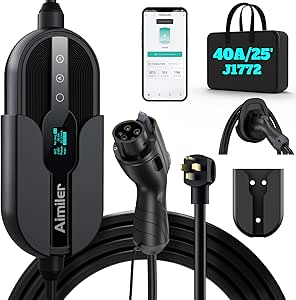
| Aimiler Level 2 Electric Vehic | J1772 | 25 ft | — | — |
| EVIQO Level 2 EV Charger J1772 | J1772 | 25 ft | 3 years | 240V |
| ELEGRP Level 2 EV Charger 40Am | J1772 | 25 ft | — | 240V |
| Mach 3 Fast 40 Amp Level 1 & 2 | — | 25 ft | 5 years | — |
| Level 2 EV Charger | J1772 | 25 ft | — | — |
More Details on Our Top Picks
ChargePoint HomeFlex Level 2 EV Charger, Hardwired NACS Charging Station – Tesla Compatible, Fast Charge Solution for Electric Vehicles
For a truck with a NACS charging port, this hardwired HomeFlex avoids the J1772-to-Tesla adapter requirement that comes with the DEWALT and Autel MaxiCharger 80A models. Its stated charging rate of up to 45 miles of range per hour can make overnight home charging practical, though actual rates depend on the vehicle and electrical setup. The ChargePoint app adds remote management, and indoor or outdoor installation gives owners more mounting options. The tradeoff is that this is a single-port, hardwired charger, so installation calls for a qualified electrician and it is less flexible to relocate than a plug-in station. Buyers who need the highest listed output should compare it with the Autel 80A; this ChargePoint is the more direct fit for Tesla-compatible NACS charging rather than maximum amperage.
Pros:- Native NACS connector suits compatible Tesla vehicles without a connector adapter.
- Up to 45 miles of stated range per hour can support overnight charging.
- Indoor and outdoor installation options offer placement flexibility.
- App features support remote charging management.
Cons:- Hardwired installation requires professional electrical work.
- Its output is below the Autel MaxiCharger 80A’s stated maximum.
- A single port cannot charge two vehicles at once.
Best for: Tesla electric-truck owners with a suitable 240-volt circuit who want a hardwired home station with a native NACS connector.
Not ideal for: Owners of J1772-only trucks seeking a plug-in charger, or households that need the highest available charging output.
- Connector:NACS (Tesla)
- Voltage:240 V input and output
- Ports:1
- Compatible vehicles:Tesla vehicles
- Installation:Hardwired
- Installation location:Indoor or outdoor
- Dimensions:7.06 × 11.19 × 5.2 in
- Warranty:3 years
Our verdict“Choose this HomeFlex if your electric truck uses NACS and you want a hardwired, app-managed home charger rather than the lineup’s highest amperage.”
Autel MaxiCharger Level 2 EV Charger, 80 Amp Fast Charging, Indoor/Outdoor, J1772, Hardwired
The Autel MaxiCharger stands apart from the other picks here with up to 80A and 19.2 kW of stated output. For an electric-truck owner whose vehicle can accept that power, and whose home electrical service can support it, the higher ceiling may shorten charging sessions compared with the 48A DEWALT or 50A plug-in/hardwire J1772 option. Its app controls, energy monitoring, and theft protection add useful oversight for a permanently installed station. That capacity comes with a real infrastructure requirement: full output calls for a 100A circuit, so this is not a simple swap for a standard outlet charger. The J1772 connector also means Tesla drivers need an adapter. I would put this ahead of lower-output options only for buyers who can use its power and plan for the electrical work.
Pros:- Up to 80A and 19.2 kW offer the highest stated output among these five picks.
- App scheduling, remote control, and energy monitoring support managed charging.
- Theft protection and temperature monitoring add oversight for indoor or outdoor use.
- Five-year warranty is longer than the three-year coverage listed for the ChargePoint and DEWALT models.
Cons:- Full 80A output requires a 100A circuit and substantial electrical planning.
- Hardwired installation is not a plug-in option.
- Tesla vehicles need an additional adapter for the J1772 connector.
Best for: Electric-truck owners with a compatible J1772 vehicle, a high-capacity electrical setup, and frequent charging needs between long drives.
Not ideal for: Drivers with limited household electrical capacity, a standard outlet-only installation plan, or a Tesla truck owner who wants native NACS.
- Maximum amperage:80 A
- Maximum power:19.2 kW
- Voltage:240 V input and output
- Connector:SAE J1772
- Ports:1
- Compatible vehicles:North American EVs and PHEVs
- Installation:Hardwired
- Warranty:5 years
Our verdict“Pick the Autel MaxiCharger if your truck and electrical service can make use of 80A; otherwise, the lower-output DEWALT or ChargePoint models may be a more practical match.”
Level 2 EV Charger 50Amp J1772, NEMA 14-50/Hardwire 240V Charging Station
This 50A J1772 station makes the most sense for buyers who want a choice between a NEMA 14-50 plug and hardwiring. That flexibility can help match the charger to an existing outlet or a planned permanent installation, unlike the hardwired-only DEWALT and Autel 80A units. Its weatherproof construction also suits an outdoor parking area, while app-based remote management gives owners charging controls beyond a basic station. The listing does not provide a brand name or warranty details, so buyers have less product-specific information to weigh than with ChargePoint or DEWALT. It also depends on Wi-Fi for smart functions. Compared with the NEMA 14-50 ChargePoint HomeFlex, this model offers the installation choice but less clearly documented support and charging-network integration.
Pros:- Selectable NEMA 14-50 plug or hardwired installation accommodates different home setups.
- 50A output is higher than many basic home charging options.
- Weatherproof design supports outdoor mounting.
- Mobile app enables remote management.
Cons:- Smart features depend on a Wi-Fi connection.
- Tesla vehicles require a compatible adapter for the J1772 connector.
- The supplied product data does not state a warranty or charging-network support.
Best for: J1772 electric-truck owners who want a weatherproof station and may choose between a 14-50 outlet installation and hardwiring.
Not ideal for: Buyers who need native NACS, detailed warranty information, or smart controls that remain available without Wi-Fi.
- Maximum amperage:50 A
- Voltage:240 V
- Connector:J1772
- Installation options:NEMA 14-50 plug or hardwired
- Weather protection:Weatherproof
- Smart control:Mobile app; Wi-Fi required for smart features
Our verdict“Choose this station if installation flexibility and outdoor use matter more than a clearly documented brand ecosystem or native Tesla compatibility.”
DEWALT Electric Vehicle Level 2 EV Charger up to 48 Amps 240V with App Control, Bluetooth & Wi-Fi, 25 ft Cable
The DEWALT pairs a 48A hardwired output with a 25-foot cable, making it a strong fit when the parking position is not right beside the wall-mounted station. Its rugged, waterproof design and indoor/outdoor suitability give it an advantage for exposed driveways over the plug-in ChargePoint HomeFlex, while Bluetooth and Wi-Fi app control offer more ways to manage charging. The stated rate is up to 46 miles of range per hour, though a truck’s onboard charging limit affects the actual result. Compared with Autel’s 80A model, the DEWALT has a lower power ceiling and avoids that model’s stated 100A circuit requirement. It remains a hardwired J1772 unit, so installation still needs planning and Tesla owners need a separate adapter.
Pros:- 25-foot cable can reach vehicles parked farther from the mounting point.
- Rugged waterproof construction supports indoor and outdoor installation.
- Bluetooth and Wi-Fi app controls provide remote charging management.
- 48A output offers substantial home charging capacity without the Autel 80A model’s stated 100A circuit requirement.
Cons:- Hardwired installation requires professional electrical work.
- J1772 connector requires an adapter for Tesla vehicles.
- Output is lower than the Autel MaxiCharger 80A.
Best for: J1772 electric-truck owners who park outdoors or need a long cable to reach the charging port from a fixed wall location.
Not ideal for: Drivers who want a plug-in station, native NACS, or the highest output available in this group.
- Maximum amperage:48 A
- Maximum power:11.5 kW
- Voltage:240 V
- Connector:SAE J1772
- Cable length:25 ft
- Installation:Hardwired
- Connectivity:Bluetooth and Wi-Fi
- Warranty:3 years
Our verdict“The DEWALT is a sensible choice for outdoor parking and longer reach, provided you can install a hardwired J1772 station.”
ChargePoint HomeFlex Level 2 EV Charger J1772 – NEMA 14-50 Plug
Among these five, this HomeFlex is the clearest fit for buyers who want a NEMA 14-50 plug-in charger with a familiar app-supported system. Its J1772 connector serves compatible non-Tesla trucks, and the stated charging rate of up to 45 miles of range per hour gives it a similar advertised pace to the hardwired NACS HomeFlex. Unlike that Tesla-focused model, this version uses a 14-50 plug, which can make installation more straightforward where a suitable outlet is already available. It is still a single-port station, and Tesla vehicles need an adapter. The DEWALT offers a longer 25-foot cable and rugged outdoor emphasis, while this ChargePoint brings app management and network access. Buyers should check outlet capacity and vehicle compatibility before choosing a plug-in setup.
Pros:- NEMA 14-50 plug offers an alternative to hardwired installation.
- Up to 45 miles of stated range per hour supports home charging between drives.
- ChargePoint app supports remote control and charging management.
- Listed for indoor or outdoor installation and UL-certified for safety.
Cons:- Tesla vehicles need an adapter for the J1772 connector.
- Charging capability depends on an appropriately installed 14-50 outlet.
- One port serves only one vehicle at a time.
Best for: J1772 electric-truck owners with a suitable NEMA 14-50 outlet who want app-based charging management without a hardwired station.
Not ideal for: Tesla drivers seeking a native NACS connection, or households without an appropriately rated 14-50 outlet.
- Connector:J1772
- Plug type:NEMA 14-50
- Maximum amperage:50 A
- Voltage:240 V input and output
- Ports:1
- Installation location:Indoor or outdoor
- Weight:13.8 lb
- Warranty:3 years
Our verdict“Choose this HomeFlex if your truck uses J1772 and you already have a suitable 14-50 outlet; pick the DEWALT instead for its longer cable and more rugged outdoor emphasis.”
EMPORIA Pro Level 2 EV Charger with PowerSmart – 48 Amp Fast Home Charging Station with J1772 Connector and 25′ Cable
For truck owners who want strong home charging without automatically committing to a panel upgrade, the EMPORIA Pro’s PowerSmart technology is its defining advantage. Its 48-amp output and 25-foot J1772 cable suit many overnight routines, while app scheduling and Vue energy monitoring help track charging and manage when the vehicle draws power. Unlike the plug-in Autel MaxiCharger 40A, this model offers hardwire installation as well as a NEMA plug option, giving buyers more setup flexibility. That flexibility is not a substitute for checking the home’s electrical capacity: professional installation may still be needed, and the unit’s higher-end feature set may be more than a basic charging setup requires. I’d shortlist it for owners who value electrical-load management and monitoring over the simplicity of a portable charger.
Pros:- PowerSmart technology is designed to help manage charging with existing electrical panels.
- 48-amp output supports faster home charging than the 40-amp Autel MaxiCharger plug-in model.
- Hardwire and NEMA plug installation options offer setup flexibility.
- App scheduling and Vue energy monitoring provide charging and usage visibility.
Cons:- Professional installation may be needed for a safe, suitable setup.
- Its advanced monitoring and load-management features may be unnecessary for buyers seeking a basic charger.
Best for: Electric-truck owners with limited panel capacity who want a hardwired or plug-in setup, app scheduling, and home energy monitoring.
Not ideal for: Buyers who want a simple portable charger or do not need smart monitoring; professional installation and the feature set may be unnecessary for their setup.
- Input voltage:240 volts
- Amperage:48 A
- Connector:J1772
- Cable length:25 feet
- Installation options:Hardwire or NEMA plug
- Dimensions:3″D x 8.25″W x 12.25″H
- Warranty:3 years
- Color:Black
Our verdict“Choose the EMPORIA Pro if panel-aware charging and energy monitoring matter more than keeping installation simple.”
Autel MaxiCharger Level 2 EV Charger up to 40Amp, 240V, Indoor/Outdoor Fast Electric Vehicle Charging Station with 25-Foot Cable and NEMA 14-50 Plug
The Autel MaxiCharger 40A is the more straightforward choice for truck owners who already have a suitable NEMA 14-50 receptacle and want a wall-mounted charger without hardwiring. Its 25-foot cable gives useful reach around a garage or driveway, and adjustable amperage can help match charging to the circuit. App scheduling and security controls add convenience, though this is still a single-port, J1772-compatible setup, not a way to charge two vehicles at once. Compared with the hardwired Autel 50A J1772, it gives up some maximum output but may be easier to install where the required outlet is already in place. Skip it if there is no compatible receptacle: adding one can erase the plug-in simplicity that makes this model appealing.
Pros:- Plug-in NEMA 14-50 design avoids hardwiring when a suitable receptacle is already available.
- Adjustable output can better match the available circuit.
- 25-foot cable offers practical reach across a garage or driveway.
- App controls support scheduling and security features.
Cons:- Requires a NEMA 14-50 receptacle, which may require electrical work if one is not present.
- 40-amp maximum output is below the hardwired Autel 50A J1772 model.
- One port cannot serve two vehicles at the same time.
Best for: Truck owners with an existing NEMA 14-50 outlet who want adjustable charging, app scheduling, and a long cable.
Not ideal for: Buyers without a NEMA 14-50 receptacle, or households that need more than one charging port or higher output than 40 amps.
- Input voltage:240 volts
- Output voltage:240 volts
- Maximum amperage:40 A
- Plug type:NEMA 14-50
- Cable length:25 feet
- Ports:1
- Installation:Plug-in; requires NEMA 14-50 receptacle
- Warranty:3 years
Our verdict“Pick this Autel if you have the right outlet and want a smart, adjustable plug-in charger rather than a higher-output hardwired unit.”
Autel Level 2 EV Charger up to 50Amp, 240V, Indoor/Outdoor Car Charging Station with J1772 Connector, Wi-Fi and Bluetooth Enabled, 25-Foot Cable, Hardwired, Dark Gray
Among these five, the Autel 50A J1772 is the strongest fit for owners seeking higher-output home charging and a permanent installation. Its 50-amp rating and 25-foot cable can serve trucks whose onboard charging equipment supports that rate, while the NEMA Type 4 enclosure and CSA certification support outdoor placement. Wi-Fi and Bluetooth app access make remote management more capable than the display-focused EVDANCE portable models, but this Autel is hardwired and calls for professional installation. That makes it less flexible than the plug-in Autel MaxiCharger 40A, which is easier to move or connect to an existing outlet. It also uses J1772, so owners of vehicles with a different inlet need a compatible adapter. Its extra output only pays off when the vehicle and home circuit can use it.
Pros:- 50-amp, up-to-12-kW output offers more charging capacity than the 40-amp models in this batch.
- NEMA Type 4 protection supports outdoor installation.
- Wi-Fi and Bluetooth enable app-based remote management.
- 25-foot J1772 cable gives useful reach to a parked vehicle.
Cons:- Hardwired installation calls for professional electrical work.
- J1772 connector may require an adapter for vehicles with another inlet type.
- Higher output is only useful when the vehicle and home electrical setup support it.
Best for: Electric-truck owners with a suitable electrical circuit who want a permanent, higher-output charger for indoor or outdoor installation.
Not ideal for: Renters, frequent travelers, or owners seeking plug-in portability; this unit is hardwired and requires professional installation.
- Input voltage:240 volts
- Maximum amperage:50 A
- Maximum power:12 kW
- Connector:J1772
- Cable length:25 feet
- Installation:Hardwired
- Certifications and enclosure:CSA; NEMA Type 4
- Warranty:3 years
Our verdict“Choose this Autel for a permanent outdoor-capable installation when your truck and electrical circuit can make use of its 50-amp output.”
EVDANCE Level 2 EV Charger 40Amp, 240V, 9.6KW Portable Electric Vehicle Charging Station with NEMA 14-50P, 25FT Cable, Adjustable Current, Delay Timer, J1772 Compatibility
The EVDANCE 40A portable charger suits truck owners who want a higher-output unit they can unplug and carry, rather than a fixed wall station. It reaches 9.6 kW, offers adjustable current and a delay timer, and its TFT display puts charging information on the unit without relying on an app. The 25-foot cable adds reach, while the stated operating range of -22°F to +122°F gives buyers useful temperature guidance for varied conditions. Compared with the hardwired Autel 50A J1772, EVDANCE is easier to relocate but tops out at a lower amperage and lacks the same listed app connectivity. It needs a NEMA 14-50 outlet, and Tesla owners need an adapter. Its portability is a plus only if the outlet and storage arrangements suit regular use.
Pros:- Up to 40 amps and 9.6 kW provide more output than the 32-amp EVDANCE portable model.
- Portable plug-in format can be carried or stored when not in use.
- TFT display, adjustable current, and delay timer support direct control at the charger.
- 25-foot cable and stated operating range support flexible placement.
Cons:- Requires a NEMA 14-50 outlet for use.
- Tesla vehicles require an adapter.
- Does not list Wi-Fi or app controls like the hardwired Autel 50A model.
Best for: Truck owners who already have a NEMA 14-50 outlet and want a portable 40-amp charger with an on-unit display and adjustable current.
Not ideal for: Buyers seeking a permanent hardwired station, app-based remote controls, or a charger that connects directly to a Tesla inlet without an adapter.
- Voltage:240 V
- Maximum amperage:40 A
- Maximum power:9.6 kW
- Plug type:NEMA 14-50P
- Compatibility:J1772 vehicles
- Cable length:25 feet
- Operating temperature:-22°F to +122°F
- Controls:TFT display, adjustable current, and delay timer
Our verdict“Choose this EVDANCE if you want a portable 40-amp charger with on-device controls and have a suitable NEMA 14-50 outlet.”
EVDANCE Level 2 EV Charger (32Amp, 240V, NEMA 14-50P), 7.68kW Portable Electric Car Charger with 25ft Cable and Adjustable Current
The EVDANCE 32A is the simpler portable pick for truck owners whose charging routine does not call for the 40-amp EVDANCE’s higher 9.6-kW ceiling. Its output adjusts from 16 to 32 amps, so owners can reduce the draw to suit a compatible circuit; the 25-foot cable and carrying case also make it easier to pack away or take along. A display provides local charging information, but this model’s appeal is practical portability, not app-driven control. Compared with the Autel MaxiCharger 40A, it offers a lower maximum output and a one-year warranty, while avoiding a fixed hardwired installation. The product description cautions against direct sunlight or heavy rain, so its waterproof construction should not be read as permission for unrestricted outdoor exposure.
Pros:- Adjustable 16–32A output can match charging to a compatible circuit.
- Portable design, 25-foot cable, and carrying case suit storage and travel.
- J1772 compatibility covers many North American EVs.
- Local display provides charging information at the unit.
Cons:- 32-amp maximum output is lower than either the EVDANCE 40A or Autel 40A charger.
- Tesla vehicles require an adapter.
- Product guidance advises against direct sunlight or heavy rain exposure.
- One-year warranty is shorter than the three-year coverage listed for both Autel models.
Best for: Truck owners who want a portable, adjustable charger for home or travel and do not need more than 32 amps.
Not ideal for: Drivers who need the highest charging output available in this group or plan to leave a charger exposed to heavy rain or direct sun.
- Voltage:240 V
- Amperage range:16–32 A
- Maximum power:7.68 kW
- Plug type:NEMA 14-50P
- Connector:J1772
- Cable length:25 feet
- Warranty:1 year
- Vehicle compatibility:J1772 EVs; Tesla requires an adapter
Our verdict“Pick this EVDANCE for portable, adjustable charging when 32 amps is enough and you can protect the unit from harsh exposure.”
Aimiler Level 2 Electric Vehicle (EV) Charger, 40A, 25ft Cable, WiFi App Control, ETL Certified, 220-240V, NEMA 14-50P Plug, J1772 Connector
The Aimiler is a good fit for electric truck owners who want 40A charging plus remote scheduling without stepping up to a hardwired unit. Its WiFi app and adjustable current give it more control than the simpler ELEGRP portable charger, while the 25-foot cable can reach a truck parked farther from the outlet. Its J1772 connector works with compatible vehicles, but Tesla or NACS trucks need an adapter; the dual-connector Mach 3 is the easier pick if you switch between those standards. The housing carries strong weather-protection ratings, yet the supplied guidance cautions against direct sun and rainy exposure, so I would not treat its outdoor rating as permission for an unprotected installation. App setup may also take patience for buyers who prefer plug-and-charge simplicity.
Pros:- 40A output delivers up to 9.6 kW on a suitable 240V circuit.
- WiFi app control supports remote monitoring and scheduling.
- Adjustable amperage offers flexibility when matching the charger to the circuit.
- 25-foot cable provides useful reach around a parked truck.
Cons:- Tesla and NACS vehicles require a separate adapter.
- App and WiFi setup may be difficult for less technical owners.
- Product guidance discourages direct sunlight and rainy outdoor placement despite the weather-protection ratings.
Best for: J1772 electric truck owners with a NEMA 14-50 outlet who want app scheduling, adjustable current, and a long cable.
Not ideal for: Tesla or NACS truck owners who want to connect without an adapter, and buyers planning an exposed installation in direct sun or rain.
- Connector:J1772
- Input voltage:240V
- Current:40A
- Charging power:Up to 9.6 kW
- Cable length:25 ft
- Plug:NEMA 14-50P
- Weather protection:NEMA Type 4, IP66
- Certifications:ETL, FCC, SAE J1772, UL2231-1/-2, UL 991, UL 2251, UL1998, UL 2594
Our verdict“Choose the Aimiler if app scheduling and adjustable 40A charging matter more than native NACS support or carefree exposed outdoor placement.”
EVIQO Level 2 EV Charger J1772 40A NEMA 14-50 – 240V Wall Charging Station
The EVIQO earns its place for owners who need a 40A J1772 charger rated for indoor or outdoor use and want app-based scheduling and energy tracking. Its IP66/NEMA 4 housing and listed UL, ETL, FCC, and Energy Star credentials give it a more clearly documented weather-ready profile than the Aimiler, whose product guidance warns against rainy exposure and direct sun. Both provide a 25-foot cable and 40A output, so the choice turns on installation confidence and app features rather than charging speed. The EVIQO still depends on a dedicated 240V NEMA 14-50 outlet, and WiFi runs on 2.4 GHz, which can mean setup troubleshooting in some homes. Truck owners using NACS need an adapter, making the dual-connector Mach 3 more convenient for mixed-connector households.
Pros:- 40A charging is compatible with many J1772 electric trucks and plug-in hybrids.
- IP66/NEMA 4 housing is specified for indoor and outdoor use.
- WiFi app offers scheduling and energy tracking.
- Three-year warranty is specified.
Cons:- Requires a dedicated 240V NEMA 14-50 outlet.
- NACS vehicles need an adapter.
- 2.4 GHz WiFi setup may require troubleshooting.
Best for: J1772 electric truck owners with a dedicated NEMA 14-50 outlet who want app scheduling and a charger suited to indoor or outdoor installation.
Not ideal for: NACS truck owners seeking a native connector, or buyers without a 240V NEMA 14-50 outlet and unwilling to arrange one.
- Connector:J1772
- Voltage:240V
- Current:40A
- Cable length:25 ft
- Plug:NEMA 14-50
- Weather protection:IP66 / NEMA 4
- Connectivity:WiFi, 2.4 GHz
- Certifications:UL, ETL, FCC, Energy Star
- Warranty:3 years
Our verdict“Pick the EVIQO for a J1772 truck and a suitable outlet when documented weather protection and app scheduling are priorities.”
ELEGRP Level 2 EV Charger 40Amp, J1772 Portable Electric Car Charger, 240V NEMA 14-50 Plug, ETL Certified with 25FT Extension Cable
The ELEGRP suits truck owners who want a portable 40A charger with several current settings, rather than app-connected controls. Its 16A, 20A, 24A, 32A, and 40A options make it easier to match charging to available circuit capacity; that flexibility is a clearer selling point than the EVIQO, which adds WiFi scheduling but lists a fixed 40A output. The 25-foot cable and stated IP67 protection support use across different parking arrangements, and its temperature range is useful for owners facing seasonal conditions. This is still a NEMA 14-50 plug-in charger, not a solution for homes without that outlet. It uses J1772, so NACS trucks need an adapter, while the Mach 3 avoids that extra step with its included connector options. Buyers who want remote monitoring should also look elsewhere.
Pros:- Selectable 16A to 40A settings allow charging current to be adjusted.
- Up to 9.6 kW charging power at the highest supported setting.
- 25-foot cable helps reach a truck parked away from the outlet.
- IP67 protection and a stated -21°F to 121°F temperature range suit varied conditions.
Cons:- Requires a NEMA 14-50 outlet.
- Tesla and NACS vehicles need a separate adapter.
- No WiFi app control is listed.
Best for: Electric truck owners who travel between compatible NEMA 14-50 outlets and want to set charging current to suit the circuit.
Not ideal for: NACS owners who do not want an adapter, or drivers who want WiFi monitoring and scheduled charging through an app.
- Connector:J1772
- Voltage:240V
- Charging power:Up to 9.6 kW
- Current settings:16A, 20A, 24A, 32A, 40A
- Plug:NEMA 14-50
- Cable length:25 ft
- Certification:ETL
- Protection:IP67; PBE safety technology
- Operating temperature:-21°F to 121°F
Our verdict“Choose the ELEGRP if portable use and selectable current matter more than app features or native NACS compatibility.”
Mach 3 Fast 40 Amp Level 1 & 2 Portable EV Charger with SAE J1772 and Tesla NACS Connectors
The Mach 3 stands apart in this group by including both J1772 and Tesla NACS connectors, a practical advantage for households with different vehicle makes or a truck that uses NACS. Unlike the Aimiler and ELEGRP, it does not require a separate NACS adapter for compatible vehicles. Its Level 1 and Level 2 support also gives owners more outlet flexibility when away from home, while the 25-foot cable and live LED display help with everyday placement and status checks. The tradeoff is a 40A ceiling: it cannot match the higher-current hardwired options elsewhere in the roundup. The product data also does not specify a plug type, so buyers should verify that its connection suits their intended outlet. No wall mount or carrying case is listed.
Pros:- Includes J1772 and Tesla NACS connectors for broad US EV compatibility.
- Supports both Level 1 and Level 2 charging.
- 25-foot cable offers flexible parking reach.
- LED display provides live charging updates and the listed warranty is five years.
Cons:- Maximum current is 40A, below higher-current hardwired choices in the roundup.
- Product data does not specify the plug type.
- No wall mount or carrying case is listed.
Best for: Households with both J1772 and NACS vehicles, or electric truck owners who want one portable charger for Level 1 and Level 2 use.
Not ideal for: Owners seeking charging above 40A, or buyers who need a specified outlet connection, wall mount, or carrying case.
- Charging levels:Level 1 and Level 2
- Output voltage:120–240V
- Maximum current:40A
- Connectors:J1772 and Tesla NACS
- Cable length:25 ft
- Dimensions:2.34 × 3.79 × 9.15 in
- Warranty:5 years
Our verdict“Choose the Mach 3 when native J1772 and NACS support and Level 1/Level 2 flexibility matter more than charging above 40A.”
Level 2 EV Charger, 40 Amp 240V 9.6kW, 25ft Cable, LED Display
This charger is aimed at J1772 truck owners who want 40A charging with a programmable delay timer, without making WiFi a requirement. The timer can shift a charging session to a preferred start time, while the LED display gives a direct status readout. Compared with the app-equipped Aimiler and EVIQO, this model keeps its listed feature set simpler, though it gives up remote monitoring and energy tracking. Its 25-foot cable and adjustable current add practical flexibility, and 9.6 kW is a useful ceiling for a compatible 240V setup. Product details call for proper grounding and a dry environment, so it is a less convincing choice for exposed outdoor mounting than the weather-rated ELEGRP. Tesla and NACS trucks also need an adapter.
Pros:- Up to 40A and 9.6 kW charging on a compatible 240V circuit.
- Adjustable current settings offer charging flexibility.
- 25-foot cable helps accommodate different parking positions.
- LED display and programmable delay timer provide useful local controls.
Cons:- Requires proper grounding and a dry environment.
- Tesla and NACS vehicles need an adapter.
- Warranty information is limited to a 30-day return guarantee in the supplied data.
Best for: J1772 electric truck owners who want a 25-foot cable, visible charging status, and delayed start without relying on WiFi.
Not ideal for: NACS truck owners seeking a native connector, or buyers who need documented weather protection for an exposed outdoor installation.
- Connector:J1772
- Input voltage:240V
- Output voltage:240V
- Current:Up to 40A
- Charging power:Up to 9.6 kW
- Cable length:25 ft
- Controls:LED display, adjustable current, programmable delay timer
- Warranty information:30-day return guarantee
Our verdict“Pick this charger for basic J1772 truck charging with a delay timer, but choose a weather-rated or app-connected alternative for exposed or remotely managed setups.”

How We Picked
I ranked these stations around the needs that matter most for home charging an electric truck: usable output, installation fit, connector compatibility, cable reach, and practical controls. A truck may have a large battery, but its onboard AC charger and the home circuit set the actual charging rate; I treated high amperage as an advantage only when the rest of the setup can support it. I also weighed whether each unit is hardwired, plug-in, or portable, since those formats affect installation, flexibility, and day-to-day convenience.
The order favors options with a clearer fit for distinct buyer needs rather than simply grouping the highest amperage first. The Autel 80-amp model leads for buyers who can use its capacity; EMPORIA Pro and the DEWALT offer strong fixed-installation alternatives with different control and power-management appeals. Plug-in and portable models rank well for buyers prioritizing easier setup or portability, but sit below permanent stations for a dedicated home charging routine. I give no unit a blanket advantage based on features alone: electrical service, outlet condition, connector match, and installation cost can change which one makes sense.
| electric truck charging station | Connector |
|---|---|
| ChargePoint HomeFlex Level 2 E | NACS (Tesla) |
| Autel MaxiCharger Level 2 EV C | SAE J1772 |
| Level 2 EV Charger 50Amp J1772 | J1772 |
| DEWALT Electric Vehicle Level | SAE J1772 |
| ChargePoint HomeFlex Level 2 E | J1772 |
| EMPORIA Pro Level 2 EV Charger | J1772 |
| Autel MaxiCharger Level 2 EV C | — |
| Autel Level 2 EV Charger up to | J1772 |
| EVDANCE Level 2 EV Charger 40A | — |
| EVDANCE Level 2 EV Charger | J1772 |
| Aimiler Level 2 Electric Vehic | J1772 |
| EVIQO Level 2 EV Charger J1772 | J1772 |
| ELEGRP Level 2 EV Charger 40Am | J1772 |
| Mach 3 Fast 40 Amp Level 1 & 2 | — |
| Level 2 EV Charger | J1772 |
Factors to Consider When Choosing Best Electric Truck Charging Stations
Before choosing a charger, I would match the station to the truck and the house as a system. A higher-output nameplate does not guarantee a faster charge, and a plug that fits does not prove the circuit is suitable for continuous charging. These checks can prevent overspending, inconvenient cable placement, or an installation that needs to be redone.
Match Charger Output to the Truck and Circuit
Start with the truck’s maximum AC charging rate, then check the circuit capacity and charger settings against that limit. A charger rated above the truck’s onboard limit will not make the truck charge faster on AC, though it may leave room for a future vehicle. Continuous EV charging places a sustained load on household wiring, so the breaker, wire gauge, receptacle, and installation method all need to match the plan. Do not assume an existing dryer or workshop outlet is suitable just because its shape matches the charger plug. Ask a qualified electrician to verify the circuit before relying on it. This check often matters more than choosing between two nearby charger amperage ratings.
Choose Hardwired, Plug-In, or Portable for Your Parking Routine
A hardwired station is a natural fit for a fixed parking spot and a dedicated installation, and it avoids relying on a frequently used receptacle. A NEMA 14-50 model can be easier to relocate or replace, but only when the outlet and circuit are properly rated for the charging load. Portable chargers are useful if you expect to charge in more than one place, yet they still need an appropriate power source and careful storage. A common mistake is treating a plug-in unit as installation-free; adding a receptacle for EV charging may still require electrical work. Consider whether the truck parks inside, outside, or in a shared space before settling on a format. The best choice is the one that matches how the vehicle is actually parked and charged.
Confirm the Connector and Adapter Plan
Check the truck’s charge-port standard rather than relying on the model name or a seller’s broad compatibility claim. Most options in this roundup list J1772 connectors, while the ChargePoint hardwired NACS model and the Mach 3’s NACS connector provide different connection paths. An adapter may bridge some connector differences, but compatibility can depend on the vehicle, charging equipment, and adapter type. Confirm that the manufacturer permits the intended combination and that the adapter is suitable for the charging current. If more than one vehicle will use the station, list both inlet types before purchasing. This avoids the frustrating outcome of installing a capable charger that cannot connect to the truck without another part.
Measure Cable Reach and Mounting Location
Measure from the proposed charger mounting point to the truck’s charge port with the vehicle parked in its usual position. A 25-foot cable is common among these picks, but vehicle size, port location, garage layout, and where the station can be mounted all affect real reach. Do not stretch a cable across a walking route or leave it where a garage door, tire, or sharp edge can damage it. Outdoor installations also call for attention to the charger’s stated environmental rating and the exposure of the receptacle or wiring. A longer cable can make daily charging easier, but extra length may be heavier to handle and harder to store neatly. Planning the route first can prevent buying based on a length that looks adequate on paper.
Treat Smart Controls as Management Tools
Wi-Fi, Bluetooth, and app features can help schedule charging, review use, or adjust current, but their value depends on how reliably the connection reaches the parking area. Scheduling can make it easier to charge during preferred hours, while adjustable current can help fit a charger to a circuit with a lower safe limit. These tools do not replace a correctly sized circuit or change the truck’s maximum AC charging rate. If the garage has weak wireless coverage, a model with app-dependent controls may be less convenient than expected. Think about whether you want remote access, simple plug-in operation, or load management before paying attention to feature lists. For many buyers, dependable charging and straightforward controls matter more than a long menu of app functions.
Budget for Installation and Future Use, Not Just the Unit
The charger is only one part of a home setup; the distance from the electrical panel, panel capacity, wiring route, and any new circuit can shape the final project. A higher-amperage station may call for more substantial electrical work, so compare the complete installation plan rather than focusing only on its output rating. On the other hand, a lower-output unit can be a sensible match if the truck charges overnight and the existing service has limited spare capacity. If another EV may join the household, consider whether the installation can support future charging or load management. Keep room in the plan for mounting hardware, weather protection where needed, and a safe cable-storage spot. Paying for capacity that the truck and home cannot use may bring little day-to-day benefit.
Frequently Asked Questions
Will an 80-amp charger make my electric truck charge faster than a 48-amp model?
Only if the truck’s onboard AC charger can accept the extra power and the home electrical system supports the required circuit. If the truck’s limit is lower, it will charge at that limit even when connected to a higher-rated station. The Autel 80-amp model is most relevant to buyers who have confirmed both vehicle and service compatibility. A 48-amp unit such as the EMPORIA Pro may deliver the same practical result for a truck with a lower AC charging ceiling. Check the vehicle manual and have an electrician review the planned circuit before choosing based on amperage alone.
Can I plug a NEMA 14-50 charger into an outlet I already use for another appliance?
Do not assume an existing outlet is ready for routine EV charging. The receptacle, wiring, breaker, and circuit condition must suit the charger’s continuous load, and sharing a circuit with another appliance can create a safety or capacity problem. A qualified electrician can verify whether the outlet is appropriate and whether it should be dedicated. Plug-in models such as the EVDANCE 40-amp still depend on a suitable installation; the plug itself does not make an undersized circuit safe. If the outlet needs upgrading, compare that work with the cost and practicality of a hardwired station.
Are J1772 chargers compatible with electric trucks that use a different charge-port connector?
Compatibility depends on the truck’s inlet, the charging standard it supports, and the adapter approved for that combination. Many products here have J1772 connectors, while the ChargePoint NACS hardwired model and Mach 3 offer different connector configurations. An adapter can be part of the solution, but buyers should verify charging direction, current rating, and vehicle guidance before relying on one. Do not treat a physical fit as proof that charging will work correctly. If the household has multiple vehicles, confirm the connector needs of each before selecting a station.
Should I buy a portable EV charger for regular home charging?
A portable model can work for regular home charging when it is connected to a properly rated outlet and mounted or stored safely between uses. Its flexibility is useful if you need to move the charger or take it along, but handling and setup may be less convenient than a fixed wall station. Portable options in this roundup still require attention to circuit capacity, cable routing, and weather exposure. If the truck has one permanent parking spot, a hardwired or fixed plug-in station may provide a tidier routine. Choose portability for a real use case, not as a substitute for checking the electrical installation.
When is it worth paying for a higher-amperage or smart charger?
Higher amperage is worth considering when the truck can use the additional AC power, the electrical service can support it, and quicker overnight replenishment matters to your routine. Smart functions are useful when you want schedules, remote monitoring, or adjustable current, especially if household charging needs vary. Neither feature automatically lowers installation needs or speeds charging beyond the truck’s limits. A lower-output model can be the better fit for overnight charging, limited panel capacity, or a simple setup. Compare the benefit you will use with the electrical work and complexity required to get it.
Conclusion
For a permanent home setup with compatible vehicle and electrical capacity, I would start with the Autel MaxiCharger 80 Amp as the best overall high-output choice. The EVDANCE 32-amp is my value-oriented pick for buyers who need a more modest portable option, while the EMPORIA Pro is the best premium-style choice for a 48-amp fixed station with power-management features. For beginners who already have a verified NEMA 14-50 outlet, the Autel 40 Amp plug-in offers a straightforward starting point; buyers without a suitable outlet should get electrical advice before choosing. If connector flexibility is the priority, compare the ChargePoint NACS and Mach 3 against your truck’s inlet and approved adapter requirements. My final recommendation is to confirm the truck’s AC limit and home circuit first, then choose the station format and features that suit your parking routine.
Halloween Picks
halloween
As an affiliate, we earn on qualifying purchases.