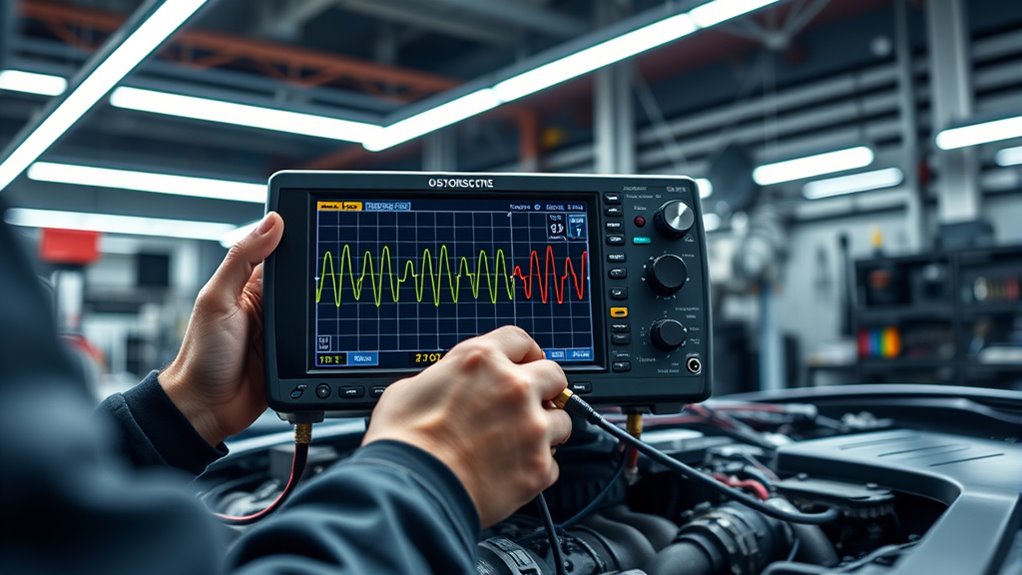

Professional automotive oscilloscopes vary most in how they connect to the vehicle, display signals and support the number of tests you need to run at once. I give the TOPDON Phoenix Scope the best overall position for its automotive-focused four-channel role, while the Hantek 1008C stands out for multi-channel PC-based diagnostics and the Micsig SATO1004 for portable use. Those options serve different workflows, and a higher channel count or bandwidth alone does not guarantee a better fit for vehicle fault-finding. Buyers also need to weigh screen and software workflow, portability, included connections and whether the instrument is designed for automotive use. Read on for the full comparison and guidance by shop need.

Get garage and car supplies delivered free — and shop member deals
- Fast, free delivery on millions of items
- Access to Prime Big Deal Days deals on October 6–7
- Prime Video, Amazon Music and more included
Complete the kit


Key Takeaways
The TOPDON Phoenix Scope takes the overall slot because this lineup includes several automotive-specific four-channel choices, and it gives buyers a focused alternative to general-purpose bench and handheld scopes.
The Hantek 1008C family is the lineup’s clearest route to eight-channel work, but its PC-based format asks the technician to build the diagnostic setup around a computer.
The Micsig SATO1004 and Micsig tablet series are better aligned with portable, self-contained workflows than the USB-connected Hantek instruments.
The FNIRSI DSO153 and combined scope-meter-generator handhelds trade automotive-specific workflow for compact versatility; their listed bandwidth and sampling figures should be matched to the signals a shop actually diagnoses.
The two Autel MaxiScope MP608 entries are the same named model, so they do not represent two distinct capabilities or a meaningful head-to-head choice in this roundup.




| professional automotive oscilloscope | Channels | Bandwidth |
|---|---|---|
| LAUNCH X-431 Oscilloscope O2-2 | 4 | — |
| Micsig Tablet Oscilloscope Ser | — | 100/200/300 MHz, depending on model |
| FNIRSI 1013D Plus 100MHz Oscil | 2 | 100 MHz |
| Micsig SATO1004 Portable Autom | 4 | 100 MHz |
| Hantek 1008C 8-Channel Automot | 8 | — |
| FNIRSI DSO153 2 in 1 Handheld | — | 1 MHz |
| 3 in 1 Handheld Oscilloscope A | 2 | Up to 50 MHz in high-speed mode; 30 MHz in normal mode |
| Hantek 1008C 8-Channel USB Aut | 8 analogue | — |
| Hantek 1008C+ 8CH Automotive D | 8 | — |
| Autel MaxiScope MP608 4-Channe | 4 | 20 MHz |
| TOPDON Phoenix Scope 4-Channel | 4 | — |
| FNIRSI 2C53T Upgraded Handheld | 2 | 50 MHz |
| Autel MaxiScope MP608 4-Channe | 4 | 20 MHz |
More Details on Our Top Picks
LAUNCH X-431 Oscilloscope O2-2 Scopebox Analizador 4 Channels Digital Scopebox Tester USB Port
The LAUNCH X-431 O2-2 Scopebox is the most targeted choice here for a shop already working in the X-431 diagnostic ecosystem. Its listed four-channel design can let a technician compare related signals during a fault check, while the USB connection points to a setup built around a separate diagnostic device rather than a self-contained tablet. Compared with the Micsig SATO1004, this listing provides far less detail about supported tests, display, storage, or connectivity, so I would choose the SATO1004 for a documented all-in-one automotive workflow. The LAUNCH may suit buyers who specifically need an X-431 scope accessory, but the sparse product data makes it hard to judge capability or plan probes and software needs. Its main tradeoff is ecosystem focus over clearly specified standalone flexibility.
Pros:- Four channels can support comparison of multiple vehicle signals
- USB connection is suited to integration with a compatible host
- Product is positioned specifically for automotive diagnostics
Cons:- Bandwidth and sampling rate are not provided
- The listing does not clarify compatibility, software requirements, or included accessories
Best for: Automotive technicians who already use a compatible LAUNCH X-431 device and want a four-channel scope accessory for that workflow
Not ideal for: Buyers who need documented bandwidth, sampling rate, included probes, or standalone screen and storage details before choosing a professional scope
- Channels:4
- Connection:USB
- Product type:Digital scopebox tester
- Diagnostic focus:Automotive
- Product series:LAUNCH X-431
- Model:O2-2
Our verdict“Choose this when you need a four-channel scopebox for an established compatible X-431 setup and can confirm its specifications before purchase.”
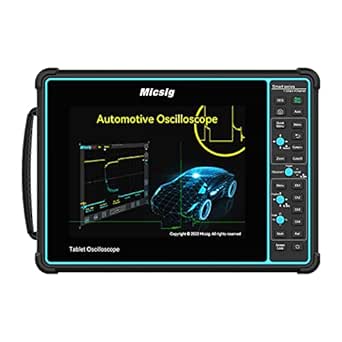
Micsig Tablet Oscilloscope Series T01004 T2004 T3004 T2002, 100/200/300MHz, 2/4 Channel, Touch Screen, Portable, Lab & Automotive
For technicians who need one instrument to move between vehicle work and bench analysis, the Micsig Tablet Oscilloscope series offers the broadest stated signal headroom in this group: models reach 300 MHz bandwidth with a 2 GSa/s sampling rate. That gives it more capacity for examining faster signals than the 100 MHz FNIRSI 1013D Plus, though those headline limits apply across a series whose channel and bandwidth configurations vary. The 10.1-inch touchscreen, Wi-Fi, USB, and HDMI make operation and sharing more flexible than the Hantek 1008C’s host-computer USB approach. The tradeoff is a 7.7-pound body and a more involved interface, which may be excessive for routine sensor checks. Buyers should match the specific model configuration to their channel and bandwidth needs.
Pros:- Series configurations offer bandwidth up to 300 MHz and sampling up to 2 GSa/s
- 10.1-inch touchscreen provides a large waveform viewing area
- Wi-Fi, USB, and HDMI support varied connection and display workflows
- Available two- and four-channel configurations
Cons:- At 7.7 pounds, it is relatively heavy for frequent mobile use
- Complex functions may take time to learn
- Battery life details are not supplied
Best for: Automotive electronics specialists who also do bench work and need a larger display, multiple channels, and higher bandwidth options
Not ideal for: Mobile technicians prioritizing a light carry kit or buyers who only need basic vehicle sensor and actuator checks
- Bandwidth:100/200/300 MHz, depending on model
- Sampling rate:2 GSa/s
- Memory depth:220 Mpts
- Analog channels:2 or 4, depending on model
- Display:10.1-inch, 1280 × 800
- Weight:7.7 lb
- Dimensions:12.6 × 13.78 × 6.69 in
- Connectivity:Wi-Fi, USB, HDMI
Our verdict“Pick the Micsig series if you need a capable shared automotive and lab instrument and are willing to carry and learn a larger tablet scope.”
FNIRSI 1013D Plus 100MHz Oscilloscope, 2 Channel 7″ TFT Touchscreen
The FNIRSI 1013D Plus is the portable option for buyers who want an independent screen and useful waveform tools without stepping up to the heavier Micsig tablet series. Its two channels, 100 MHz bandwidth, and 1 GSa/s sampling rate suit many signal inspection tasks, while FFT and waveform comparison add ways to investigate signal shape beyond a basic trace. The seven-inch touchscreen and battery power make it easier to carry around a vehicle than the four-channel Micsig SATO1004, but its two-channel limit restricts simultaneous comparisons on multi-signal faults. It is also a general circuit instrument rather than a dedicated automotive diagnostic platform, so the SATO1004 and Hantek 1008C are more directly oriented to vehicle test procedures. Four hours of stated battery use may call for planned charging during a long day.
Pros:- Portable, battery-powered design with a seven-inch touchscreen
- 1 GSa/s sampling rate and 100 MHz bandwidth
- FFT and waveform comparison support deeper signal inspection
- Stores up to 1,000 screenshots and waveform data
Cons:- Two channels limit simultaneous comparison of vehicle signals
- Approximately four hours of battery use may be short for extended field work
- Listing does not detail included automotive probes or guided test coverage
Best for: Independent technicians and electronics repairers who need a portable two-channel scope for occasional automotive signal checks and general circuit work
Not ideal for: Automotive specialists who routinely need four or more channels or guided vehicle-specific diagnostic tests
- Bandwidth:100 MHz
- Sampling rate:1 GSa/s
- Channels:2
- Display:7-inch TFT touchscreen, 800 × 480
- Battery:6000 mAh, approximately 4 hours of use
- Storage:1 GB, up to 1,000 screenshots and waveform data
- High-voltage tolerance:Up to 400 V
Our verdict“Choose this for portable, general-purpose waveform work when two channels are enough and vehicle-specific test guidance is not a priority.”
Micsig SATO1004 Portable Automotive Oscilloscope
The Micsig SATO1004 earns the dedicated automotive role because its stated test coverage maps directly to shop work: ignition, sensors, actuators, vehicle networks, charging and starter circuits, communication protocols, and pressure. Four channels let a technician compare signals in a way the two-channel FNIRSI 1013D Plus cannot, and its 8-inch touchscreen and Android-based software keep the workflow self-contained. Waveform transfer over Wi-Fi adds a way to view and share data on a smartphone, although that depends on a stable connection. Compared with the Micsig tablet series, the SATO1004 is more explicitly built around automotive diagnostics, while the series provides higher bandwidth options for lab and faster-signal work. Its 100 MHz bandwidth and remote-transfer reliance define the tradeoff.
Pros:- Automotive test coverage includes ignition, sensors, actuators, networks, charging, starter, and pressure checks
- Four channels support simultaneous signal comparison
- Android touchscreen interface with 32 GB internal storage
- Wi-Fi app connectivity plus USB-C, LAN, and HDMI
Cons:- 100 MHz bandwidth is below the highest Micsig tablet series configurations
- Remote viewing and transfer depend on a stable Wi-Fi connection
Best for: Professional automotive technicians who want a self-contained four-channel instrument with vehicle-focused test coverage and onboard waveform storage
Not ideal for: Electronics labs needing the higher bandwidth options of the Micsig tablet series or technicians who cannot rely on Wi-Fi for sharing data
- Channels:4
- Bandwidth:100 MHz
- Sampling rate:1 GSa/s
- Display:8-inch touchscreen
- Operating system:Android
- Internal storage:32 GB
- Minimum operating voltage:7.5 V
- Connectivity:Wi-Fi, USB Type-C, LAN, HDMI, USB Host, USB Device
Our verdict“Pick the SATO1004 for a dedicated shop scope that combines four-channel capture with broad automotive test functions.”
Hantek 1008C 8-Channel Automotive Diagnostic Oscilloscope
When a diagnosis calls for tracking many circuits at once, the Hantek 1008C stands apart with eight channels and more than 80 automotive diagnostic functions. That channel count exceeds the four on the Micsig SATO1004, giving it room to capture several related signals in a single setup; the SATO1004, in turn, offers a built-in touchscreen and onboard storage, while this Hantek connects by USB to a computer. Report generation and saving can help document a repair, and online video help offers some support for learning the automotive functions. Its focus is firmly on vehicle diagnostics rather than general bench use, and the listing does not provide bandwidth or sampling-rate figures. Buyers who need a portable, self-contained scope should favor the Micsig instead.
Pros:- Eight channels allow broad simultaneous signal capture
- More than 80 automotive diagnostic functions are specified
- Can generate, print, capture, and save diagnostic reports
- Online video help is available
Cons:- USB computer connection makes it less self-contained than the Micsig SATO1004
- Bandwidth and sampling rate are not stated in the supplied product data
- Automotive focus limits its appeal as a general-purpose scope
Best for: Automotive diagnostic technicians who use a computer-based workflow and need to capture several vehicle circuits together
Not ideal for: Mobile technicians seeking an independent screen, battery-powered operation, or a clearly specified bandwidth and sampling rate
- Channels:8
- Connection:USB
- Diagnostic functions:More than 80
- Supported diagnostics:Ignition, sensors, bus detection, starter and charging circuits
- Report features:Generate, print, and capture diagnostic reports
- Data storage:Multiple save methods
Our verdict“Choose the Hantek 1008C when multi-circuit vehicle diagnostics and computer-based reporting matter more than portability.”
FNIRSI DSO153 2 in 1 Handheld Oscilloscope/DDS Signal Generator
The DSO153 is the simplest carry-along pick here: its handheld format, one-button waveform setup, and built-in DDS generator suit quick checks when a full diagnostic station is impractical. Its 1 MHz bandwidth and 5 MS/s sampling put it well below the Hantek 1008C’s eight-channel automotive coverage and the Autel MP608’s deeper vehicle-focused analysis. That gap matters for complex or fast signals; this is better for basic, slower electrical troubleshooting than for a shop’s primary scope. The generator adds useful signal output for simple checks, though its ceiling is 10 kHz. A 2.8-inch screen and roughly four-hour battery life favor portability, but limit prolonged waveform analysis. I’d choose it for convenience and basic work, not breadth or speed.
Pros:- Handheld design with a built-in rechargeable battery
- DDS generator provides 14 waveform types up to 10 kHz
- One-button automatic configuration helps with quick setup
- Auto, Normal, and Single trigger modes support different capture needs
Cons:- 1 MHz bandwidth and 5 MS/s sampling constrain signal detail
- Small 2.8-inch, 320 × 240 display limits waveform inspection
- Single-channel basic scope is less suited to comparative automotive diagnostics
Best for: Mobile technicians and DIY diagnosticians who need a small, rechargeable scope for basic, slower signal checks and occasional low-frequency signal output.
Not ideal for: Professional shops diagnosing fast or complex vehicle signals, or technicians who need multiple channels and dedicated automotive test coverage.
- Bandwidth:1 MHz
- Sampling rate:5 MS/s
- Maximum voltage:400 V
- DDS waveforms:14 types
- DDS frequency:Up to 10 kHz
- Display:2.8-inch TFT, 320 × 240
- Battery:1000 mAh; about 4 hours
- Charging:USB Type-C
Our verdict“Choose the DSO153 for portable basic checks and simple signal generation, but use a higher-bandwidth automotive scope for demanding shop diagnostics.”
3 in 1 Handheld Oscilloscope Automotive Dual Channel 50MHz with Digital Multimeter and Signal Generator
This ZT-703S combines a dual-channel scope, a 25,000-count multimeter, and a signal generator in one handheld tool, which can reduce the number of instruments a technician carries for general electrical work. Its 50 MHz bandwidth and 280 MSa/s high-speed mode give it substantially more scope headroom than the FNIRSI DSO153, while resistance, capacitance, continuity, diode, and current measurements add practical bench and vehicle checks. The tradeoff is that high-speed mode draws more power, and the listing does not give battery runtime or generator output limits. It also lacks the Hantek 1008C’s eight-channel automotive diagnostic suite, so this is a flexible general-purpose handheld rather than a vehicle-specific multi-circuit system. I’d favor it when portability and instrument consolidation matter more than guided automotive coverage.
Pros:- Dual-channel scope with up to 50 MHz bandwidth in high-speed mode
- High-speed sampling reaches 280 MSa/s
- 25,000-count multimeter measures resistance, capacitance, continuity, diodes, and current
- Signal generator and Type-C charging/data connection add flexibility
Cons:- High-speed mode consumes more power
- Product details do not specify battery capacity or runtime
- No listed automotive diagnostic library comparable to the Hantek 1008C
Best for: Automotive electricians and mobile technicians who want a handheld scope and broad multimeter functions in one instrument.
Not ideal for: Shops that need guided, multi-channel vehicle tests or buyers who need clearly documented battery runtime and generator limits.
- Channels:2
- Bandwidth:Up to 50 MHz in high-speed mode; 30 MHz in normal mode
- Sampling rate:Up to 280 MSa/s in high-speed mode; 200 MSa/s in normal mode
- Storage depth:128K
- Multimeter:25,000 counts
- Multimeter functions:Resistance, capacitance, continuity, diodes, and current
- Signal generator:Sine, square, triangle, and other waveforms
- Connection:USB Type-C charging and data transfer
Our verdict“Pick the ZT-703S if a portable scope and full set of common multimeter functions matter more than specialized automotive diagnostics.”
Hantek 1008C 8-Channel USB Automotive Diagnostic Oscilloscope Kit
The 1008C earns its place through eight analogue channels and more than 80 automotive diagnostic functions, a combination aimed at comparing related signals across vehicle systems. It can simulate crankshaft and camshaft signals, and the included lead and probe set gives a shop a ready starting kit. Against the handheld ZT-703S, the Hantek provides far more simultaneous channel coverage and automotive-specific software functions; against the Autel MP608, it offers twice the channel count but lists a much lower 2.4 MSa/s sampling rate and only 4K memory depth. Those limits make it less compelling for fine detail or fast events. Its USB 2.0, Windows-dependent setup also ties diagnostics to a computer, so I’d choose it for multi-signal vehicle work where channel count matters more than portability.
Pros:- Eight analogue channels support simultaneous signal comparison
- More than 80 automotive diagnostic functions
- Can simulate crankshaft and camshaft signals
- Includes HT30A, HT201, HT25, HT307, and eight cables
Cons:- Requires Windows software and a connected PC
- 2.4 MSa/s sampling rate and 4K memory depth limit capture detail
- Supported Windows versions are not specified
Best for: Automotive repair shops diagnosing relationships among multiple vehicle signals at once, with a Windows PC available at the workbench.
Not ideal for: Technicians who need a standalone handheld scope, deep waveform capture, or a high sampling rate for fast signal detail.
- Channels:8 analogue
- Resolution:12 bits
- Memory depth:4K
- Real-time sampling rate:2.4 MSa/s
- Automatic measurement modes:20
- Signal generator range:0–250 kHz
- Interface and compatibility:USB 2.0; Windows
- Included components:1008C, HT30A, HT201, HT25, HT307, and 8 cables
Our verdict“Choose the Hantek 1008C when multi-channel automotive coverage is your priority and a Windows PC is part of the diagnostic setup.”
Hantek 1008C+ 8CH Automotive Diagnostic PC Oscilloscope
The 1008C+ is built around a PC-based automotive workflow: it lists more than 80 vehicle diagnostic functions, video help, long waveform recording, and one-key report and screenshot output. That makes it a stronger fit for repeatable service documentation than the compact FNIRSI DSO153, whose emphasis is portability and simple waveform viewing. It also matches the newer Hantek 1008C’s eight-channel, 2.4 MSa/s profile, though the supplied details here don’t confirm resolution, memory depth, or included leads. Crankshaft and camshaft simulation adds practical signal testing, and USB connection needs no extra power supply. The tradeoff is dependence on Windows and a computer screen; this is not a grab-and-go handheld. I’d shortlist it when saved captures and diagnostic reports are part of the job, while checking software and accessory requirements before purchase.
Pros:- More than 80 automotive diagnostic functions
- Eight-channel design supports multiple vehicle signal checks
- Long-term waveform recording with report, screenshot, and data-saving options
- Crankshaft and camshaft signal simulation; USB connection needs no extra power supply
Cons:- Requires a Windows PC and compatible software
- Provided product details omit sampling rate, resolution, and memory depth
- Included accessories are not specified in the supplied data
Best for: Automotive technicians who work at a Windows PC and need recorded waveforms, vehicle-specific tests, and shareable diagnostic reports.
Not ideal for: Mobile technicians seeking a standalone display, or buyers who require confirmed resolution, memory-depth, and accessory specifications before choosing.
- Channels:8
- Automotive functions:More than 80
- Connection:USB 2.0
- Power:USB; no extra power supply required
- Computer compatibility:Windows
- Listed operating system:Windows 7
- Signal simulation:Camshaft and crankshaft
- Documentation:Waveform recording, diagnostic reports, and screenshots
Our verdict“Choose the 1008C+ for a Windows-based diagnostic workflow that values recorded evidence and reports over portability.”
Autel MaxiScope MP608 4-Channel Automotive Oscilloscope
The MP608 is the most vehicle-focused choice in this batch for technicians who need guided tests and communication-protocol decoding alongside waveform capture. Its four channels and 12-bit resolution suit close inspection of several related signals, while CAN, CAN FD, FlexRay, LIN, UART, and I²C decoding extend its use beyond basic sensor checks. Compared with the Hantek 1008C, it has half the channels but lists much faster single-channel sampling, deeper shared memory, advanced triggers, and ±1% DC accuracy. That makes the Autel a more capable choice for detailed captures, though it depends on select MaxiSys tablets or a Windows PC. Tablet support may also depend on future software updates. The included leads, attenuators, probes, and ignition pickup reduce accessory gaps; the platform restriction remains the key buying constraint.
Pros:- 12-bit resolution with ±1% DC measurement accuracy
- Up to 80 MS/s single-channel sampling and 32M shared buffer
- Decodes CAN, CAN FD, FlexRay, LIN, UART, and I²C
- Includes guided tests, advanced triggers, and a broad probe and lead kit
Cons:- Requires select Autel MaxiSys tablets or a Windows PC
- Tablet support may depend on future software updates
- Four channels provide less simultaneous coverage than the eight-channel Hantek models
Best for: Professional automotive technicians with a compatible MaxiSys tablet or Windows PC who need guided testing, protocol decoding, and detailed captures.
Not ideal for: Buyers seeking a standalone display or shops that rely on more than four simultaneous channels or broad, confirmed tablet compatibility.
- Channels:4
- Vertical resolution:12-bit
- Bandwidth:20 MHz
- Maximum sampling rate:80 MS/s single-channel
- Buffer memory:32M shared
- DC measurement accuracy:±1%
- Supported protocols:CAN, CAN FD, FlexRay, LIN, UART, and I²C
- Compatibility:Select Autel MaxiSys tablets and Windows PC
- Included components:4 shielded test leads, ignition pickup clamp, attenuators, multimeter probes, and hanging strap
Our verdict“Choose the MP608 for guided, high-detail automotive diagnostics if your shop already has a compatible host device.”
TOPDON Phoenix Scope 4-Channel Automotive Oscilloscope
The TOPDON Phoenix Scope makes the most sense for a shop already using a compatible Phoenix diagnostic tool: its four channels let you compare related vehicle signals, while waveform recording and replay help with faults that are hard to catch live. Its 23 automatic measurements, math, and FFT add analysis options beyond the guided presets offered by the Autel MaxiScope MP608. The tradeoff is the required host: this scope cannot operate on its own, and Phoenix Nano owners cannot use it. Its stated memory depth of up to 50M also gives it room to capture longer or more detailed traces, though the supplied product data does not specify sampling rate or bandwidth. I’d choose it for Phoenix workflow integration, not as a standalone scope or a flexible first purchase.
Pros:- Four channels support comparison of multiple related circuit signals
- Records and replays waveforms for faults that are difficult to capture live
- 23 automatic measurements plus waveform math and FFT analysis
- One-tap waveform storage and customizable settings
Cons:- Requires a compatible TOPDON Phoenix diagnostic tool to operate
- Does not work with the Phoenix Nano
- Product data does not state bandwidth or sampling rate
Best for: Automotive technicians who already own a compatible Phoenix Max, Smart, Elite, Lite 3, Lite 2, Plus, or Plus 2 and need four-channel waveform analysis
Not ideal for: Buyers seeking a standalone oscilloscope, Phoenix Nano owners, or shops that do not use compatible TOPDON diagnostic tools
- Channels:4
- Memory depth:Up to 50M
- Automatic measurements:23
- Analysis:Waveform math and FFT
- Compatible tools:Phoenix Max, Smart, Elite, Lite 3, Lite 2, Plus, Plus 2
- Incompatible tool:Phoenix Nano
- Manufacturer warranty:1 year
Our verdict“Choose the Phoenix Scope if your shop already uses a compatible Phoenix tool and wants integrated four-channel capture with replay and signal analysis.”
FNIRSI 2C53T Upgraded Handheld Oscilloscope
The FNIRSI 2C53T combines a two-channel scope, a 4.5-digit multimeter, and a signal generator in one handheld unit. For a technician who moves between basic electrical checks and waveform troubleshooting, that mix can reduce the number of tools to carry. Its 50 MHz bandwidth and 250 MSa/s sampling rate are substantial on paper for a compact instrument, while image export and reference waveform display help with recording and comparing results. Against the four-channel Autel MaxiScope MP608, however, it gives up simultaneous channel count and automotive-specific guided diagnostics. The listed 1 Kpts record depth also limits how much waveform context it can capture at once. I’d treat it as a versatile portable bench aid, not a full replacement for a dedicated shop scope when multi-signal diagnosis is routine.
Pros:- Combines a two-channel oscilloscope, multimeter, and signal generator
- 50 MHz bandwidth and 250 MSa/s sampling rate
- Supports waveform image storage, export, and reference comparisons
- Built-in 3000 mAh battery with stated standby time up to 6 hours
Cons:- Two channels cannot match four-channel automotive scopes for simultaneous signal comparisons
- 1 Kpts record depth restricts waveform capture context
- Product description does not specify automotive guided diagnostics or bus decoding
Best for: Mobile technicians and automotive electrical learners who want a handheld scope, multimeter, and basic signal generator in one device
Not ideal for: Professional shops that routinely need four-channel capture, deep waveform records, or guided automotive diagnostics
- Channels:2
- Bandwidth:50 MHz
- Maximum sampling rate:250 MSa/s
- Record depth:1 Kpts
- Multimeter display:4.5-digit, 19,999 counts
- Signal generator:Up to 50 kHz; 13 waveforms
- Display:2.8-inch LCD
- Battery:3000 mAh; standby up to 6 hours
Our verdict“Pick the 2C53T if portability and combined electrical tools matter more than four-channel capture and automotive-specific analysis.”
Autel MaxiScope MP608 4-Channel Automotive Oscilloscope
For technicians who want automotive-specific help alongside raw traces, the Autel MaxiScope MP608 pairs four-channel capture with guided presets, a waveform library, and serial bus decoding. Its 12-bit vertical resolution and stated ±1% accuracy support detailed signal inspection, while the included probes, ignition pickup, attenuators, and test leads give a shop a broad starting kit. Compared with the TOPDON Phoenix Scope, the MP608 works with Windows 10/11 and can connect to compatible Autel tablets, rather than requiring a Phoenix host. Its 20 MHz bandwidth and 80 MS/s maximum sampling rate are more modest than the FNIRSI 2C53T’s listed bandwidth and rate, and the software feature set may take time for a newcomer to learn. I’d favor it when guided automotive workflows and four-channel coverage outweigh portability.
Pros:- Four-channel capture for comparing vehicle circuits simultaneously
- Guided presets, waveform library, auto scale, and serial bus decoding
- 12-bit vertical resolution and stated ±1% accuracy
- Includes probes, leads, clips, attenuators, and a secondary ignition pickup
Cons:- Tablet connection is limited to supported Autel models
- Feature set may be complex for beginners
- 20 MHz bandwidth and 80 MS/s sampling rate are below the FNIRSI 2C53T’s listed figures
Best for: Automotive repair technicians who use Windows 10/11 or supported Autel tablets and want guided diagnostics, bus decoding, and four-channel capture
Not ideal for: Buyers who need a standalone handheld instrument, broad compatibility with non-Autel tablets, or the higher listed bandwidth of the FNIRSI 2C53T
- Channels:4
- Bandwidth:20 MHz
- Maximum sampling rate:80 MS/s
- Vertical resolution:12-bit
- Accuracy:±1%
- Input range:±50 mV to ±200 V
- Memory depth:32M
- Supported operating systems:Windows 10/11 64-bit
- Warranty:12 months
Our verdict“Choose the MP608 if your shop wants four-channel automotive diagnostics with guided tools and can work within its Windows or supported Autel tablet setup.”

How We Picked
I compared the 13 listed entries by how well their stated design fits professional vehicle diagnostics: automotive focus, channel count, portability, display or computer workflow, and the practical value of combined functions. Those criteria help separate a shop-ready diagnostic setup from a general-purpose handheld instrument, even when both are called an oscilloscope. I gave more weight to workflow fit and simultaneous signal coverage than to headline bandwidth alone, since technicians need to capture the relevant signals reliably and work comfortably at the vehicle.
The ranking reflects the product information supplied, not hands-on testing or a claim that every model has been verified against the same signal set. Automotive-focused four-channel instruments lead the general recommendation, while the Hantek eight-channel USB family ranks strongly for multi-signal analysis and the Micsig portable options suit technicians who need a screen on the tool. Compact FNIRSI and multifunction instruments are positioned for narrower or mixed-use needs. The duplicate MP608 listing remains one distinct model, and closely related Hantek listings are treated as separate configurations rather than assumed to include identical software or accessories.
Factors to Consider When Choosing Professional Automotive Oscilloscopes
Choosing a scope for a professional bay starts with the diagnostic work and the way you move around a vehicle. These broader checks can help prevent buying around a single headline spec that does not match your everyday workflow.
Match channel count to the tests you actually run
Channel count determines how many signals you can capture together, which matters when diagnosing interactions such as a sensor input and actuator response. A four-channel instrument can cover many common comparisons without the setup of an eight-channel system. More channels help when a test plan calls for several related signals at once, but they add little if you rarely use them. Before choosing, write down a few recurring fault-finding jobs and count the signals each requires. Remember that probes and connection points also take time, so channel count alone does not set the pace of a test. Avoid paying for capacity based only on an imagined future job.
Treat bandwidth and sampling as a pair
Bandwidth describes the range of signal frequencies an instrument can represent, while sampling rate describes how often it takes measurements. Neither number by itself proves that a scope will capture every automotive event clearly. Check the expected signal type and time scale for your work, then compare both specifications and any stated limits on channel use. A mismatch can leave a fast event poorly represented even when the bandwidth headline seems generous. General-purpose handheld units may have different strengths from automotive diagnostic scopes, so compare their stated performance in the context of your planned tests. Do not assume that the largest bandwidth number automatically makes a tool the better vehicle diagnostic choice.
Choose a workflow that fits the bay
A USB scope can use a larger computer display and may suit a fixed diagnostic station, but it depends on a compatible computer being available where the vehicle is parked. A tablet or handheld instrument puts the screen closer to the test point and can reduce trips between the vehicle and a bench. Consider where technicians connect probes, where they read waveforms and whether the workspace is shared. Check software compatibility, connection requirements and how the instrument handles saving or reviewing captures. A portable body is only helpful if it can be positioned securely and its interface is readable during actual work. Base the decision on the whole path from connection to diagnosis.
Verify automotive connections and support
Automotive diagnostic work depends on suitable leads, probes, back-probing options and protection for the circuits being measured. Product titles do not always spell out which accessories are included, so confirm kit contents and compatible add-ons before deciding. Also check the manufacturer’s documentation for input limits, grounding guidance and supported software. This is especially important when comparing near-identical listings that may bundle different accessories. An instrument with many channels can still slow a job if the right connections must be sourced separately. Make a list of the vehicle connections and signal types you use most, then confirm the proposed setup covers them.
Decide whether combined tools earn their space
A scope that also includes a multimeter or signal generator can reduce the number of tools carried to a vehicle. That convenience may suit mobile technicians or general electrical work. A multifunction design can also bring a smaller screen or lower stated performance than a dedicated scope, so decide which function will be used most often. If waveform diagnostics are central to the shop, prioritize capture workflow and signal access over a long list of secondary modes. If the instrument will handle varied electronics tasks, integrated functions may be more useful. Check whether the combined tool’s individual functions meet your needs rather than treating the feature count as a measure of capability.
Plan for learning and repeatable diagnosis
A scope can produce a waveform without making that waveform easy to interpret. New users benefit from a clear interface, useful triggering controls and training materials tied to automotive signals. Experienced technicians may prefer flexible controls and multi-channel comparisons even if the setup takes longer to learn. Consider how the shop will save known-good captures, document findings and share results between technicians. A familiar, repeatable process often helps more than a small specification advantage. Before buying, identify who will use the scope and what support will help them move from connecting leads to reaching a diagnosis.
Frequently Asked Questions
Is an eight-channel automotive scope worth choosing over a four-channel model?
It is worth choosing when your regular tests require several related signals to be captured at the same time. The Hantek 1008C entries provide the lineup’s eight-channel route, while the TOPDON and Autel entries represent four-channel automotive options. More channels can reduce repeated setup during complex comparisons, but they also make computer workflow, lead organization and screen space more relevant. If most of your diagnostics use only a few signals, a four-channel tool may be easier to deploy and use. Base the choice on actual test procedures rather than channel count alone.
Should I choose a USB scope or a portable screen-based scope for a repair shop?
Choose around where you perform and review tests. A USB model can suit a dedicated station with a compatible computer and room to work at a screen. A portable scope places its display near the vehicle and may fit jobs where the technician moves between connection points. Computer access, software requirements, storage and how captures are reviewed all affect the total workflow. The Hantek USB options and Micsig portable models in this lineup illustrate those different approaches. Neither format is automatically faster for every shop.
Can a general-purpose handheld oscilloscope handle professional automotive diagnostics?
It can serve selected tasks if its input limits, probes, triggering and signal performance fit the measurements you need. The FNIRSI handheld entries offer compact or combined-tool formats, while dedicated automotive models are more directly framed around vehicle diagnostics. Do not infer automotive suitability from a product title or portability alone. Check documentation for safe connection methods and the signals the instrument can capture accurately. For a shop relying on repeatable diagnostic procedures, support and suitable automotive accessories should weigh heavily in the decision.
What should I check before buying a scope with a high bandwidth rating?
Compare bandwidth with sampling rate, channel configuration and the time scale of the signals you intend to inspect. Then check whether the stated figures apply when several channels are active and whether the supplied probes support the same range. A single high number does not describe triggering, capture usability or the full diagnostic workflow. In this roundup, the compact FNIRSI DSO153 has a notably different stated bandwidth profile from the Micsig tablet series, which shows why intended use matters. Match specifications to your procedures rather than selecting by the largest figure.
Are the two Autel MaxiScope MP608 listings different products?
Both entries are named Autel MaxiScope MP608 4-Channel Automotive Oscilloscope, so the supplied list does not establish a capability difference between them. Treat them as duplicate listings unless a seller or manufacturer specification sheet identifies a different bundle or revision. Compare what is included, software compatibility, warranty terms and support documentation before purchasing from a particular listing. This roundup does not count the duplicate as a separate design advantage. If you are comparing models, use the remaining entries to assess distinct channel, portability and workflow choices.
Conclusion
For a broad professional shop recommendation, I would start with the TOPDON Phoenix Scope as best overall, then compare its automotive-focused workflow with your existing diagnostic setup. The Hantek 1008C is my value-oriented pick for technicians who need eight-channel coverage and are comfortable working from a computer. For a premium choice, I would look first at the Micsig tablet series and select a configuration based on the channels and bandwidth the shop needs. Beginners may find a portable, screen-based model such as the Micsig SATO1004 easier to place into a vehicle-side workflow than a USB-only setup, provided its specifications fit their jobs. For compact mixed-use needs, consider the FNIRSI 2C53T or another multifunction handheld; for simultaneous multi-signal work, prioritize the Hantek eight-channel family. The best choice follows your recurring tests, connection needs and working location.
Halloween Picks
halloween
As an affiliate, we earn on qualifying purchases.