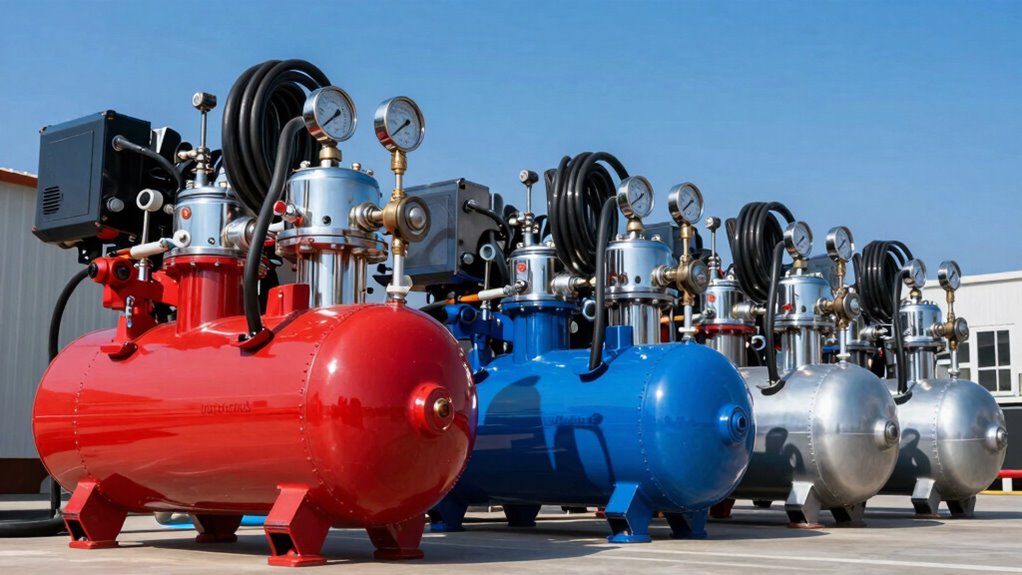

When I compare twin stack air compressors for high PSI, I look beyond the maximum-pressure number: airflow at working pressure determines whether a tool can keep running, while portability and upkeep shape day-to-day use. The Ingersoll Rand P1IU-A9 leads on listed maximum pressure at 135 PSI and offers two couplers, the Iron Horse IHTS104L-AK stands out for its 5.1 CFM at 90 PSI and included hose kit, and the Rolair FC2002 is a straightforward 2 HP option with a cast-iron cylinder.

Get business pricing on garage and car supplies
- Business-only prices and quantity discounts
- Tax-exempt purchasing
- Multiple users, one account, clear invoices
The tradeoff is clear: maximum PSI is not the same as sustained tool output. The Iron Horse supplies the most stated airflow at 90 PSI, while Ingersoll Rand reaches the highest stated tank pressure but is the heaviest. Rolair has a lower 90 PSI maximum, so it suits buyers whose tools do not need pressure above that point. I rank these models by how usefully their pressure, airflow, and practical ownership details line up.
Complete the kit


Key Takeaways
- Iron Horse is the airflow pick: its stated 5.1 CFM at 90 PSI exceeds the Rolair‘s 4.1 CFM and Ingersoll Rand’s 3.2 CFM at the same pressure.
- Ingersoll Rand has the highest stated maximum pressure: 135 PSI, plus two quick-connect couplers, but it weighs 77 pounds.
- Rolair tops out at 90 PSI: a limitation for tools needing more pressure, though its 4.3-gallon tank and 4.1 CFM suit many portable tasks.
- All three require some lifting: listed weights range from 62 to 77 pounds, so twin-stack portability does not mean easy one-handed carrying.
- Oil upkeep separates these picks from oil-free models: Iron Horse and Ingersoll Rand are oil-lubricated, while Rolair uses splash lubrication; check each manual for service requirements.
| Iron Horse IHTS104L-AK 4-Gallon Twin Stack Portable Air Compressor, 125 PSI |  | Best Overall for Airflow and Included Accessories | Tank capacity: 4 gallons | Maximum pressure: 125 PSI | Airflow: 5.1 CFM at 90 PSI | VIEW ON AMAZON | See Our Full Breakdown |
| Ingersoll Rand 2 HP Portable Twin-Stack Air Compressor |  | Best for Maximum Pressure and Two-Tool Connections | Model: P1IU-A9 | Tank capacity: 4 gallons | Maximum pressure: 135 PSI | VIEW ON AMAZON | See Our Full Breakdown |
| Rolair FC2002 2 HP Twin Stack Air Compressor |  | Best for Straightforward 90-PSI Tool Work | Tank capacity: 4.3 gallons | Maximum pressure: 90 PSI | Airflow: 4.1 CFM at 90 PSI | VIEW ON AMAZON | See Our Full Breakdown |
| twin stack air compressor high psi | Tank capacity | Maximum pressure | Airflow | Weight |
|---|---|---|---|---|
| Iron Horse IHTS104L-AK 4-Gallo | 4 gallons | 125 PSI | 5.1 CFM at 90 PSI | 65 pounds |
| Ingersoll Rand 2 HP Portable T | 4 gallons | 135 PSI | 3.2 CFM at 90 PSI; 4.3 CFM maximum | 77 pounds |
| Rolair FC2002 2 HP Twin Stack | 4.3 gallons | 90 PSI | 4.1 CFM at 90 PSI | 62 pounds |
More Details on Our Top Picks
Iron Horse IHTS104L-AK 4-Gallon Twin Stack Portable Air Compressor, 125 PSI
I rank the Iron Horse IHTS104L-AK first because its stated 5.1 CFM at 90 PSI is the strongest working-pressure airflow figure in this group. That can matter more to a tool user than a headline maximum PSI: when an air tool draws steadily, more available airflow can help the compressor keep pace. Its 125 PSI maximum also gives it more pressure headroom than the Rolair FC2002, whose stated maximum is 90 PSI, though less than the Ingersoll Rand’s 135 PSI.
The package is also unusually ready to set up: a 25-foot hose and 20-piece accessory kit are included, alongside a regulator, gauge, and quick coupler. That makes it a practical pick for a buyer who wants one compressor for varied household or workshop jobs rather than sourcing basic accessories separately. At 65 pounds, it is a little heavier than the Rolair’s 62 pounds but well below the Ingersoll Rand’s 77-pound listed weight. Its stated 65 dB noise level is lower than the 79–80 dBA figures supplied for the other two, though measurement methods may differ.
The tradeoff is oil-lubricated maintenance: the cast-iron cylinder and oil lubrication are appealing for a buyer comfortable following service instructions, but they add upkeep compared with an oil-free design. Also, the 125 PSI rating is not the highest here. I would choose Ingersoll Rand instead if maximum pressure and two couplers matter more; I would skip Iron Horse if avoiding oil service is a firm requirement or if the compressor must be carried frequently up stairs.
Pros:- Highest stated airflow here: 5.1 CFM at 90 PSI
- 125 PSI maximum exceeds the Rolair’s stated 90 PSI ceiling
- Includes a 25-foot hose and 20-piece accessory kit
- Listed at 65 dB, below the other models’ stated noise figures
Cons:- Oil lubrication requires routine maintenance
- At 65 pounds, it is not light for frequent lifting
- Its 125 PSI maximum is below Ingersoll Rand’s 135 PSI
Best for: Buyers who want the strongest stated airflow at 90 PSI in this comparison, plus a hose and accessory kit for general portable tool use.
Not ideal for: People who want oil-free ownership, the highest maximum PSI, or a compressor light enough for frequent carrying.
- Tank capacity:4 gallons
- Maximum pressure:125 PSI
- Airflow:5.1 CFM at 90 PSI
- Motor:1 HP, 115 volts
- Lubrication:Oil-lubricated
- Weight:65 pounds
- Noise level:65 dB
- Included accessories:25-foot hose and 20-piece accessory kit
Our verdict“I would choose Iron Horse for the best balance of stated 90-PSI airflow, useful pressure headroom, and ready-to-use accessories.”
Ingersoll Rand 2 HP Portable Twin-Stack Air Compressor
If the phrase high PSI is the main priority, the Ingersoll Rand P1IU-A9 has the clearest advantage: its stated 135 PSI maximum is the highest in this lineup. It also provides two quick-disconnect couplers, which can make it easier to leave two air lines connected rather than repeatedly swapping a single connection. Compared with the Iron Horse, it offers 10 PSI more maximum pressure and dual couplers, but its stated 3.2 CFM at 90 PSI is substantially lower than Iron Horse’s 5.1 CFM.
That distinction matters when choosing tools. Buyers should confirm both the tool’s pressure needs and its airflow demand; the compressor’s 4.3 CFM maximum airflow is not the same as its 3.2 CFM figure at 90 PSI. The four-gallon tank keeps it in the compact twin-stack class, and the cast-iron cylinder is a durable construction detail. Still, at 77 pounds, it is the heaviest of these three. Its 79–80 dBA listed noise level is also closer to Rolair’s 79 dB than Iron Horse’s stated 65 dB.
This pick makes most sense when a buyer values higher maximum pressure, two connections, and the stated pump warranty terms: one year for the full package and two years on the pump with the specified Ingersoll Rand lubricant. It remains an oil-lubricated machine, so regular oil changes are part of ownership. I would pass if carrying weight or higher airflow at 90 PSI matters more than the extra pressure headroom; Iron Horse is the stronger airflow choice and lighter, while Rolair is slightly lighter still.
Pros:- Highest stated maximum pressure in this group at 135 PSI
- Two quick-disconnect couplers support two connected air lines
- Cast-iron cylinder and 2 HP motor
- Pump warranty is listed as two years with the specified lubricant
Cons:- Heaviest model here at 77 pounds
- Stated 3.2 CFM at 90 PSI is below both competitors
- Oil changes are required, and listed noise is 79–80 dBA
Best for: Buyers whose tools benefit from pressure headroom up to 135 PSI and who want two quick-connect couplers available.
Not ideal for: People who prioritize the highest stated airflow at 90 PSI, lower weight, or minimal lubrication maintenance.
- Model:P1IU-A9
- Tank capacity:4 gallons
- Maximum pressure:135 PSI
- Airflow:3.2 CFM at 90 PSI; 4.3 CFM maximum
- Power:2 HP, 115 volts
- Couplers:Two quick disconnect couplers
- Weight:77 pounds
- Noise level:79–80 dBA
- Warranty:1 year full package; 2 years on pump with specified lubricant
Our verdict“I recommend Ingersoll Rand when 135 PSI and dual couplers outweigh its greater weight and lower stated airflow at 90 PSI.”
Rolair FC2002 2 HP Twin Stack Air Compressor
The Rolair FC2002 is the most focused choice in this group: a 2 HP, 4.3-gallon twin-stack compressor with 4.1 CFM at 90 PSI and a stated maximum pressure of 90 PSI. That ceiling places it behind Iron Horse and Ingersoll Rand for high-pressure applications, so I would not rank it first for a buyer specifically seeking extra PSI headroom. But for tasks built around tools operating at or below 90 PSI, the airflow figure is stronger than Ingersoll Rand’s stated 3.2 CFM at that pressure.
Its cast-iron cylinder, splash lubrication, overload protection, and manual reset point to a practical work setup rather than an accessory-rich package. The described uses include air brushing, drilling, nailing, and spraying, though the right choice still depends on the tool’s own pressure and CFM requirements. At 62 pounds, Rolair is the lightest of the three by a small margin; it is only three pounds lighter than Iron Horse, so neither should be mistaken for an effortless carry. The listed 79 dB noise level is also much higher than Iron Horse’s 65 dB figure.
Rolair is a better fit than Ingersoll Rand when the buyer wants a 2 HP motor and higher stated 90-PSI airflow without paying for a 135 PSI maximum that may go unused. It is not the right match for jobs that call for more than 90 PSI, and the supplied information does not list accessories comparable to Iron Horse’s included hose and kit. Check the manual for lubrication care before buying; splash lubrication does not mean maintenance-free operation.
Pros:- 4.1 CFM at 90 PSI, above Ingersoll Rand’s stated figure at that pressure
- 4.3-gallon tank and 2 HP motor
- Cast-iron cylinder with overload protection and manual reset
- Lightest listed weight in this comparison at 62 pounds
Cons:- Maximum pressure is limited to 90 PSI
- Listed noise level is 79 dB
- No comparable hose or accessory kit is specified
Best for: Buyers using portable tools rated for 90 PSI or less who value 4.1 CFM at 90 PSI and a cast-iron pump design.
Not ideal for: Anyone needing more than 90 PSI, lower operating noise, or an included hose-and-accessory package.
- Tank capacity:4.3 gallons
- Maximum pressure:90 PSI
- Airflow:4.1 CFM at 90 PSI
- Motor:2 HP, 115 volts AC
- Lubrication:Splash
- Cylinder:Cast iron
- Weight:62 pounds
- Noise level:79 dB
Our verdict“I would pick Rolair for 90-PSI tool work where its airflow and protection features matter more than high-pressure headroom.”

How We Picked
I ranked these compressors around the actual meaning of high PSI in a twin-stack format: maximum pressure, usable airflow at a stated working pressure, and whether the tank and controls make sense for portable tool use. A high maximum-pressure figure can help where a tool or task calls for higher pressure, but it does not by itself tell me how long the compressor can sustain that tool. That is why I compare the available CFM figures at 90 PSI separately from each machine’s maximum PSI.
I also weighed ownership tradeoffs rather than treating portability as a label. Weight, noise, lubrication, motor protection, couplers, and supplied accessories affect setup and ongoing use. The supplied descriptions do not give every model the same set of measurements, so I avoid filling gaps with assumptions. My ranking favors clear strengths for distinct buyer needs: airflow and included gear first, pressure headroom and dual connections next, and a rugged but 90-PSI-limited workhorse for buyers whose tools fit that range.
| twin stack air compressor high psi | Lubrication |
|---|---|
| Iron Horse IHTS104L-AK 4-Gallo | Oil-lubricated |
| Ingersoll Rand 2 HP Portable T | — |
| Rolair FC2002 2 HP Twin Stack | Splash |
Factors to Consider When Choosing Twin Stack Air Compressor High Psi
I would choose a twin-stack compressor by matching tool requirements to pressure and airflow, then checking whether the weight, noise, and service routine suit the workspace. These three models have similar tank sizes, but they do not offer the same pressure ceiling or airflow at 90 PSI.
Maximum PSI and working pressure
Maximum PSI describes the upper pressure the compressor is specified to reach; it does not tell me how much air it can continuously supply to a tool. Here, Ingersoll Rand lists 135 PSI, Iron Horse lists 125 PSI, and Rolair lists 90 PSI. If a tool’s required operating pressure exceeds the Rolair’s ceiling, it is an unsuitable match. For tools operating around 90 PSI, the airflow rating at that pressure is often the more useful comparison. I would check each tool’s manual rather than selecting on maximum PSI alone.
Compare CFM at the pressure your tool uses
Airflow, shown as CFM, helps indicate how much air a compressor can deliver at a stated pressure. The listed 90-PSI figures are 5.1 CFM for Iron Horse, 4.1 CFM for Rolair, and 3.2 CFM for Ingersoll Rand. That makes Iron Horse the lead pick for stated airflow at this common working pressure, while Rolair sits between the other two. Do not treat Ingersoll Rand’s 4.3 CFM maximum as equivalent to 4.3 CFM at 90 PSI: its description separately states 3.2 CFM at 90 PSI. For tools with high air demand or continuous use, compare the tool’s consumption with the compressor’s stated delivery.
Tank size and twin-stack portability
Tank capacity affects stored air and how often the motor may need to run during intermittent tasks, but it cannot replace adequate ongoing airflow. These tanks range from 4 to 4.3 gallons, a narrow spread that does not erase the larger differences in CFM. All three use a portable twin-stack format, yet their listed weights run from 62 pounds for Rolair to 77 pounds for Ingersoll Rand. If the unit will move between floors or job sites, think about how it will be loaded, carried, and stored; a compact shape is not the same as a light load.
Noise and workspace fit
The supplied noise figures range from 65 dB for Iron Horse to 79–80 dBA for the other models. Those numbers suggest Iron Horse may be the more appealing option for noise-sensitive settings, but published measurements can use different methods, so I would avoid treating them as perfectly direct comparisons. A garage, enclosed shop, or work area near other people makes noise more consequential. Placement, ventilation, hearing protection, and the time of day can matter as much as a single specification.
Lubrication and maintenance
Iron Horse and Ingersoll Rand are explicitly described as oil-lubricated, and both call for regular care; the Ingersoll Rand description specifically mentions oil changes. Rolair uses splash lubrication, but buyers should still consult its manual for service needs rather than assuming it requires no upkeep. Oil-lubricated designs may suit owners comfortable checking and changing oil on schedule. If low-maintenance ownership is the priority, compare these against oil-free compressors, while checking that an alternative still meets the tool’s PSI and CFM demands.
Accessories, connections, and protection
Included gear can affect how quickly a compressor is ready for use. Iron Horse clearly includes a 25-foot hose and 20-piece accessory kit, as well as a regulator, gauge, and quick coupler. Ingersoll Rand supplies two quick-disconnect couplers, a useful distinction if two lines need to stay connected. Rolair lists overload protection and a manual reset, which are practical electrical protection features. Compare what is in the box with the connections your tools use, since extra adapters or hose purchases may be needed when they do not match.
Frequently Asked Questions
Which of these twin-stack compressors has the highest maximum PSI?
The Ingersoll Rand P1IU-A9 has the highest listed maximum at 135 PSI. Iron Horse is rated to 125 PSI, while Rolair is listed at 90 PSI. That ranking only answers the maximum-pressure question; I would also compare airflow at the pressure your tool uses before choosing.
Which model has the most airflow at 90 PSI?
The Iron Horse IHTS104L-AK leads on the supplied figures with 5.1 CFM at 90 PSI. Rolair lists 4.1 CFM at 90 PSI, and Ingersoll Rand lists 3.2 CFM at 90 PSI. Match that figure against the air consumption of your tool, especially if it runs continuously rather than in short bursts.
Is a higher maximum PSI always better for air tools?
No. A compressor’s maximum PSI indicates its stated pressure ceiling, but a tool also needs a particular operating pressure and enough airflow to keep working. A higher maximum can be useful for tools or tasks that need more pressure, but it does not automatically mean more sustained air at 90 PSI. I would check the tool’s specifications and compare its requirements with the compressor’s CFM at the relevant pressure.
Which option is easiest to move?
Rolair is the lightest by the listed specifications at 62 pounds, followed by Iron Horse at 65 pounds and Ingersoll Rand at 77 pounds. The difference between the first two is modest, and all three remain substantial loads to lift regularly. I would plan around handles, vehicle access, stairs, and storage location rather than relying on the twin-stack design alone to make transport easy.
Which one should I choose for a quieter workspace?
Iron Horse has the lowest supplied noise figure at 65 dB, compared with Rolair at 79 dB and Ingersoll Rand at 79–80 dBA. Those specifications point to Iron Horse as the noise-conscious pick, although measurement methods may vary and the numbers are not necessarily directly comparable. If sound is a major concern, check the manufacturer’s measurement details and plan for hearing protection where appropriate.
Conclusion
For most buyers comparing twin stack air compressors with high PSI, I would start with the Iron Horse: it combines 125 PSI maximum pressure with the strongest stated airflow at 90 PSI and includes a hose and accessory kit. Pick the Ingersoll Rand if 135 PSI and two couplers matter more than weight or airflow at 90 PSI. Choose the Rolair for tools rated to work at or below 90 PSI when its 4.1 CFM figure and overload protection suit the job. Before ordering, confirm tool pressure and CFM needs, then weigh those against the machine’s carrying weight, noise, and lubrication routine.
Halloween Picks
halloween
As an affiliate, we earn on qualifying purchases.