
TL;DR

Get business pricing on garage and car supplies
- Business-only prices and quantity discounts
- Tax-exempt purchasing
- Multiple users, one account, clear invoices
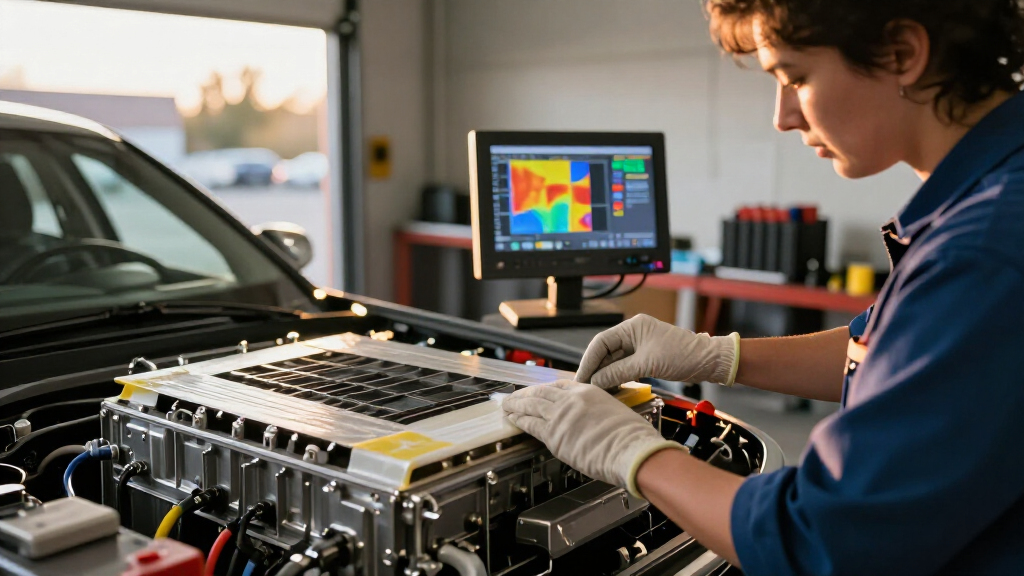
A report by Avery Dennison employees describes a three-part pressure-sensitive adhesive tape strategy for battery-pack thermal management and thermal-runaway mitigation. It covers heat transfer with electrical insulation, barriers between cells, and management of vented gases and flames; the supplied material does not include independent test results or the report’s full venting details.
A report published by Charged EVs and authored by Max VanRaaphorst and Avery Dennison sets out a three-part strategy using pressure-sensitive adhesive (PSA) tapes to address battery-pack heat transfer, cell-to-cell isolation and vent management. The company-authored report describes potential engineering uses rather than independently verified evidence that the approach prevents thermal runaway in production vehicles.
The report frames the proposal around three challenges: moving heat from cells to cooling components while maintaining electrical insulation; slowing heat transfer from a failing cell to nearby cells; and managing the hot gases, flames and particles released when a cell vents. It says denser packs and faster charging make thermal management a more demanding design task, while leaving little space for thick barriers or air gaps.
For cooling and electrical isolation, the authors describe Avery Dennison’s Volt Tough tape line, which uses a dielectric film carrier and acrylic adhesive to bond components such as cells, modules and cooling hardware. They compare an 85-micrometre dielectric PSA tape with a 250-micrometre thermosetting dielectric powder coating. Under the report’s assumption of comparable thermal conductivity, they calculate that the thinner tape reduces conductive thermal resistance by about 66% and could transfer heat nearly three times faster. Those figures are the report’s stated comparison, not independent test findings presented in the supplied material.
For barriers, the report proposes laminating insulating materials such as mica, aerogel or ceramic paper with low-thermal-conductivity PSA tape. It says the resulting structures can pair insulation with mechanical support, and describes adhesives designed to tolerate temperatures approaching 500°C for short durations. The authors also point to low-release liners as a way to handle fragile substrates on automated assembly lines. A third part of the strategy uses anisotropic venting tapes to manage gases and flames, but the provided report excerpt ends before explaining how those products work or giving performance data.
Tape’s Role in Battery-Pack Safety
The proposal matters because battery designers must balance cooling, electrical isolation and fire protection within compact packs that are also built for manufacturability. Thin materials that can be cut to a pack’s geometry and applied by hand or automation may give engineers another option when space is limited. The report describes PSA tapes as lightweight and customizable, with potential uses in bonding, sealing, insulation and wire management as well as thermal management.
However, the claimed benefits should be read as a materials strategy, not as proof of a safety outcome. The supplied source does not provide independent evaluations, comparative test protocols, pack-level demonstrations or evidence that a tape system can stop a runaway event. Its practical value will depend on product performance under relevant operating and failure conditions, as well as integration with a battery’s cooling, electrical and venting systems.
pressure sensitive adhesive tape for battery cooling
As an affiliate, we earn on qualifying purchases.
As an affiliate, we earn on qualifying purchases.
Why Battery Packs Need Layered Controls
The report says electrification is increasing demand for high-performance batteries and that higher energy density and faster charging intensify thermal-management challenges. In a densely packed battery, heat must move efficiently toward components such as cold plates or cooling fins, while live electrical components remain isolated. The authors note that increasing thermal conductivity and maintaining dielectric strength can impose competing material requirements.
The report also describes the difficulty of placing barriers between cells without consuming scarce pack space. It identifies mica as an effective insulating material but says it can be fragile and hard to integrate into automated assembly. PSA tapes, which bond when applied rather than requiring a separate curing step, are presented as a way to attach or reinforce thin materials and fit them to pack designs. This is the report’s proposed manufacturing advantage; no production adoption figures are supplied.
“A three-part strategy for prevention and mitigation”
— Max VanRaaphorst and Avery Dennison, report authors
Evidence and Venting Details Missing
The supplied source is an excerpt from a report authored by employees of Avery Dennison, a tape manufacturer, and does not include independent validation or detailed test methods. It is not clear whether the thermal-resistance comparison accounts for differences in complete pack assemblies, how the products perform across long-term cycling, or how results vary with cell chemistry and pack design. The report’s claim that heat could transfer nearly three times faster is conditional on comparable thermal conductivity.
The source material also cuts off during its description of anisotropic venting tapes. It does not explain the direction or rate of vent flow, how flames or particulates are contained, or whether pressure relief was tested at cell or pack scale. No specific vehicle, battery maker, deployment, certification, or adoption decision is identified.
Further Testing Would Clarify Performance
The next useful evidence would include the full venting-tape discussion and test data showing performance in representative battery assemblies. Comparisons should state their test conditions and baselines, including electrical breakdown, heat transfer, exposure to flame and hot gases, durability, and assembly-line handling. The supplied material does not announce a testing schedule, product launch, vehicle application or regulatory action, so no such milestone can be confirmed.
For now, the report presents PSA tapes as one possible component in a layered battery-safety design. Whether the approach is adopted will depend on engineering validation and on how it performs alongside a pack’s cooling, monitoring, isolation and pressure-relief systems.
Key Questions
What does the report propose?
It describes using pressure-sensitive adhesive tapes to support heat transfer with electrical insulation, create barriers around insulating materials, and manage gases and flames during cell failure.
What is the report’s thermal-resistance comparison?
The authors compare an 85-micrometre dielectric PSA tape with a 250-micrometre thermosetting powder coating. Assuming comparable thermal conductivity, they calculate about a 66% reduction in conductive thermal resistance. The supplied material does not provide independent test results.
Does the report show that PSA tape prevents thermal runaway?
No. It outlines a proposed materials strategy for mitigation and thermal management. The supplied excerpt does not establish that the approach prevents runaway or stops it from spreading in a production battery pack.
How are vented gases and flames addressed?
The report names anisotropic venting tapes as a possible tool, but the excerpt ends before explaining their operation or providing supporting performance data.
Source: rss
Fall Picks
fall essentials
As an affiliate, we earn on qualifying purchases.