TL;DR

Get business pricing on garage and car supplies
- Business-only prices and quantity discounts
- Tax-exempt purchasing
- Multiple users, one account, clear invoices
JEHC and trailer manufacturer Valew have developed a heavily reinforced race-car trailer designed for Baja conditions. Its axle ends accept mid-2000s Chevy and GMC 3500 front wheel bearings and brake assemblies, which the designer says could make repairs easier in the region. Price, production timing and the trailer’s weight have not been announced.
Race-car designer JEHC and truck-body manufacturer Valew have developed a reinforced trailer for hauling trophy trucks over rough Baja roads, with axle ends designed to accept mid-2000s Chevy and GMC 3500 front wheel bearings and brake assemblies. JEHC’s Jason Heard says using those widely available truck parts could reduce repair delays in the region, though the companies have not announced a price or production schedule.
The trailer is about 24 feet long and 96 inches wide, and its deck is designed around race vehicles with wheelbases of roughly 120 to 128 inches. The layout targets vehicles such as Class 6100 and Class 1 race trucks. According to The Drive’s report, the low deck can let trophy trucks drive aboard without ramps, although ramps are stored at the rear.
JEHC’s chassis drawings show 2-by-6-inch main frame rails with 3/16-inch walls, alongside thinner supporting sections. Heard said the design routes a race car’s tire loads onto structural ribs rather than leaving tire contact patches unsupported by the main structure. The trailer uses two 8,000-pound axles; a three-axle version is being considered, not confirmed as a production option.
Storage is built into the layout: three aluminum boxes on each side, a forward compartment for the electric-over-hydraulic brake equipment, and space between the frame rails for as many as five 42-inch tires. Heard says the aluminum boxes save 800 pounds compared with the first version. The Drive reported that the trailer’s total weight was not known.
Repairs Built Around Local Parts
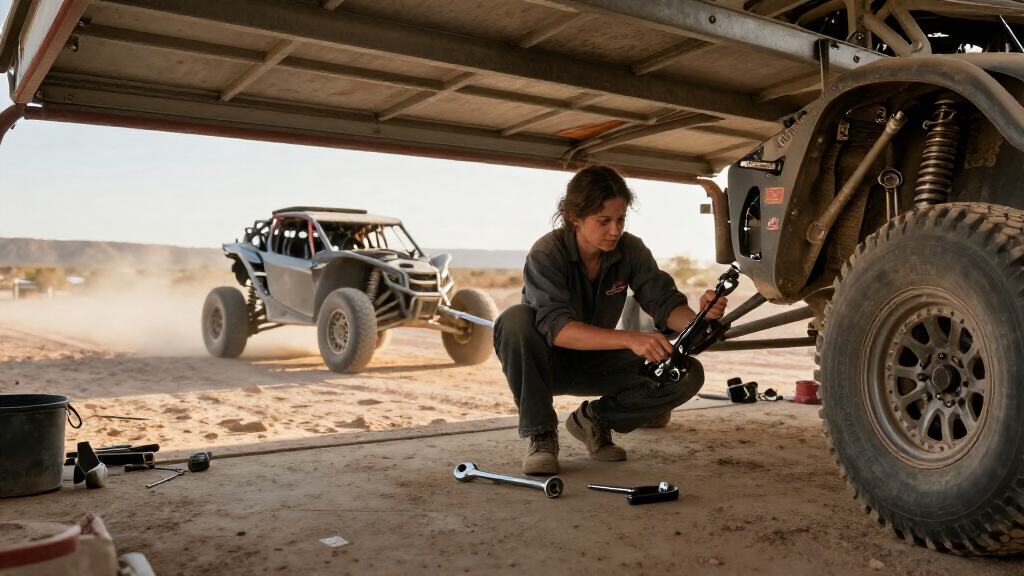
The design’s serviceability addresses a practical risk for teams hauling race vehicles through remote areas: a damaged hub or brake component can mean downtime if replacement parts are difficult to find. JEHC says the trailer’s axle housing ends accept front wheel bearings and brake assemblies from mid-2000s Chevrolet and GMC 3500 trucks, models the designer says are common around Ensenada.
That compatibility is a design choice, not a guarantee that every repair will be available or straightforward. But drawing on common truck components may give teams more options than relying on uncommon trailer-specific parts while traveling in Baja. The trailer also combines this repair approach with a low deck, substantial storage and a frame laid out for race-car loads.
As an affiliate, we earn on qualifying purchases.
A Trailer Designed for Baja
JEHC typically designs race cars, but Jason Heard set out to create a hauler suited to his requirements. The company partnered with Valew, which The Drive describes as a truck-body manufacturer with the capacity to build the design at scale. The published details come from a report featuring a JEHC and Valew fabrication breakdown and chassis drawings.
The trailer’s suspension uses a Timbren assembly rather than leaf springs or torsion bars. Heard said the prototype has handled rough Baja roads well. It does not currently have shocks, although the assembly can be fitted with them. The Drive noted that steel makes up much of the trailer, while aluminum storage boxes reduce weight relative to an earlier iteration.
“At no point in time, if you have a race car on this trailer, is the contact patch of the tire ever floating between sheet metal.”
— Jason Heard of JEHC, as quoted in The Drive
Price and Production Remain Open
The available report does not state what the trailer will cost, when it may go on sale, or how many units JEHC and Valew plan to build. It also does not give a confirmed overall weight. Heard’s comments about a possible tri-axle version describe an option under consideration, not a finalized specification.
The report relays the designer’s account of the prototype’s performance on rough roads, but provides no independent test data, operating history or durability figures. The stated compatibility with Chevy and GMC 3500 components also does not establish that replacement parts will be stocked or accessible at every location along a route.
Commercial Details Still Ahead
The next useful update would be a production announcement from JEHC and Valew with pricing, availability, final specifications and weight. Those details would help race teams judge the trailer’s fit for their vehicles and towing equipment. Further information could also clarify whether the companies will offer the proposed tri-axle configuration and whether shocks will be included or offered as an option.
Until those details are released, the trailer remains a documented design and prototype rather than a product with confirmed delivery dates. Its real-world repairability and durability over repeated Baja trips have not been established in the published material.
Key Questions
Who designed and built the trailer?
JEHC developed the design with Valew, a truck-body manufacturer. JEHC’s Jason Heard is the designer quoted in The Drive’s report.
What makes repairs easier in Baja?
The axle housing ends are designed to accept front wheel bearings and brake assemblies from mid-2000s Chevy and GMC 3500 trucks. JEHC says those vehicles are common around Ensenada, potentially making replacement parts easier to source.
What race vehicles is the trailer designed to carry?
The deck is designed for vehicles with wheelbases of about 120 to 128 inches, including Class 6100 and Class 1 race trucks, according to the report.
How much does the trailer cost, and when will it be available?
No price or production date has been announced in the source report. The number of units planned and final commercial specifications are also not stated.
Is the trailer’s weight known?
No confirmed overall weight is provided. The Drive reports that the aluminum boxes save 800 pounds compared with the first iteration, but that figure is not the trailer’s total weight.
Source: rss
Fall Picks
fall essentials
As an affiliate, we earn on qualifying purchases.