TL;DR
Dominic Chinea’s effort to adapt a 1917 Liberty V12 aircraft engine for an Edwardian-style race car has run into cracking in its aged cast-aluminum block. After difficult welding attempts, he asked viewers for help, and commenters with experience in vintage machinery and fabrication offered suggestions. The repair is ongoing; the source report does not say whether the engine has been successfully reassembled.
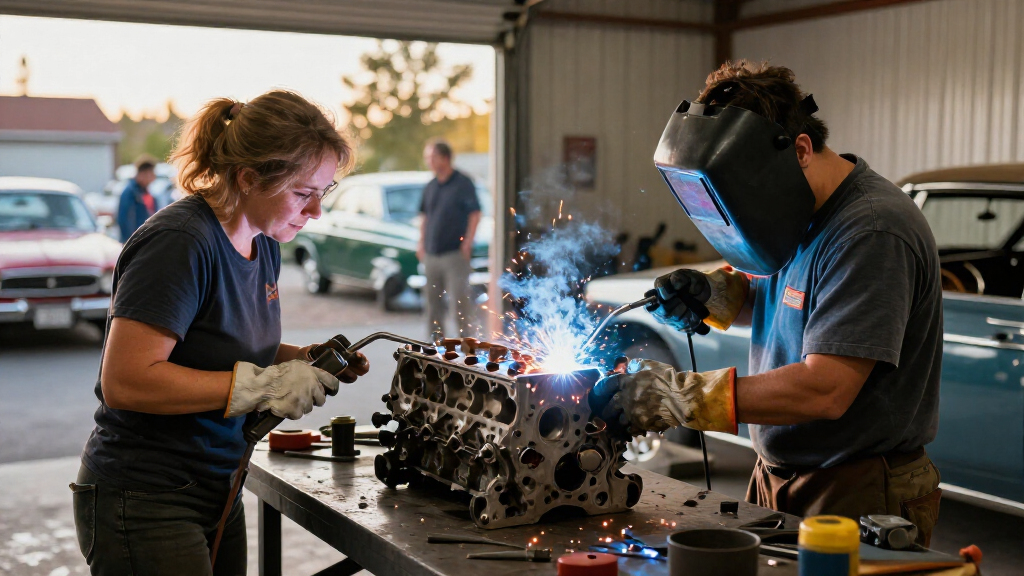
Dominic Chinea’s effort to convert a 1917 Liberty V12 aircraft engine into a V8 for an Edwardian-style race car has prompted welding advice from people around the world after the engine block cracked during repair. The project, documented on Chinea’s YouTube channel, involves joining the engine’s cast-aluminum upper block after cutting it to fit a 1912 Rochet-Schneider chassis.

Get business pricing on garage and car supplies
- Business-only prices and quantity discounts
- Tax-exempt purchasing
- Multiple users, one account, clear invoices
The car is being built to resemble the aero-engined racing specials popular in Britain during the Edwardian era. According to The Drive’s report, Chinea hopes to make it eligible for vintage racing, specifically the Goodwood Members’ Meeting, and is using period-correct components and techniques. The Liberty V12 was originally built for aircraft and is too long for the chassis, leading Chinea to shorten it and reconfigure it as a V8.
The engine block is made from cast aluminum produced to 1910s-era standards. In the video, Chinea concentrates on rejoining the upper section, which contains the cylinders. The metal’s impurities bubbled up during welding and contaminated the welds, resulting in cracks. After trying to work on both the inside and outside of the block, he encountered further cracking and ran out of welding gas.
Chinea then asked viewers for suggestions. The Drive reports that commenters included a Swiss welder experienced with 1920s Bugattis and Bentleys, a former locomotive engineer, and an ex-fabricator who had worked on hydraulic rams. Their suggestions included addressing aluminum oxide, drilling small holes to limit crack propagation, and building up the joint through smaller tack-style welds. The report does not establish whether Chinea has adopted those recommendations or completed the repair.
Advice for a Century-Old Engine
The exchange shows how online communities can provide specialist knowledge for a repair that may lack a surviving manual or readily available firsthand expertise. The suggestions came from people with different backgrounds in vintage cars, rail engineering and fabrication, offering Chinea possible approaches to a problem that defeated his initial welding attempts.
The stakes are practical as well as historical: the engine must be adapted to fit the chassis while remaining suitable for the project’s intended period-style racing use. But advice in a comment thread is not proof that a repair will work. The block’s condition, the strength of any weld and the safety of the finished engine remain matters for the project itself to establish.
Products Worth Considering

Chemical Guys TORQX Random Orbital Polisher Kit, 9-Piece

Autel MaxiCharger AC Home Level 2 EV Charger, 50A, J1772, Wi-Fi, Hardwired, 25 ft

Chemical Guys 10-Piece Car Wash Kit with Foam Gun
As an affiliate, we earn on qualifying purchases.
From Liberty V12 to V8
After World War I, aircraft engines attracted racing enthusiasts because they could provide substantial power for their weight. The Liberty engine was mass-produced for wartime use, and surplus engines became available afterward, according to The Drive. Chinea’s project pairs one of those engines with a 1912 Rochet-Schneider chassis.
The Liberty engine’s construction adds to the challenge. Its block has two large sections: an upper part containing the cylinders and a lower part containing the crankcase and sump. The video segment described in The Drive’s report addresses the upper part rather than a completed rebuild of the full engine. Chinea’s work combines a historical engine and chassis with a substantial alteration, making the fit and repair central to the car’s planned use.
“There’s no instruction manual for repairing century-old hardware”
— The Drive, describing the repair challenge
Repair Results Are Still Unknown
The available report describes failed welds, viewer advice and Chinea’s attempt to work through the problem; it does not say whether the block has since been successfully joined. It is also unclear which, if any, of the comments he will follow, whether the suggested methods will stop further cracking, or how the finished repair will perform.
The reported target is eligibility for the Goodwood Members’ Meeting, but no completion date or confirmation of entry is provided. The source also focuses on the upper block, so the current status of the lower engine section and the wider car build is not established.
Further Welding and Project Updates
The next reported milestone is whether Chinea can use the advice to complete a sound repair to the upper block, then continue adapting and assembling the engine for the car. Viewers can follow the work through his YouTube channel, where the project is documented.
No schedule for the next repair attempt, engine testing or completion of the car is given in the source report. Until Chinea provides a further update, the outcome of the welding and the car’s eventual participation in vintage racing remain unconfirmed.
Key Questions
Who is working on the Liberty engine?
Dominic Chinea, a former set designer and cast member of the BBC program The Repair Shop, is documenting the project on his YouTube channel.
Why is he changing the Liberty V12 into a V8?
The 1917 Liberty V12 is too long for the 1912 Rochet-Schneider chassis. Chinea is shortening and reconfiguring it for an Edwardian-style race car.
What caused problems with the welding?
The block is aged cast aluminum, and impurities bubbled up during welding, contaminating the welds and contributing to cracks. A commenter suggested excess aluminum oxide as a possible issue, but the report does not confirm that diagnosis.
Has the engine been repaired?
The available report does not confirm a completed repair. It describes welding failures and advice from viewers, but gives no later result.
What racing event is the car intended for?
Chinea is building the car with the Goodwood Members’ Meeting as a specific vintage-racing target. The source does not confirm that the car has been entered or will take part.
Source: thedrive.com