Finding the best mini car polishers means balancing portability with enough power to correct paint defects without risking damage. The SPTA Cordless Mini Car Polisher, 12V stands out as the best overall pick due to its reliable battery life and consistent orbital motion, making it ideal for enthusiasts who value mobility. For those prioritizing premium build quality, the Griot’s Garage G8 Mini Orbital Polisher offers superior ergonomics and durability, though at a higher cost. The main tradeoff in this category lies between the convenience of cordless freedom and the sustained power of corded units. Continue reading to see how these models compare in performance, ease of use, and value for your specific detailing tasks.

Get business pricing on garage and car supplies
- Business-only prices and quantity discounts
- Tax-exempt purchasing
- Multiple users, one account, clear invoices
Complete the kit


Key Takeaways
- Cordless models dominate the mini polisher market, but battery runtime varies widely between 15 and 45 minutes, directly impacting project scope.
- Dual-action (DA) mechanisms are safer for beginners and most paint types, while rotary options offer faster cutting but demand higher skill to avoid burning clear coat.
- Pad size flexibility is critical; models supporting both 2-inch and 3-inch pads provide better versatility than single-size units.
- Ergonomics often outweigh raw power in mini tools, as hand fatigue sets in quickly during prolonged use on door jambs and trim.
- Kit completeness matters; some bundles include multiple pads and compounds, while others require separate purchases that increase total cost.
| SPTA Cordless Mini Car Polisher, 12V |  | Best for Precise Spot Correction | Model: SP-DA1US | Power source: Battery powered | Power: 80 W | VIEW LATEST PRICE | See Our Full Breakdown |
| SPTA 12V Cordless Mini Car Polisher Kit |  | Best Accessory-Rich Starter Kit | Model: LD104SET2 | Power source: Battery powered | Battery capacity: 2 × 2000 mAh | VIEW LATEST PRICE | See Our Full Breakdown |
| ZOTA Mini Dual-Action Orbital Polisher, 2- and 3-Inch Pads |  | Best Corded Mini Polisher | Model: G83-B | Motor power: 380 watts | Orbital throw: 8 mm | VIEW LATEST PRICE | See Our Full Breakdown |
| GLEX Cordless Mini Car Polisher, 12V |  | Best for Cordless Versatility | Model: MY-3051 | Voltage: 12V | Motor: Brushless | VIEW LATEST PRICE | See Our Full Breakdown |
| SPTA 12V Cordless Mini Polisher Kit |  | Best for Attachment Variety | Model: LD104US | Power source: Battery powered | Voltage: 12V | VIEW LATEST PRICE | See Our Full Breakdown |
| Griot’s Garage G8 Mini Orbital Polisher |  | Best Corded Precision Pick | Brand: Griot’s Garage | Model: 10908 | Motor power: 700 watts | VIEW LATEST PRICE | See Our Full Breakdown |
| Howcow Cordless Mini Car Polisher, 3-in-1 Rotary and Dual Action, 8-Speed |  | Best for Mode Flexibility | Brand: Howcow | Model: H-Mi-PGJ | Modes: Rotary, 3 mm DA, and 5 mm DA | VIEW LATEST PRICE | See Our Full Breakdown |
| AUTIWOZ Cordless Mini Dual-Mode Car Polisher |  | Best Simple Cordless Dual-Mode Pick | Brand: AUTIWOZ | Model: W02PO62-K1 | Power source: Battery powered | VIEW LATEST PRICE | See Our Full Breakdown |
| AOBEN Mini Rotary Car Buffer and Polisher with 1–4 Inch Pads |  | Best Pad-Size Range | Brand: AOBEN | Model: AT3501-1-260717 | Polisher type: Rotary | VIEW LATEST PRICE | See Our Full Breakdown |
| DCA 12V Cordless Brushless Mini Polisher and Sander Kit |  | Best Multi-Task Tool | Brand: DCA | Model: ADSP75(EK-US01) | Power source and voltage: Battery powered, 12V | VIEW LATEST PRICE | See Our Full Breakdown |
| SPTA 12V Cordless Mini Polisher |  | Best for Simple Cordless Control | Model: LP105 | Voltage: 12V | Motor: Brushless | VIEW LATEST PRICE | See Our Full Breakdown |
| LDHTHOPI 73-Piece Cordless Mini Car Polisher Kit, 12V, 6-Speed |  | Best Complete Kit for Multiple Tasks | Power: 12V | Motor: Brushless | Polishing modes: Rotary and dual action | VIEW LATEST PRICE | See Our Full Breakdown |
| SPTA Mini Rotary Car Polisher with 27-Piece Pad Kit and M14 Extension Shafts |  | Best for Recessed and Hard-to-Reach Areas | Model number: ROMPS3ACUSA | Motor power: 750 W | Speed range: 1,000–5,500 RPM | VIEW LATEST PRICE | See Our Full Breakdown |
| RAYBAO 750W Mini Random Orbital Polisher with 2- and 3-Inch Pads |  | Best Corded Pick for Small and Medium Areas | Model: 9517 | Power: 750 W | Backing plate sizes: 2 in and 3 in | VIEW LATEST PRICE | See Our Full Breakdown |
| BATOCA S5 Cordless Mini Car Polisher with Rotary and Dual Action Modes |  | Best Dual-Mode Cordless Pick | Model: S5 | Power source: Cordless | Polishing modes: Rotary and 12 mm random orbital | VIEW LATEST PRICE | See Our Full Breakdown |
| mini car polisher | Model | Speed range | Speed settings |
|---|---|---|---|
| SPTA Cordless Mini Car Polishe | SP-DA1US | 1,000–5,000 OPM | — |
| SPTA 12V Cordless Mini Car Pol | LD104SET2 | — | — |
| ZOTA Mini Dual-Action Orbital | G83-B | — | — |
| GLEX Cordless Mini Car Polishe | MY-3051 | 2,000–5,000 RPM | 6 |
| SPTA 12V Cordless Mini Polishe | LD104US | 2,000–4,500 oscillations per minute | — |
| Griot’s Garage G8 Mini Orbital | 10908 | — | 6 |
| Howcow Cordless Mini Car Polis | H-Mi-PGJ | 2,500–6,000 RPM | 8 |
| AUTIWOZ Cordless Mini Dual-Mod | W02PO62-K1 | 2,000–5,500 RPM | 6 |
| AOBEN Mini Rotary Car Buffer a | AT3501-1-260717 | — | — |
| DCA 12V Cordless Brushless Min | ADSP75(EK-US01) | — | 0–2,800 RPM and 0–8,300 RPM |
| SPTA 12V Cordless Mini Polishe | LP105 | 2,000–5,800 oscillations per minute | 4 |
| LDHTHOPI 73-Piece Cordless Min | — | 1,000–5,600 RPM | 6 |
| SPTA Mini Rotary Car Polisher | — | 1,000–5,500 RPM | 6 |
| RAYBAO 750W Mini Random Orbita | 9517 | 2,000–5,500 OPM | 6 |
| BATOCA S5 Cordless Mini Car Po | S5 | 2,000–5,500 rpm | 6 |
More Details on Our Top Picks
SPTA Cordless Mini Car Polisher, 12V
The SPTA Cordless Mini Car Polisher is a focused choice for touching up emblems, body lines, and other spots where a full-size tool is awkward. Its 1-inch backing plate and cordless design prioritize access over coverage, while dual-action and rotary modes give buyers two approaches for different detail jobs. The variable 1,000–5,000 OPM range also starts slower than the SPTA LD104SET2’s 2,000 OPM minimum, which may suit careful work around delicate areas. The tradeoff is scale: this is not the pick for polishing a hood or door efficiently. Its stated maximum runtime is up to one hour at maximum speed, and the listed package includes the polisher rather than the broader pad-and-battery assortment supplied with the LD104US kit. I’d choose it for targeted correction, not as a one-tool solution for a whole car.
Pros:- Cordless operation makes it easier to reach tight spots away from an outlet
- One-inch backing plate is suited to small, intricate areas
- Dual-action and rotary modes offer different approaches to detail work
- Variable speed spans 1,000 to 5,000 OPM
Cons:- Small backing plate covers broad panels slowly
- Maximum runtime is stated as up to one hour at maximum speed
- Included components list only the polisher, so buyers may need to source pads and accessories separately
Best for: Detailers who need a compact cordless tool for isolated scratches, emblems, and narrow body lines
Not ideal for: Owners planning to polish large panels or wanting multiple batteries and a full accessory kit in the box
- Model:SP-DA1US
- Power source:Battery powered
- Power:80 W
- Backing plate:1 inch
- Speed range:1,000–5,000 OPM
- Maximum runtime:Up to 1 hour at maximum speed
- Included components:Polisher
Our verdict“Choose this SPTA for portable, precise spot work, but pick a larger-pad kit for regular polishing across full panels.”
SPTA 12V Cordless Mini Car Polisher Kit
The SPTA LD104SET2 makes sense for buyers who want a cordless detail tool and the basic range of attachments in one package. Its 75 mm, 50 mm, and 38 mm pads let you move between somewhat broader spots and tighter contours, while two rechargeable batteries reduce the need to stop when one runs down. That bundle is more immediately equipped than the single-polisher SPTA SP-DA1US, which has a smaller one-inch plate and a simpler listed package. Its 2,000–4,500 oscillations-per-minute range is aimed at small corrections, not fast coverage of large panels. The included compounds, extension shanks, protective covers, and polishing, sanding, and cleaning accessories add flexibility, but also mean a larger assortment to sort and store. I’d favor this kit for a new detailer building a small-area setup; buyers who already own pads may prefer a simpler tool.
Pros:- Two 2000 mAh batteries provide a spare for continued work
- Three pad sizes suit different small-area contours
- Includes compounds and accessories for polishing, sanding, and cleaning
- One-year warranty is specified
Cons:- Designed for small areas rather than efficient polishing of large panels
- Runtime and battery charging time are not specified
- The broad accessory assortment may be unnecessary for buyers who already have detailing supplies
Best for: New car-care hobbyists who want several pad sizes, two batteries, and task-specific accessories for small-area detailing
Not ideal for: Experienced detailers who already own compatible pads and compounds, or anyone seeking a tool for fast full-panel correction
- Model:LD104SET2
- Power source:Battery powered
- Battery capacity:2 × 2000 mAh
- Speed:2,000–4,500 oscillations per minute
- Polishing pad sizes:75 mm, 50 mm, and 38 mm
- Included components:Polisher, 2 batteries, charger, compounds, extension shanks, protective covers, backing plates, wrench, towel, and polishing pads
- Material:Aluminum and plastic
- Warranty:1 year
Our verdict“Pick the LD104SET2 if you want a ready-to-use cordless kit for small corrections and value having multiple pads and a spare battery.”
ZOTA Mini Dual-Action Orbital Polisher, 2- and 3-Inch Pads
Unlike the cordless SPTA and GLEX options in this group, the ZOTA G83-B plugs into a 110-volt AC supply. That means no stated battery-runtime limit to plan around, a useful advantage for extended work near an outlet. Its 380-watt motor, 8 mm random orbital throw, and speed range of 3,000–7,200 RPM give it a more substantial setup than the cordless spot-detail kits, while the included 2-inch and 3-inch plates cover more area than the one-inch SPTA SP-DA1US. It remains a mini polisher, though: small pads are still slow on large panels, and the cord restricts movement around a vehicle. At 3.7 pounds, it is relatively light for a corded tool, but buyers wanting cordless access to wheel arches or work away from outlets should favor the GLEX instead.
Pros:- Corded power avoids reliance on battery runtime
- Includes 2-inch and 3-inch backing plates for small surfaces and tighter areas
- 380-watt motor and variable 3,000–7,200 RPM speed range
- Listed weight of 3.7 pounds supports a compact setup
Cons:- Power cord limits freedom of movement compared with cordless models such as the GLEX
- Small backing plates cover large panels slowly
- Requires access to a 110-volt AC outlet
Best for: Detailers who work near a power outlet and want a compact orbital tool without relying on battery runtime
Not ideal for: Mobile users who need to work far from outlets or owners looking for efficient polishing across large vehicle panels
- Model:G83-B
- Motor power:380 watts
- Orbital throw:8 mm
- Speed:3,000–7,200 RPM
- Voltage:110 volts AC
- Amperage:3.1 A
- Weight:3.7 lbs
- Included components:Polisher, 2-inch and 3-inch backing plates, sponge pads, wool pad, microfiber finishing pad, wrench, carbon brushes, and microfiber towel
Our verdict“Choose the ZOTA if steady corded operation matters more to you than the mobility of a battery-powered mini polisher.”
GLEX Cordless Mini Car Polisher, 12V
The GLEX Cordless Mini Car Polisher is the most flexible cordless pick here for buyers who want one tool for different small detailing jobs. Its brushless motor, six speed settings, and dual-action orbital design pair with two 12V batteries and an assortment of sponge, wool, and polishing discs. Compared with the SPTA LD104SET2, the GLEX specifies six settings and a brushless motor, while the SPTA lists three pad sizes plus compounds and sanding and cleaning accessories. That makes the choice less about a clear winner and more about the kit’s focus: GLEX emphasizes interchangeable pads and use across surfaces such as wood, leather, and tile. The 2,000–5,000 RPM range is useful for varied tasks, but no runtime or charging time is given, and the 2.0Ah battery capacity may leave frequent users wanting more information before committing.
Pros:- Brushless motor paired with six speed settings
- Two 12V 2.0Ah batteries are included
- Dual-action orbital design uses interchangeable Velcro pads
- Includes varied polishing discs and a storage bag
Cons:- Runtime and charging time are not specified
- Battery capacity is 2.0Ah per battery
- The listed kit does not specify pad sizes, making it harder to compare coverage with the SPTA LD104SET2
Best for: Detailers who want a cordless mini polisher for vehicle touch-ups and occasional work on furniture, wood, or other listed surfaces
Not ideal for: Buyers who need published runtime and charging details, or a kit centered on compounds and multiple measured pad sizes
- Model:MY-3051
- Voltage:12V
- Motor:Brushless
- Speed settings:6
- Speed range:2,000–5,000 RPM
- Batteries:2 × 12V 2.0Ah
- Design:Dual-action orbital with interchangeable Velcro pads
- Included accessories:Charger, eccentric blocks, polishing discs, sponge discs, wool discs, wrench tools, storage bag, and instruction manual
Our verdict“Choose GLEX for a flexible cordless setup with two batteries and multiple pad types, provided you can work with its unspecified runtime.”
SPTA 12V Cordless Mini Polisher Kit
The SPTA LD104US stands out for buyers who want several ways to reach awkward contours, not just a cordless polisher with a basic pad set. Its dual-action and rotary modes, extension shafts, and 25 mm, 50 mm, and 80 mm backing plates give it a broader attachment range than the single-plate SPTA SP-DA1US. Two batteries are included, and the 91-item count signals a sizable assortment of pads and accessories for detail work. The tradeoff is that the kit’s breadth does not make it a fast choice for large panels: even its largest listed plate is 80 mm. Runtime is also not specified, unlike the SP-DA1US, which gives an up-to-one-hour maximum-speed figure. I’d pick the LD104US for varied small-area tasks and accessory flexibility, but not for buyers who want simple setup or predictable session length.
Pros:- Dual-action and rotary modes support different polishing approaches
- Three backing plate sizes cover a range of tight-area jobs
- Two batteries and extension shafts support portable detail work
- Includes a broad assortment of pads and accessories
Cons:- Small plates are inefficient for polishing large vehicle panels
- Battery runtime is not specified
- The large accessory assortment may add setup and storage complexity
Best for: Detailing hobbyists who work on emblems, body lines, and tight contours and want multiple plate sizes, extension shafts, and two batteries
Not ideal for: Drivers seeking a straightforward polisher for large panels or buyers who need a stated battery runtime
- Model:LD104US
- Power source:Battery powered
- Voltage:12V
- Battery capacity:2,000 mAh
- Speed range:2,000–4,500 oscillations per minute
- Backing plate sizes:25 mm, 50 mm, and 80 mm
- Included batteries:2
- Number of items:91
Our verdict“Choose the LD104US for attachment variety and access to tight spots, but favor the SP-DA1US if a stated runtime matters more than a larger kit.”
Griot’s Garage G8 Mini Orbital Polisher
The Griot’s Garage G8 is my pick for controlled correction on tight contours when you can work near an outlet. Its 700-watt motor, 8 mm orbit, and six speed settings give it a more focused, adjustable approach than the cordless Howcow, which trades cord-free movement for rotary and two dual-action modes. The included 2-inch and 3-inch backing plates let you match the contact area to narrow trim or small painted panels, rather than relying on one pad size. The tradeoff is reach: its cord restricts movement around a vehicle, and these small plates make broad panels slower to cover. Choose it for deliberate spot correction, not as a replacement for a full-size polisher.
Pros:- 700-watt motor and six speed settings support adjustable spot correction
- Includes both 2-inch and 3-inch backing plates
- Compact body suits tight contours and localized defects
- Ergonomic grip and quick-access maintenance features
Cons:- Cord limits movement around the car and requires access to an outlet
- Small working area makes large panels slow to polish
- Unlike the Howcow, it does not offer multiple orbit modes
Best for: Detailers who have a nearby outlet and want adjustable, focused correction on emblems, tight curves, and small paint defects.
Not ideal for: People polishing a whole vehicle away from power outlets or seeking a fast tool for large panels.
- Brand:Griot’s Garage
- Model:10908
- Motor power:700 watts
- Orbit:8 mm
- Speed:6,400 RPM
- Speed settings:6
- Power source:Corded electric, 120 V
- Backing plates:2-inch and 3-inch
Our verdict“Choose the G8 for corded, adjustable correction in small areas; skip it if mobility or whole-car coverage matters more.”
Howcow Cordless Mini Car Polisher, 3-in-1 Rotary and Dual Action, 8-Speed
The Howcow stands out for buyers who want to switch polishing action without changing tools. Its rotary, 3 mm DA, and 5 mm DA modes cover different small-area tasks, while eight speed settings offer more adjustment than the AUTIWOZ’s six. Three backing plate sizes, from 1 inch to 2 inches, keep the kit aimed at trim, badges, and other confined spots rather than broad panels. Two swappable batteries help avoid stopping to recharge, though actual runtime depends on speed, pressure, workload, and battery condition. The extensive accessory set is useful if you want a ready-to-go detailing kit, but it also means more parts to keep organized. I’d choose it over the Griot’s Garage G8 when cordless reach and selectable modes matter more than corded operation.
Pros:- Three modes provide rotary, 3 mm DA, and 5 mm DA action
- Eight speed settings span 2,500–6,000 RPM
- Two 21V batteries allow a charged spare to be ready
- Includes three backing plates and 21 polishing pads
Cons:- Runtime varies with speed, workload, pressure, and battery condition
- Small plates are slow for broad paintwork
- The many accessories add storage and setup complexity
Best for: Mobile detailers and hands-on car owners who want to choose between rotary and two DA actions for small, varied jobs.
Not ideal for: Drivers seeking a simple polisher for large panels or buyers who do not need a large assortment of accessories.
- Brand:Howcow
- Model:H-Mi-PGJ
- Modes:Rotary, 3 mm DA, and 5 mm DA
- Speed range:2,500–6,000 RPM
- Speed settings:8
- Backing plates:1-inch, 1.5-inch, and 2-inch
- Batteries:Two 21V 2,000mAh packs
- Warranty:1 year
Our verdict“Pick the Howcow if you want cordless flexibility across several small-area polishing tasks, not efficient whole-car coverage.”
AUTIWOZ Cordless Mini Dual-Mode Car Polisher
The AUTIWOZ keeps the choice straightforward: a cordless tool that switches between dual-action and rotary modes, with two backing plate sizes for compact detailing jobs. Its 1-inch plate is suited to very narrow areas, while the 3-inch option gives more coverage than the Howcow’s largest included plate. That wider plate has a condition, though: it works only with the 12 mm orbital drive, and the kit includes just one eccentric module. Six speed settings from 2,000 to 5,500 RPM provide useful adjustment, but the Howcow offers more settings and three distinct modes for buyers who want finer control. Two 12V batteries and a two-year warranty add practical reassurance. I’d favor the AUTIWOZ when ease and warranty matter more than maximum mode variety.
Pros:- Switches between dual-action and rotary operation
- Includes 1-inch and 3-inch backing plates for different work areas
- Six speed settings span 2,000–5,500 RPM
- Two batteries and a two-year warranty are included
Cons:- The 3-inch backing plate works only with the 12 mm orbital drive
- Only one eccentric module is included
- Fewer modes and speed settings than the Howcow
Best for: DIY detailers who want a cordless tool for headlights, mirror caps, spoilers, and other small areas with a 3-inch plate option.
Not ideal for: Users who want several interchangeable orbital drives or the broader mode selection offered by the Howcow.
- Brand:AUTIWOZ
- Model:W02PO62-K1
- Power source:Battery powered
- Modes:Dual-action and rotary
- Speed range:2,000–5,500 RPM
- Speed settings:6
- Backing plates:1-inch and 3-inch
- Batteries and warranty:Two 12V batteries; 2-year warranty
Our verdict“Choose the AUTIWOZ for simple cordless dual-mode detailing and a larger plate option, but not if you need multiple eccentric modules.”
AOBEN Mini Rotary Car Buffer and Polisher with 1–4 Inch Pads
The AOBEN is the standout here for pad-size variety: its 1-, 2-, 3-, and 4-inch pads cover more surface widths than the Griot’s Garage G8’s two backing plates. Extension rods also help reach recessed areas, while foam and wool pads provide options for cutting, polishing, and finishing. That range makes the kit adaptable across paint, headlights, wheels, trim, and other projects, but it is a rotary system, not a dual-action polisher like the AUTIWOZ or Howcow. I’d favor it when pad choice and access are the priority, while buyers new to rotary polishing may prefer a dual-action model. The supplied product details do not specify power or speed settings, so there is less information for judging control and performance before purchase.
Pros:- Four pad sizes cover narrow spots through wider small surfaces
- Extension rods help reach recessed areas
- Foam and wool pads support cutting, polishing, and finishing
- Suitable for automotive, motorcycle, boat, and DIY projects
Cons:- Rotary operation may not suit users who prefer dual-action polishing
- Compact pads cover large panels more slowly than larger tools
- Power and speed settings are not specified in the product details
Best for: Experienced detailers and DIY users who want several pad widths and extension rods for varied small-area and recessed work.
Not ideal for: Beginners who prefer dual-action operation, or buyers who need stated power and speed specifications before choosing.
- Brand:AOBEN
- Model:AT3501-1-260717
- Polisher type:Rotary
- Pad sizes:1, 2, 3, and 4 inches
- Included accessories:Extension rods; foam and wool polishing pads
- Warranty:12 months
- Color:Brick red
Our verdict“Choose the AOBEN for pad-size range and access to recessed spots, but look elsewhere if dual-action operation or clear speed specifications are a priority.”
DCA 12V Cordless Brushless Mini Polisher and Sander Kit
The DCA makes the most sense when a mini polisher needs to earn its place beyond paint care. Its brushless 12V motor and interchangeable 2-inch and 3-inch heads support polishing, waxing, and sanding, giving it a wider workshop role than the polish-focused AUTIWOZ. Two batteries and a fast charger help keep small jobs moving, and the stated 2.4-pound weight favors one-handed work. Its speed settings are split between 0–2,800 RPM and 0–8,300 RPM, rather than the Howcow’s eight-step adjustment across three polishing modes. That makes the DCA more of a compact multi-task tool than a highly configurable paint-correction specialist. The small heads remain slow on large panels, and buyers focused only on detailing may not need its sanding function.
Pros:- Combines polishing, waxing, and sanding in one tool
- Brushless 12V motor with two speed ranges
- Two batteries and a 3A fast charger are included
- 2.4-pound weight supports one-handed use
Cons:- 2-inch and 3-inch heads work slowly across large surfaces
- Two speed ranges offer less step-by-step adjustment than the Howcow
- Sanding capability may add little value for buyers seeking only paint polishing
Best for: DIY owners and hobbyists who want one lightweight cordless tool for small-scale polishing, waxing, and sanding.
Not ideal for: Detailers focused on paint correction alone, or anyone who needs broad surface coverage from a polisher.
- Brand:DCA
- Model:ADSP75(EK-US01)
- Power source and voltage:Battery powered, 12V
- Motor:Brushless
- Speed settings:0–2,800 RPM and 0–8,300 RPM
- Head sizes:2-inch and 3-inch
- Weight:2.4 lb
- Batteries and charger:Two 2.0Ah batteries; 3A fast charger
- Warranty:2 years
Our verdict“Pick the DCA if you need a lightweight cordless tool for polishing and small sanding jobs, not a specialist for fast whole-car correction.”
SPTA 12V Cordless Mini Polisher
The SPTA LP105 is a straightforward choice for detailers who want cordless movement and a brushless motor without a large accessory bundle. Its four speeds, from 2,000 to 5,800 oscillations per minute, cover gentle cleaning through more active polishing, while two batteries let you swap packs instead of stopping to recharge. Charging takes about 45 minutes, a useful advantage over setups that leave you waiting longer between sessions.
Compared with the LDHTHOPI 73-Piece Kit, this SPTA is simpler: it has fewer speed choices and the supplied attachment details are unclear, but also less kit complexity. Its six-month warranty is a real limitation beside the longer coverage stated for the RAYBAO and BATOCA options. I’d choose it for focused, portable work, not for buyers who need a clearly specified, all-in-one attachment set.
Pros:- Cordless design makes it easier to work around mirrors, trim, and other tight areas.
- Brushless motor pairs with a useful 2,000–5,800 oscillations-per-minute range.
- Two included batteries reduce interruptions during a detailing session.
- About 45-minute charging time helps shorten waits between battery swaps.
Cons:- Only four speed settings provide less control than the six-speed alternatives.
- Attachment details are incomplete, making it harder to confirm which tasks the included setup supports.
- Six-month warranty is shorter than the stated coverage for the RAYBAO and BATOCA models.
Best for: Car owners who want a compact cordless polisher for occasional spot correction and detailing away from an outlet.
Not ideal for: Buyers who need a clearly itemized attachment kit, many speed steps, or longer stated warranty coverage.
- Model:LP105
- Voltage:12V
- Motor:Brushless
- Speed settings:4
- Speed range:2,000–5,800 oscillations per minute
- Included batteries:2
- Charging time:About 45 minutes
- Warranty:6 months
Our verdict“Choose the LP105 for uncomplicated cordless spot work, but pick the LDHTHOPI if you want more modes and a better-defined accessory bundle.”
LDHTHOPI 73-Piece Cordless Mini Car Polisher Kit, 12V, 6-Speed
The LDHTHOPI 73-piece kit is the most flexible pick here for buyers who want a ready-made selection of polishing supplies. It combines rotary and dual-action modes with 5 mm and 12 mm orbit options, so the tool can suit different approaches to correction and finishing. Six speeds add finer adjustment than the four-speed SPTA LP105, while the 1-, 1.5-, and 2-inch discs target tight details rather than broad panels.
Its two 2.0Ah batteries are rated for up to 60 minutes each, though that is a stated maximum rather than a guarantee for every task. The 60 foam and wool pads make this a much fuller bundle than the RAYBAO, but the small working area means it is not a fast choice for whole-car polishing. I’d favor it for varied detail jobs; buyers who mainly polish larger surfaces should look at a larger-pad option.
Pros:- Rotary and dual-action modes offer different approaches for correction and finishing.
- Two orbit options and six speeds give more adjustment than the four-speed SPTA LP105.
- Three disc sizes suit tight details and small surfaces.
- Two batteries and 60 included pads create a broad ready-to-use kit.
Cons:- Small discs make large panels slow to polish.
- The stated runtime of up to 60 minutes per battery may vary with workload.
- A 73-piece kit may be more equipment than occasional spot-detailing requires.
Best for: Detailers who work on cars, motorcycles, boats, or RVs and want multiple modes, small disc sizes, and a broad pad selection in one kit.
Not ideal for: People polishing large panels regularly, since the included discs are only 1 to 2 inches and cover limited area per pass.
- Power:12V
- Motor:Brushless
- Polishing modes:Rotary and dual action
- Orbit options:5 mm and 12 mm
- Speed settings:6
- Speed range:1,000–5,600 RPM
- Batteries:2 × 12V 2.0Ah
- Disc sizes:1 in, 1.5 in, and 2 in
- Included pads:60 foam and wool polishing pads
Our verdict“Pick the LDHTHOPI when you want the broadest small-area kit, but choose the RAYBAO for more efficient work across larger sections.”
SPTA Mini Rotary Car Polisher with 27-Piece Pad Kit and M14 Extension Shafts
The SPTA ROMPS3ACUSA stands out for access: its three M14 extension shafts, from 75 to 140 mm, can bring a small pad into recessed areas that a compact cordless tool may not reach comfortably. The 25, 50, and 76 mm backing plates also cover a useful range of detail sizes. With a 750 W motor and six settings spanning 1,000–5,500 RPM, it offers more sustained power than the battery-powered SPTA LP105, but requires a mains connection.
This is a rotary polisher, not the gentler random-orbital approach used by the RAYBAO 9517. That direct action can suit focused correction, yet demands careful speed and pressure management on delicate paint. The 27-piece set gives buyers several tools for the job, though sorting pads and shafts adds setup time. I’d choose it for experienced users tackling narrow or recessed sections, not for beginners seeking the simplest paint-safe workflow.
Pros:- Three extension shafts help reach recessed and narrow areas.
- Backing plates from 25 to 76 mm support several small detailing tasks.
- Six speeds provide control across a 1,000–5,500 RPM range.
- 750 W corded power avoids battery-runtime limits during longer sessions.
Cons:- Rotary action calls for careful technique to reduce the risk of damaging delicate surfaces.
- A cord limits movement compared with the cordless SPTA LP105 and BATOCA S5.
- The many pads and extensions take time to sort and match to each task.
Best for: Experienced detailers correcting narrow, recessed, or awkwardly positioned areas who can manage a rotary tool carefully.
Not ideal for: Beginners or anyone prioritizing a more forgiving random-orbital action and cordless mobility.
- Model number:ROMPS3ACUSA
- Motor power:750 W
- Speed range:1,000–5,500 RPM
- Speed settings:6
- Backing plate sizes:25 mm, 50 mm, and 76 mm
- Extension shaft lengths:75 mm, 100 mm, and 140 mm
- Thread type:M14
- Number of items:27
Our verdict“Choose this SPTA for precise access and rotary correction if you have the experience to control it; beginners are better served by the RAYBAO’s orbital action.”
RAYBAO 750W Mini Random Orbital Polisher with 2- and 3-Inch Pads
The RAYBAO 9517 is the clearest choice for buyers who want a small polisher that can handle both tight details and somewhat broader sections. Its 2- and 3-inch backing plates give it more coverage flexibility than the 1- to 2-inch discs in the LDHTHOPI kit, while the 12 mm random-orbital motion is a less direct approach than the rotary SPTA ROMPS3ACUSA. Six speeds, from 2,000 to 5,500 OPM, let you adjust the pace for different surfaces.
The tradeoff is a cord: the 16.4-foot reach provides room to move near an outlet, but cannot match the BATOCA S5’s cordless access. The supplied pads and two handles add useful setup choices, although the listing gives inconsistent pad counts, so I would not buy it based on a particular quantity. Its stated 24-month warranty is the longest among these five options.
Pros:- 2- and 3-inch plates offer more coverage flexibility than the LDHTHOPI’s smallest discs.
- 12 mm random-orbital action is less direct than the SPTA rotary model.
- A 16.4-foot cord gives useful working reach around an outlet.
- Includes two handles, pads, and a stated 24-month warranty.
Cons:- Corded operation restricts where the tool can be used.
- The listed pad counts are inconsistent, making the exact included quantity unclear.
- Its 2- and 3-inch plates are less suited to extremely narrow crevices than the SPTA’s smallest backing plates.
Best for: Home detailers who have access to an outlet and want one compact corded tool for lights, mirrors, trim, and smaller paint sections.
Not ideal for: People who detail far from power outlets or need a truly pocket-sized tool for the narrowest crevices.
- Model:9517
- Power:750 W
- Backing plate sizes:2 in and 3 in
- Orbital throw:12 mm
- Speed settings:6
- Speed range:2,000–5,500 OPM
- Cord length:16.4 ft (5 m)
- Included handles:D-shaped handle and straight handle
- Warranty:24 months
Our verdict“Choose the RAYBAO for versatile small-area polishing with orbital action and dependable outlet access, but go cordless if you need unrestricted movement.”
BATOCA S5 Cordless Mini Car Polisher with Rotary and Dual Action Modes
The BATOCA S5 earns its place for combining cordless operation with a choice of rotary and 12 mm random-orbital modes. That makes it more adaptable than the single-action rotary SPTA ROMPS3ACUSA, while its 1- and 3-inch backing plates cover both pinpoint work and somewhat wider detailing. Six speeds from 2,000 to 5,500 rpm and two replaceable 12V batteries add flexibility without tying the tool to an outlet.
Runtime is the main compromise: the stated 20–30 minutes is without load, so sustained polishing may call for a battery change sooner. The listing also says only the 1-inch plate fits the straight shaft, which narrows how some accessories can be used. Compared with the LDHTHOPI, the S5 has fewer included pads, but offers a clearer two-mode setup and a stated one-year warranty. I’d pick it for mobile detailers who value mode choice over a large consumables bundle.
Pros:- Switches between rotary and 12 mm random-orbital modes.
- Two replaceable batteries and a fast charger support work away from an outlet.
- 1- and 3-inch backing plates serve both pinpoint and small-area polishing.
- Six speeds and a stated one-year warranty offer useful flexibility and coverage.
Cons:- Stated 20–30-minute runtime is measured without load and may limit continuous work.
- Only the 1-inch backing plate fits the straight shaft.
- Orbital mode may produce more noticeable vibration than rotary mode.
Best for: Mobile detailers who need cordless access and want both rotary and orbital options for small paintwork and hard-to-reach areas.
Not ideal for: People doing extended correction sessions without battery breaks or buyers who want a large supply of included pads.
- Model:S5
- Power source:Cordless
- Polishing modes:Rotary and 12 mm random orbital
- Speed settings:6
- Speed range:2,000–5,500 rpm
- Batteries:2 × 12V 2.0Ah Li-ion
- Backing plates:1 in and 3 in
- Battery runtime:20–30 minutes without load
- Warranty:1 year
Our verdict“Choose the BATOCA S5 for cordless mode flexibility and small-area access, but pick the LDHTHOPI if a larger pad supply matters more than runtime limits.”
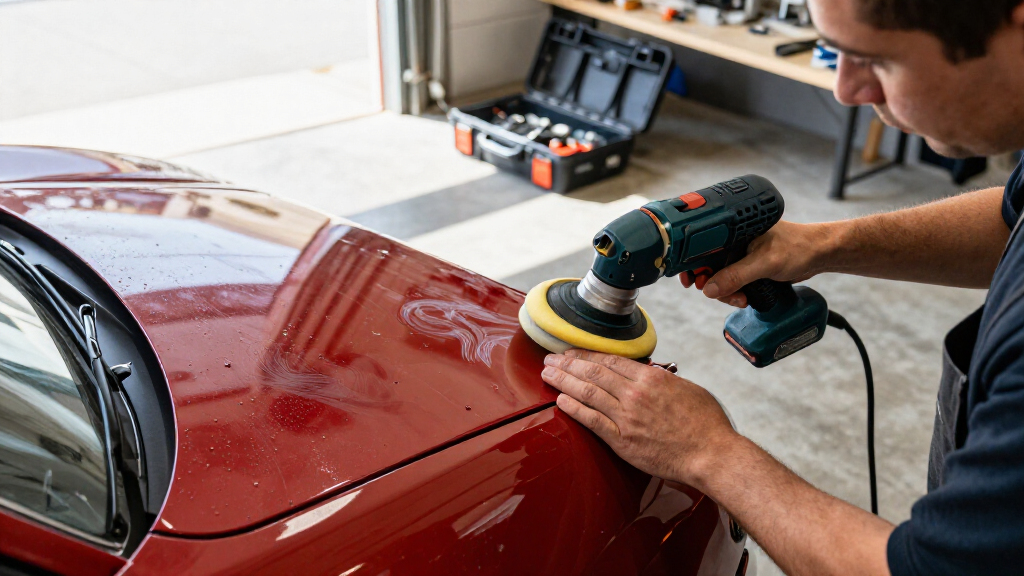
How We Picked
I evaluated these mini polishers based on three primary criteria: performance consistency, ergonomic design, and versatility. Performance consistency was judged by how well the tool maintained speed under load, a common issue in smaller motors. I prioritized models with variable speed controls, as fixed-speed units limit usability across different compounds and paint conditions.
Ergonomic design was assessed through grip texture, weight distribution, and vibration levels. A tool that feels balanced reduces hand fatigue, which is critical for precision work on small panels. Versatility was measured by pad compatibility and mode switching (rotary vs. DA). Models that offer multiple modes or pad sizes were ranked higher because they adapt to more detailing scenarios, from wax application to defect correction.
Factors to Consider When Choosing Best Mini Car Polishers
Choosing the right mini polisher requires looking beyond marketing claims. Here are the key factors that should drive your decision.Corded vs. Cordless Power Sources
Cordless convenience comes with limitations. Battery life is the primary constraint; most 12V mini polishers run for 20-30 minutes on a full charge. If you plan to polish an entire car, you will need spare batteries or a charging break. Corded models offer unlimited runtime but restrict movement, especially in tight spaces or when working outdoors away from outlets. Decide if the freedom of movement outweighs the hassle of managing a cord.
Dual-Action vs. Rotary Mechanics
Dual-action (DA) polishers oscillate and rotate, reducing the risk of holograms or burns, making them safer for most users. Rotary polishers spin in a single direction, offering more cutting power for severe defects but requiring significant skill to control heat buildup. Unless you are experienced in correction work, a DA or hybrid model is the safer choice for preserving your vehicle’s paint integrity.
Pad Size and Compatibility
Mini polishers typically use 1-inch to 3-inch pads. Smaller pads (1-2 inches) excel in tight areas like door jambs, emblems, and interior trim. Larger pads (3 inches) cover more surface area on panels like hoods and doors. A model that accepts multiple pad sizes offers greater flexibility, allowing you to switch tasks without changing tools. Check if the backing plate is standard or proprietary, as proprietary plates limit pad options.
Speed Control and Variable Settings
Fixed-speed tools are limiting. Variable speed controls allow you to adjust RPMs based on the compound and pad type. Lower speeds are better for waxing or applying sealants, while higher speeds aid in cutting defects. Look for a dial with distinct settings rather than a trigger-only design, which makes maintaining a consistent speed difficult during long sessions.
Ergonomics and Vibration Management
Small tools can vibrate excessively, leading to hand numbness. Balanced weight distribution and rubberized grips help mitigate fatigue. If a tool feels top-heavy, it will pull away from the surface, making it hard to control. Heavier tools may feel more stable, but they tire your arm faster. Find a balance where the tool feels like an extension of your hand, not a struggle.
Frequently Asked Questions
Can I use a mini polisher for the entire car?
Technically yes, but it is inefficient. Mini polishers are designed for spot work, trim, and hard-to-reach areas. Using one on large panels like doors or hoods will take significantly longer than a standard 5- or 6-inch polisher and will drain batteries quickly. It is best to use a mini tool for detailing edges, jambs, and small accents, while reserving a larger machine for broad surface areas.
What is the difference between a 12V and 20V mini polisher?
Voltage correlates with motor power and torque. A 20V model generally handles heavier compounds and larger pads better than a 12V unit, maintaining speed under load more effectively. However, 20V tools are often heavier and bulkier, potentially reducing the maneuverability that defines a ‘mini’ tool. For light polishing and waxing, 12V is sufficient; for correction work, 20V offers better performance.
Do mini polishers require special pads?
Many mini polishers use standard hook-and-loop backing plates that accept common microfiber or foam pads, but some use proprietary systems. Always check the backing plate diameter and attachment method before buying replacement pads. If a model uses a unique interface, you may be locked into buying pads from the same manufacturer, which can be more expensive and less available than generic options.
Is a cordless or corded mini polisher better for beginners?
Cordless models are often easier for beginners because there is no cord to drag across the paint surface, reducing the risk of accidental scratches. However, you must manage battery life carefully. Corded models provide consistent power, which can be reassuring for learning speed control, but managing the cord requires extra attention to avoid dragging it over clear coat. For most novices, the freedom of cordless is less frustrating.
How do I prevent burning the paint with a mini polisher?
Burning occurs from excessive friction and heat. To prevent this, use lower speeds initially and keep the tool moving constantly. Do not apply heavy pressure; let the compound do the work. If the surface feels hot to the touch, stop immediately and let it cool. Using a DA mechanism instead of rotary also reduces heat buildup, making it a safer choice for those new to polishing.
Conclusion
Choosing the right mini polisher depends on your specific detailing goals. For the best overall balance of power and portability, the SPTA Cordless Mini Car Polisher, 12V is the top choice. If you prefer a premium build with superior ergonomics, the Griot’s Garage G8 Mini Orbital Polisher is worth the investment. Beginners should look toward DA-only models like the ZOTA Mini Dual-Action Orbital Polisher for safety. For those needing versatility in pad sizes and modes, the Howcow Cordless Mini Car Polisher offers excellent flexibility. Finally, if you are on a tight budget, the LDHTHOPI 73-Piece Cordless Mini Car Polisher Kit provides great value with included accessories.