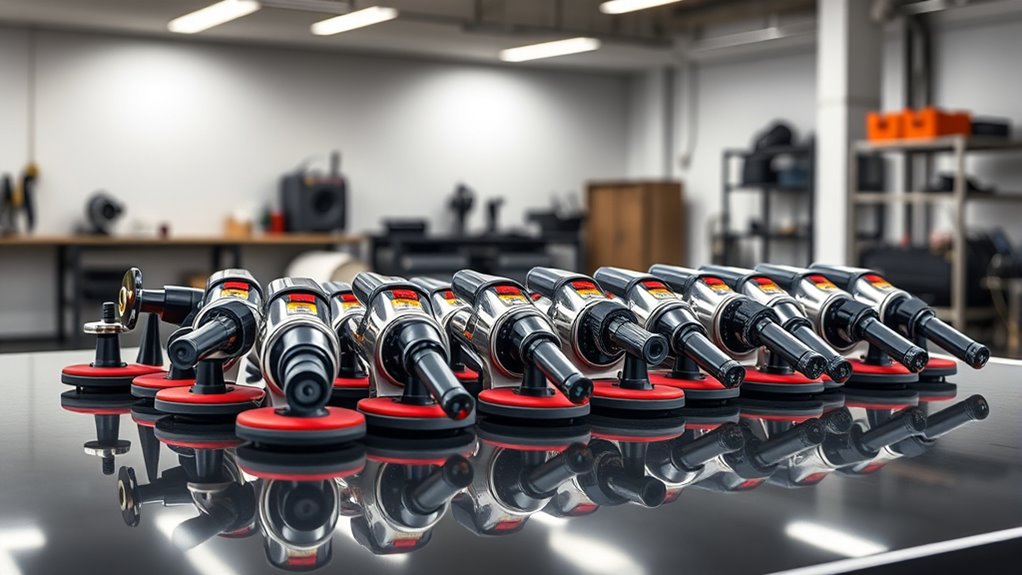

Among these high-end rotary polishing machines, I name the RUPES LH19E Rotary Polisher Complete Kit best overall for buyers seeking a dedicated rotary with a kit-focused setup. The FLEX FC3311-Z stands out for its corded brushless design, while the Flex Cordless PE 150 18-EC C suits work where freedom from a cord matters. The central tradeoff is control and sustained power versus weight, portability, and the learning curve of rotary polishing. This roundup also includes random-orbital polishers and specialty wet-stone and compact tools, so the right choice depends on the surface and task, not just the product label. Read on for the full breakdown of how each option fits.

Get business pricing on garage and car supplies
- Business-only prices and quantity discounts
- Tax-exempt purchasing
- Multiple users, one account, clear invoices
Complete the kit


Key Takeaways
- The RUPES LH19E Complete Kit is my best overall pick because it is a dedicated rotary option presented as a complete kit, a practical fit for buyers who want a focused setup rather than a specialty machine.
- FLEX FC3311-Z and Flex PE 150 18-EC C represent different priorities: the former is corded and brushless, while the latter offers cordless operation; choose around work duration and access to power.
- Not every machine here is a rotary polisher. The 3M 34101 and RUPES LHR15 Mark V are random-orbital polishers, so buyers seeking direct rotary action should check the motion type before choosing.
- The Makita PW5001C serves a different job as a wet stone polisher; its specialty design is a poor match for someone shopping for a general automotive rotary.
- Kit contents and tool format matter as much as brand. SPTA bundles pads and extensions, while the RUPES iBrid Nano prioritizes compact access; neither replaces a full-size machine for every task.
| SPTA Mini Rotary Polisher with 27-Piece Pad Kit and M14 Extension Shafts |  | Best for Tight, Detailed Areas | Motor power: 750 W (7 A) | Speed settings: 6 | Speed range: 1,000–5,500 RPM | VIEW ON AMAZON | See Our Full Breakdown |
| Flex Cordless Rotary Polisher 18V PE 150 18-EC C |  | Best Cordless Professional Pick | Voltage: 18V | Model: PE 150 18-EC C | Power source: Cordless | VIEW ON AMAZON | See Our Full Breakdown |
| 3M Perfect-It Random Orbital Polisher, 34101, 21mm, 120V/60Hz |  | Best for Swirl-Conscious Professionals | Model: 34101 | Motion: Random orbital | Throw: 21 mm | VIEW ON AMAZON | See Our Full Breakdown |
| RUPES BigFoot LHR15 Mark V Random Orbital Polisher – Tool Only |  | Best Premium Ergonomic Orbital | Brand: RUPES | Model number: LHR15V/US/STD | Machine type: Random orbital polisher | VIEW ON AMAZON | See Our Full Breakdown |
| Makita 9237CX3 7-Inch Polisher |  | Best for Large-Surface Rotary Work | Model: 9237CX3 | Polisher type: Rotary polisher | Pad size: 7 inches | VIEW ON AMAZON | See Our Full Breakdown |
| RUPES LH19E Rotary Polisher Complete Kit |  | Best Complete Kit | Tool type: Rotary polisher | Backing plate: 125 mm (5 in) | Power cord: 9 m | VIEW ON AMAZON | See Our Full Breakdown |
| Makita PW5001C 4-Inch Electronic Wet Stone Polisher |  | Best for Stone Finishing | Motor: 7.9 A | Speed range: 2,000–4,000 RPM | Weight: 4.6 lb | VIEW ON AMAZON | See Our Full Breakdown |
| M18 FUEL™ Cordless Rotary Polisher |  | Best for Cordless Mobility | Brand: Milwaukee | Tool type: Cordless rotary polisher | Included component: Polisher | VIEW ON AMAZON | See Our Full Breakdown |
| Makita 9237C 7-Inch Electronic Control Polisher |  | Best for Controlled Large-Panel Work | Polisher type: Electronic control polisher | Disc size: 7 in | Speed: 3,200 RPM | VIEW ON AMAZON | See Our Full Breakdown |
| FLEX FC3311-Z 120V Corded Brushless Rotary Polisher |  | Best for High-Control Defect Removal | Power source: 120 V corded | Motor: Brushless | Maximum speed: 1,800 RPM | VIEW ON AMAZON | See Our Full Breakdown |
| Rupes iBrid Nano 2 Polisher Kit in Systainer, 120V, USA Plug |  | Best for Tight-Space Precision | Brand: RUPES | Model number: HR81MLII/US/LUX | Voltage: 120V | VIEW ON AMAZON | See Our Full Breakdown |
| RUPES LH19E Big Foot Rotary Polisher Standard Kit |  | Best for Long-Run Workshop Polishing | Brand: RUPES | Model: LH19E | Manufacturer part number: LH19E/STN | VIEW ON AMAZON | See Our Full Breakdown |
| SPTA 7-Inch Rotary Car Polisher with Polishing Pads Set |  | Best Accessory-Rich Variable-Speed Kit | Brand: SPTA | Model: SPTA0020 | Power: 1,200 W | VIEW ON AMAZON | See Our Full Breakdown |
More Details on Our Top Picks
SPTA Mini Rotary Polisher with 27-Piece Pad Kit and M14 Extension Shafts
The SPTA Mini Rotary is the most specialized pick here: its compact backing plates and three extension shafts let a detailer reach recessed trim, narrow bodywork, and other spots that a 7-inch machine like the Makita 9237CX3 cannot access as easily. Its 750W motor and six settings, spanning 1,000–5,500 RPM, give useful speed flexibility, while the 27-piece kit supplies reusable wool and sponge pads for different jobs. That bundled setup makes it more ready for small-area work than the tool-only RUPES LHR15 Mark V. The tradeoff is scale: backing plates stop at 76 mm, so broad panels take longer, and rotary action calls for careful speed and pressure control on delicate finishes. I’d choose it for precision access, not as a sole machine for polishing an entire vehicle quickly.
Pros:- Compact 25 mm, 50 mm, and 76 mm backing plates suit small and confined work.
- Three M14 extension shafts improve access to recessed areas.
- Six speed settings cover a broad range of detailing tasks.
- 27-piece kit includes reusable wool and sponge pads.
Cons:- Small backing plates make large-panel work slower than with the Makita 9237CX3’s 7-inch pad.
- Rotary operation requires careful speed control on delicate paint.
- The included backing plates do not cover larger polishing areas.
Best for: Detailers who regularly polish tight, recessed, or intricate areas and want small pads and extension shafts in one kit.
Not ideal for: Buyers seeking a primary machine for fast correction across large panels, or beginners who are not ready to manage rotary heat and speed carefully.
- Motor power:750 W (7 A)
- Speed settings:6
- Speed range:1,000–5,500 RPM
- Backing plate sizes:25 mm, 50 mm, 76 mm
- Extension shaft lengths:75 mm, 100 mm, 140 mm
- Thread type:M14
- Included items:Mini polisher and 27-piece pad set
- Model number:ROMPS3ACUSA
Our verdict“Choose the SPTA Mini when access to tight detailing areas matters more than fast coverage of broad panels.”
Flex Cordless Rotary Polisher 18V PE 150 18-EC C
The Flex PE 150 18-EC C is the lineup’s mobility-first choice for professionals who need rotary polishing away from an outlet, including automotive, marine, or aviation work. Its 18V cordless platform removes the cord-management burden found with the corded Makita 9237CX3, while CDC electronics are described as maintaining stable speed under load. A gas switch, easy speed adjustment, ergonomic grip, battery indicator, and overload protection support controlled work rather than treating cordless convenience as the only selling point. The main compromise is power planning: the available details give no runtime figure, and sustained jobs may require spare batteries or pauses for charging. Compared with the compact SPTA Mini, this is positioned for broader professional tasks, but the supplied information does not specify pad size or speed range, making fit and performance harder to compare on paper.
Pros:- Cordless 18V operation avoids managing a power cord around large or remote work areas.
- CDC electronics are designed to maintain stable speed under load.
- Ergonomic design and soft grip support controlled handling.
- LED battery indicator and overload protection add useful operating feedback.
Cons:- Runtime is not specified, making long-job planning difficult.
- Battery replacements or charging breaks may interrupt extended work.
- The supplied product details do not state pad size or speed range.
Best for: Mobile detailing professionals who need cordless rotary operation across vehicles, boats, or aircraft and already plan around 18V batteries.
Not ideal for: Buyers who work long uninterrupted shifts without spare batteries, or those who need clearly stated speed and pad specifications before choosing.
- Voltage:18V
- Model:PE 150 18-EC C
- Power source:Cordless
- Speed adjustment:Easy speed adjustment
- Electronics:CDC electronics for stable speed under load
- Battery indicator:LED
- Protection:Overload protection
- Design features:Gas switch and ergonomic design
Our verdict“Pick the Flex PE 150 when cord-free professional mobility outweighs the uncertainty around runtime and specified polishing dimensions.”
3M Perfect-It Random Orbital Polisher, 34101, 21mm, 120V/60Hz
The 3M Perfect-It 34101 takes a different route from the rotary machines in this roundup: its random orbital motion combines rotation and oscillation to reduce swirl marks, making it a sensible choice for professional finish work where surface appearance matters as much as correction. The 21 mm throw and 6-inch backing pad give it a broader working footprint than the small-pad SPTA Mini, while the 29-foot cord allows movement around a vehicle without frequent outlet changes. Variable speed control supports adjustment to the task. It is not a direct substitute for rotary cutting power, though, and its fixed 21 mm throw offers no alternate stroke size. Compared with the tool-only RUPES LHR15 Mark V, the 3M’s stated pad and throw dimensions make its working format clearer, but its professional orientation may be less approachable for a first-time polisher.
Pros:- Random orbital motion is designed to reduce swirl marks.
- 21 mm throw and 6-inch pad suit work across vehicle panels.
- Variable speed control supports task-specific adjustment.
- 29-foot cord offers substantial reach around a work area.
Cons:- Random orbital motion is not the same as the direct rotary action sought by rotary-polisher buyers.
- Only a 21 mm throw is specified.
- Its professional focus may be more complex for beginners.
Best for: Professional detailers who prioritize swirl-conscious finishing on vehicle panels and want a long cord with a 6-inch pad.
Not ideal for: Buyers specifically seeking a rotary machine for direct rotary correction, or beginners who want a simpler entry point.
- Model:34101
- Motion:Random orbital
- Throw:21 mm
- Pad size:6 inches
- Voltage and frequency:120V / 60Hz
- Cord length:29 feet
- Speed control:Variable
Our verdict“Choose the 3M when swirl-conscious professional finishing matters more than having a true rotary machine or multiple throw options.”
RUPES BigFoot LHR15 Mark V Random Orbital Polisher – Tool Only
The RUPES BigFoot LHR15 Mark V is the premium choice here for buyers who want a compact, refined random orbital platform rather than the direct rotary action of the Makita or Flex machines. Its stated advantages—reduced vibration, improved ventilation, and an anti-spinning ring—address comfort, operating consistency, and pad protection during demanding detailing work. A 125 mm backing plate is included, giving it a clear working format unlike the 3M 34101’s 6-inch pad and 21 mm throw specification. The key limitation is the purchase format: this is tool only, so pads and other accessories may need to be sourced separately. It is also aimed mainly at professional or detailed use, not a low-complexity starter setup. I’d rank it above the 3M for buyers committed to the RUPES platform, but not for anyone who specifically needs rotary cutting action.
Pros:- Reduced vibration is intended to support smoother handling.
- Compact design aids maneuverability on complex surfaces.
- Improved ventilation is designed for consistent performance during demanding work.
- Anti-spinning ring helps protect pads and internal components.
Cons:- Random orbital operation does not meet a need for direct rotary action.
- Tool-only package may require separate accessory purchases.
- Professional-focused design may be excessive for occasional basic polishing.
Best for: Professional detailers seeking a compact random orbital machine with stated vibration and ventilation improvements and who already have compatible accessories.
Not ideal for: Rotary-only buyers, beginners looking for a complete kit, or detailers who need included pads and accessories.
- Brand:RUPES
- Model number:LHR15V/US/STD
- Machine type:Random orbital polisher
- Backing plate:125 mm
- Included components:Tool only; includes 125 mm backing plate
- Warranty:Five years
- Unit count:1
Our verdict“Choose the LHR15 Mark V for premium, compact orbital detailing if you already have accessories and do not require a rotary machine.”
Makita 9237CX3 7-Inch Polisher
The Makita 9237CX3 is the straightforward choice for buyers who need a full-size rotary polisher to cover broad surfaces. Its 7-inch pad and 10 A, 120 V motor contrast sharply with the SPTA Mini’s small backing plates: the Makita is better suited to large vehicle panels or other wide surfaces, while the SPTA reaches confined areas the Makita may not. Variable speed control and constant-speed performance under load help keep polishing consistent, and soft start can reduce product fling at startup. A rubberized loop handle supports control, while the wire mesh intake cover helps protect the motor. The cost of that reach is maneuverability; the 18.5-inch body and large pad are less convenient in tight spaces. The listed speed is 3,000 rpm, so the supplied data does not describe a variable speed range.
Pros:- 7-inch pad provides wider coverage than the SPTA Mini’s backing plates.
- Constant-speed control is designed to maintain speed under load.
- Soft start helps limit polish, wax, or paste fling.
- Rubberized loop handle and wire mesh intake cover support handling and motor protection.
Cons:- Large pad is less suited to tight or confined areas.
- 18.5-inch overall length makes it less compact than the SPTA Mini.
- The listed speed is 3,000 rpm, without a stated variable speed range.
Best for: Experienced detailers or finishers who need a corded rotary machine for broad panels and other large surfaces.
Not ideal for: Buyers working mainly in tight spaces, seeking a compact detailing tool, or needing a documented range of speed settings.
- Model:9237CX3
- Polisher type:Rotary polisher
- Pad size:7 inches
- Listed speed:3,000 rpm
- Amperage:10 A
- Voltage:120 V
- Weight:7 lb
- Overall length:18.5 inches
Our verdict“Choose the Makita 9237CX3 for corded rotary work across broad surfaces, but pick a compact machine for intricate areas.”
RUPES LH19E Rotary Polisher Complete Kit
The RUPES LH19E Complete Kit suits detailers who want a capable corded rotary and the core accessories in one package. Its high-torque motor, variable-speed dial, and progressive trigger give the operator two ways to adjust speed, while the anti-vibration loop and side handles support control during longer correction sessions. The 9-meter cord also offers room to work around a vehicle without frequent repositioning. Compared with the Milwaukee M18 FUEL Cordless Rotary Polisher, the RUPES arrives with pads, compounds, towels, and a carrying bag rather than requiring separate accessory planning; the Milwaukee, by contrast, avoids a power cord. The tradeoff is the learning curve: rotary friction can damage paint when technique or speed is poorly managed. I’d choose this kit for experienced users who value a well-equipped setup, not as a first polishing machine.
Pros:- High-torque motor in a lightweight, compact housing
- Variable-speed dial and progressive trigger allow speed changes while working
- Anti-vibration loop and side handles support control and comfort
- Includes polishing accessories and a 9-meter power cord
Cons:- Rotary heat and friction can damage surfaces if technique is poor
- Requires practice to control safely and consistently
- Corded operation can be less convenient than the Milwaukee M18 FUEL
Best for: Experienced automotive, marine, or refinishing detailers who want a corded rotary with useful pads, compounds, and accessories included.
Not ideal for: First-time polishers or buyers who need cordless operation; rotary heat demands careful technique, and this kit is corded.
- Tool type:Rotary polisher
- Backing plate:125 mm (5 in)
- Power cord:9 m
- Speed control:Variable-speed dial and progressive trigger
- Included handle:D-loop handle
- Included polishing accessories:Coarse compound, fine polish, ultrafine twisted wool pad, blue foam pad, yellow claw pad tool
- Other included items:Detailing apron, 3 microfiber towels, carrying bag
- Manufacturer part number:LH19E/US/CMP
Our verdict“Choose the RUPES LH19E kit if you want a well-equipped, high-control corded rotary and already have the skill to manage rotary polishing.”
Makita PW5001C 4-Inch Electronic Wet Stone Polisher
The Makita PW5001C has a specific job in this roundup: wet polishing stone, not correcting automotive paint. Its 7.9-amp motor and 2,000–4,000 RPM range offer controlled power for stone finishing, while soft start helps reduce the jolt at startup. At 4.6 pounds, it is also lighter than the 7.5-pound Makita 9237C, though that comparison matters most when working on stone rather than vehicle panels. A water-hose fitting supports wet use, but it also limits the machine’s usefulness for dry detailing. Unlike the RUPES LH19E, which comes with automotive polishing accessories and a long power cord, the PW5001C is supplied with stone-polishing hardware and expects access to water. I’d pick it for professional stone work; car detailers should choose a dedicated automotive rotary instead.
Pros:- 7.9-amp motor supports professional stone-polishing work
- Variable 2,000–4,000 RPM range provides speed adjustment
- Soft start helps make startup smoother
- Lightweight 4.6-pound design and water-hose compatibility
Cons:- Limited to wet polishing applications
- Requires a water connection for its intended use
- Less suitable for automotive detailing than the Makita 9237C or RUPES LH19E
Best for: Stone fabricators and finishers who need a lightweight, variable-speed wet polisher for precision work with water.
Not ideal for: Automotive detailers or anyone needing a general-purpose dry rotary; this tool is designed around wet stone polishing and water access.
- Motor:7.9 A
- Speed range:2,000–4,000 RPM
- Weight:4.6 lb
- Application:Wet stone polishing
- Water connection:Accepts most water hose connections
- Startup feature:Soft start
- Included components:Rubber pad, side handle, head cover, wrenches, front grip, dust cover
- Pad size:4 in
Our verdict“Choose the PW5001C for wet stone finishing, but skip it if your main goal is polishing vehicle paint.”
M18 FUEL™ Cordless Rotary Polisher
The Milwaukee M18 FUEL Cordless Rotary Polisher is the mobility-first pick here. Its cordless format can simplify work around vehicles when outlets or cord routing get in the way, a practical contrast with the corded RUPES LH19E and Makita 9237C. That convenience comes with important unknowns in the supplied product information: no motor output, speed range, or runtime is listed, so I can’t compare its correction capacity or work time on equal terms with those machines. It is also sold as a bare tool, meaning a compatible battery and charger must be sourced separately, and no pads or other attachments are included. This makes the Milwaukee a better fit for buyers already invested in its battery platform than for someone building a complete polishing setup from scratch.
Pros:- Cordless design avoids managing a power cord around the vehicle
- Suited to polishing and detailing tasks
- May fit conveniently into an existing compatible Milwaukee tool setup
Cons:- Battery and charger are not included
- No motor output, speed range, or battery runtime is provided in the supplied specifications
- No pads or other polishing accessories are included
Best for: Detailers who already own compatible Milwaukee batteries and chargers and need a cordless rotary for work away from outlets.
Not ideal for: Buyers seeking a ready-to-use kit or clear published performance details; the tool comes without a battery, charger, or polishing accessories.
- Brand:Milwaukee
- Tool type:Cordless rotary polisher
- Included component:Polisher
- Battery:Not included
- Charger:Not included
- Manufacturer part number:MIL 2738-20
- Unit count:1
- UPC:045926698740
Our verdict“Pick the Milwaukee if cordless mobility matters and you already have its battery platform; otherwise, the RUPES LH19E offers a more complete package.”
Makita 9237C 7-Inch Electronic Control Polisher
The Makita 9237C is a strong match for users who want a corded 7-inch rotary with electronic speed management. Its constant-speed control is designed to hold speed under load, while the variable-speed dial and trigger let the operator tune the machine to the task. Soft start helps limit compound or wax fling at startup, and rubberized contact points add comfort and surface protection. Compared with the more compact RUPES LH19E, the Makita’s larger 7-inch disc favors broader coverage, but gives up some nimbleness in tighter areas. Its listed weight of 7.5 pounds may also feel demanding over long sessions. The listed 127 V input deserves a compatibility check before purchase. I’d favor it for experienced users correcting larger panels who want corded control over cordless convenience.
Pros:- Constant-speed control helps maintain RPM under load
- Variable-speed dial and trigger allow adjustment to the job
- Soft start helps reduce polish, wax, or paste fling-off
- Rubberized handle and gear housing support comfort and surface protection
Cons:- At 7.5 pounds, it may be tiring during long sessions
- The 7-inch disc is less suited to tight or intricate areas than the RUPES LH19E’s 5-inch backing plate
- Listed 127 V input may not suit every buyer’s power setup
Best for: Experienced detailers who work on larger vehicle panels and want a corded 7-inch rotary with variable and load-responsive speed control.
Not ideal for: Buyers who need a compact machine for tight areas, a lighter tool for prolonged overhead work, or an input voltage different from the listed 127 V.
- Polisher type:Electronic control polisher
- Disc size:7 in
- Speed:3,200 RPM
- Amperage:10 A
- Voltage:127 V
- Weight:7.5 lb
- Dimensions:20 × 7 × 7 in
- Warranty:1 year
Our verdict“Choose the Makita 9237C for controlled rotary work across larger panels, provided its weight and listed voltage fit your setup.”
FLEX FC3311-Z 120V Corded Brushless Rotary Polisher
The FLEX FC3311-Z targets buyers who want a corded rotary built for controlled defect removal. Its brushless motor and constant-speed system are designed to maintain up to 1,800 RPM under pressure, while an 11-speed dial and variable-speed trigger give the operator fine control over the response. The included 5-inch and 6-inch backing plates make it more adaptable to panel size than the Makita 9237C’s listed 7-inch disc. Vibration suppression and an ergonomic grip may also help during extended work. The tradeoff is that FLEX describes this machine as aggressive in material removal, so it calls for a steady hand and sound paint-correction technique. It is corded, unlike the Milwaukee M18 FUEL, and the supplied kit lists only the backing plates—not a broader set of pads or compounds.
Pros:- Brushless motor avoids motor brush maintenance
- Constant-speed technology is designed to maintain RPM under pressure
- 11-speed dial and variable-speed trigger offer multiple control options
- Includes 5-inch and 6-inch backing plates
Cons:- Corded operation requires access to a power outlet
- Aggressive material removal demands careful technique
- Supplied components do not include polishing pads or compounds
Best for: Experienced paint-correction professionals who want a brushless corded rotary, speed adjustment, and plate sizes for different panel areas.
Not ideal for: New users seeking a forgiving first polisher, or detailers who need cordless operation or a complete pad-and-compound kit.
- Power source:120 V corded
- Motor:Brushless
- Maximum speed:1,800 RPM
- Speed control:11-speed dial with variable-speed trigger
- Included backing plates:5 in and 6 in
- Dimensions:17.8 × 3.2 × 5 in
- Warranty:One-year limited warranty when registered
- Model:FC3311-Z
Our verdict“Choose the FLEX FC3311-Z for experienced correction work that benefits from brushless power and two backing-plate sizes, not for casual or cordless use.”
Rupes iBrid Nano 2 Polisher Kit in Systainer, 120V, USA Plug
The Rupes iBrid Nano 2 is the specialist pick here: its compact form and rotary mode, which reaches 2,000 RPM, suit narrow panels and detail work where a full-size machine is cumbersome. Unlike the corded RUPES LH19E Big Foot Rotary Polisher, it runs on rechargeable batteries, so there is no power cord to work around at the vehicle. The kit also arrives with two batteries, pads, compounds, and accessories, making it more ready for varied small-area tasks than a tool-only purchase. The tradeoff is scale: its compact design is not the natural choice for polishing large panels quickly, and the available information does not specify battery runtime. It also asks for more technique than a beginner-friendly finishing tool; casual users may find this professional-oriented kit excessive.
Pros:- Compact design makes tight-space polishing more manageable than with a full-size rotary.
- Two rechargeable batteries allow work without a cord trailing around the vehicle.
- Quick-release system supports faster pad and accessory changes.
- Kit includes polishing and sanding pads, compounds, cloths, charger, and case.
Cons:- Small format is less suited to covering broad panels efficiently.
- Professional rotary operation calls for user skill and careful handling.
- Battery runtime information is not provided.
Best for: Detailers who regularly correct tight areas, trim-adjacent paint, and small panels and want cordless movement with a dedicated accessory kit.
Not ideal for: Buyers focused on fast correction across large panels, or casual users who want a simple, lower-commitment polishing setup.
- Brand:RUPES
- Model number:HR81MLII/US/LUX
- Voltage:120V
- Frequency:60Hz
- Rotary speed:Up to 2,000 RPM
- Power source:Rechargeable batteries
- Included components:Polisher, 2 rechargeable batteries, battery charger, sanding and polishing pads, compounds, cloths, case
- Items listed:27
Our verdict“Choose the iBrid Nano 2 for cordless precision in confined areas, not as your main machine for large-scale paint correction.”
RUPES LH19E Big Foot Rotary Polisher Standard Kit
For sustained rotary work on larger areas, the RUPES LH19E Big Foot is the most straightforward fit in this group. Its 9-meter cord gives a broad working radius around a vehicle, while the 5-inch backing plate and included fine and coarse foam pads let a user set up for different correction stages. That makes it a better match for full-panel work than the compact, battery-powered Rupes iBrid Nano 2, which is built around precision access rather than coverage. The corded design also avoids battery-runtime uncertainty during a long session. This is still a rotary machine, not a forgiving finishing-first choice: the coarse pad can be too aggressive for delicate work, and the cord limits freedom compared with cordless options. Buyers should also have suitable outlet access at the work area.
Pros:- Long 9-meter cord provides substantial reach around a vehicle.
- Corded power avoids pauses for battery charging or runtime limits.
- 5-inch backing plate supports a practical size for panel work.
- Fine and coarse pads plus two compounds provide a basic correction-to-finishing setup.
Cons:- Requires access to a power outlet and offers less freedom of movement than the iBrid Nano 2.
- The coarse pad can be overly aggressive for delicate paint or finishing.
- Rotary operation requires technique to manage heat and avoid surface damage.
Best for: Experienced detailers and body shops that need a corded rotary for extended full-panel correction and want a long working reach.
Not ideal for: Mobile users working far from outlets, or newcomers seeking a forgiving tool for fine finishing and small-area work.
- Brand:RUPES
- Model:LH19E
- Manufacturer part number:LH19E/STN
- Power source:Corded electric
- Maximum power:1,900 watts
- Cord length:9 meters (29.5 feet)
- Backing plate:5 inches, 5/8-inch thread
- Included components:Backing plate, two foam pads, two compounds
Our verdict“Pick the LH19E for experienced, outlet-equipped users doing extended panel correction who value corded continuity over cordless mobility.”
SPTA 7-Inch Rotary Car Polisher with Polishing Pads Set
The SPTA 7-Inch Rotary stands out for buyers who want a broad accessory set and visible speed feedback in one corded package. Its six settings from 500 to 3,000 RPM give more stated speed range than the LH19E’s supplied product data, while the digital display makes the selected setting easy to check during a job. A 7-inch pad also favors larger working areas over the iBrid Nano 2’s precision-focused format. SPTA includes side and D-shaped handles, pads, backing plates, compounds, and cleaning accessories, so the kit covers more setup needs than the RUPES standard kit. The tradeoff is a 6.6-pound tool that may feel less nimble for prolonged or intricate work. As with any rotary, speed and pressure demand control, and its cord restricts movement.
Pros:- Six speed settings span 500–3,000 RPM for adjusting the pace to the task.
- Digital display shows the selected speed while working.
- Side and D-shaped handles offer alternative grip positions.
- Includes pads, backing plates, compounds, cleaning accessories, and a storage bag.
Cons:- At 6.6 pounds, it is less suited to long sessions of intricate or overhead work than a compact polisher.
- The 7-inch format is less convenient for tight areas than the Rupes iBrid Nano 2.
- Corded power limits mobility, and rotary technique is needed to protect paint.
Best for: DIY detailers and working users who want one corded kit for larger panels, adjustable speed, and a wide selection of included accessories.
Not ideal for: Detailers prioritizing compact access, cordless mobility, or a lighter machine for extended overhead and intricate polishing.
- Brand:SPTA
- Model:SPTA0020
- Power:1,200 W
- Speed range:500–3,000 RPM
- Speed settings:6
- Display:Digital speed display
- Power source and voltage:Corded electric, 110 V
- Pad size:7 inches (180 mm)
- Weight:6.6 lb
Our verdict“Choose the SPTA if a wide accessory package and adjustable, displayed speed matter more than compact handling or cordless freedom.”

How We Picked
I ranked these products by how clearly they fit a buyer’s intended polishing work, prioritizing dedicated rotary machines for the core list. I compared the stated tool format, power source, size or pad class where given, included accessories, and whether the machine is a general polisher or a specialized tool. These details affect reach, setup, working time, and how well a machine fits regular shop use.
Ranking also reflects buyer tradeoffs: a corded rotary can suit sustained work, a cordless model can simplify access, and compact or wet-stone tools answer narrower needs. I placed complete-kit and dedicated rotary choices ahead of products that are random-orbital or built for a specialty surface, while recognizing that those alternatives may be better for particular buyers. Product names and listed specifications guide these comparisons; I do not treat an unlisted feature as confirmed.
Factors to Consider When Choosing High End Rotary Polishing Machines
Before choosing, I would match the machine to the job, then check whether its format, power source, and kit contents fit the way the work is done. These distinctions matter more than a premium label when several tools in one roundup use different motions or serve different surfaces.
Confirm Rotary Versus Random-Orbital Motion
Start by confirming the motion type, because “polisher” does not always mean rotary. A rotary machine turns the pad directly, while a random-orbital model adds orbital movement; they suit different working methods and should not be treated as interchangeable. This roundup includes the 3M 34101 and RUPES LHR15 Mark V as random-orbital tools, so they are alternatives for buyers who want that motion rather than direct rotary action. A common mistake is choosing by brand or pad size and discovering later that the machine’s motion does not match the intended process. Check the manufacturer’s specification page for the exact model before ordering, especially when a listing title uses broad wording.
Match the Power Source to the Workday
A corded machine suits work near reliable power and can avoid the pauses associated with charging or battery changes. Cordless operation can make sense around vehicles, tight work areas, or jobs where cable management gets in the way, as with the Flex cordless option in this lineup. The tradeoff is that portability alone does not tell you how long a tool can work under your load; check battery compatibility, included batteries, and charger status in the listing. Buyers often compare a cordless tool’s bare-tool form with a corded kit and overlook the extra items needed to start working. Choose around your available power and typical session length rather than assuming either format is automatically more capable.
Choose Size for Access, Not Just Coverage
A larger working format can cover broad panels with fewer passes, while a compact machine can reach narrow areas and intricate contours. The SPTA Mini and RUPES iBrid Nano show how compact tools occupy a different role from full-size rotary machines. A smaller tool is not necessarily a substitute for a primary polisher, and a larger one may feel cumbersome in confined spaces. Consider the surfaces you handle most often, including edges, recesses, and broad flat areas, before treating pad diameter as a simple performance ranking. If one machine must cover many jobs, check what backing plates or extensions the maker supports rather than assuming accessories will fit across brands.
Separate General Polishing from Specialty Work
Some tools are designed around a particular material or task, not general automotive polishing. The Makita PW5001C is identified as a wet stone polisher, so its place in this roundup does not make it a like-for-like alternative to a car polisher. Specialty tools can be the right choice when the work matches their intended use, but can become an expensive mismatch when bought for a broad range of surfaces. Verify the manufacturer’s approved applications, water requirements, and compatible accessories before using a tool outside its named purpose. For mixed work, a general-purpose rotary plus a dedicated specialty machine may make more sense than asking one tool to cover both.
Look Beyond the Box Label at Kit Readiness
A “tool only” listing and a complete kit can represent very different starting points, even when the machines are closely related. The RUPES LHR15 Mark V is listed as tool only, while the LH19E options and SPTA Mini are presented with kit contents. Check whether the package includes a backing plate, pads, handles, case, batteries, or charger, and confirm the exact contents because bundles can vary by seller. A broad pad set may lower setup friction, but it does not guarantee every included pad suits your surface or compound. Compare the items you would otherwise need to buy separately, then factor in compatibility and replacement availability.
Pay for Control and Support That Fit Your Skill
High-end pricing should buy a meaningful fit for the work, such as a preferred power format, a specific tool class, or a ready-to-use kit—not simply a premium brand name. Rotary polishing calls for careful control, so new users should weigh handling, instruction availability, and a gradual practice plan alongside motor specifications. A random-orbital alternative may suit someone who prefers a different polishing motion, while an experienced operator may prioritize a dedicated rotary. Before committing, check warranty terms, service access, replacement parts, and the manufacturer’s guidance for compatible pads. These ownership details can matter more over time than a small difference in headline specifications.
Frequently Asked Questions
Are the 3M 34101 and RUPES LHR15 Mark V rotary polishers?
No. The product names identify both as random-orbital polishers, which makes them different from the dedicated rotary machines in this roundup. They may suit buyers specifically seeking random-orbital motion, but they are not direct substitutes for a rotary if that is your requirement. Check the exact model specification before purchasing, since similar product families can include tools with different motion types. I would treat motion type as a first-stage filter rather than comparing these models only by brand or size.
Should I choose a cordless rotary or a corded one?
I would choose based on where and how long you work. Cordless operation can reduce cable management and help when outlets are awkwardly placed, while a corded machine avoids dependence on battery runtime and charging. The Flex cordless and FLEX FC3311-Z illustrate those different priorities in this lineup. Before buying, confirm whether batteries and a charger are included and whether you already own compatible packs. If your work is mostly stationary and sustained, corded may be simpler; for frequent movement, cordless may be worth the added planning.
Can the Makita PW5001C replace a car rotary polisher?
I would not assume so: it is identified as a wet stone polisher, a specialty tool rather than a general automotive rotary. Its intended material and operating conditions may differ from those of a car polisher, including water use and compatible accessories. Check Makita’s application guidance before using it on another surface. If your main work is vehicle paint, choose a machine explicitly intended for that task. The PW5001C makes sense when its specialty application is the reason for buying it.
Is a kit bundle worth choosing over a tool-only machine?
A kit can be convenient when it includes accessories you need, but the word “kit” does not guarantee a complete working setup. Compare the exact contents against the tool-only option, including pads, backing plates, handles, batteries, charger, and case. The RUPES LHR15 Mark V is listed as tool only, while several other products are presented as kits or sets. Check that included accessories fit your intended work and that replacements are available. If you already own compatible accessories, a tool-only purchase may avoid unnecessary duplication.
Which option makes the most sense for a beginner?
I would choose based on the beginner’s actual task and comfort with rotary polishing, not on a claim that one machine removes the learning curve. Someone set on rotary work may prefer a package with useful accessories and a clear support path, while a buyer open to another motion should compare the random-orbital options. Compact tools such as the SPTA Mini can help with smaller areas, but they are not automatically the best primary machine. Start with manufacturer guidance, appropriate pads, and a test surface before working on a visible panel. If the task does not require rotary action, do not buy one simply because it is positioned as high-end.
Conclusion
For a dedicated rotary that balances a focused tool choice with a kit format, I recommend the RUPES LH19E Rotary Polisher Complete Kit as best overall. The SPTA Mini Rotary Polisher with its pad kit is my best value-style pick for buyers who need compact access and bundled accessories, while the FLEX FC3311-Z is the best premium-style choice for shoppers prioritizing a corded brushless rotary. For beginners, I would start by confirming whether rotary motion is truly needed; those committed to it can favor a kit with clear accessory details, while those open to another motion should compare the 3M or RUPES random-orbital models. Choose the Flex cordless for work where cord-free movement matters, the RUPES iBrid Nano for compact access, or the Makita PW5001C only for its wet-stone application. That leaves the decision centered on motion, work surface, power format, and kit readiness—not the product label alone.