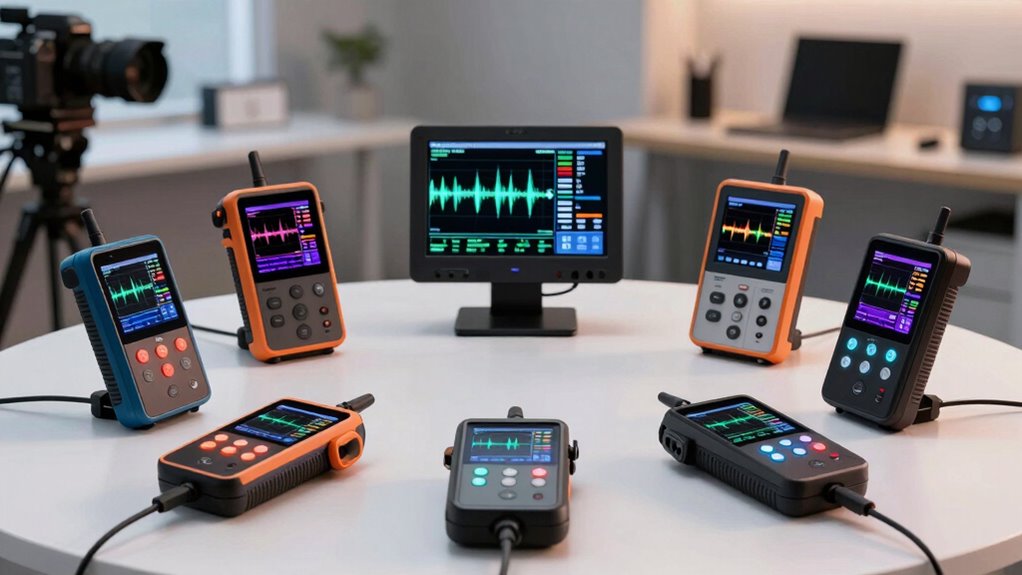

Choosing the right scan tool with oscilloscope built in depends heavily on whether you need a dedicated automotive diagnostic device or a general-purpose electronics bench tester. The Autel MaxiScope MP608 stands out as the best overall choice for professional mechanics because it integrates live data streaming with waveform capture specifically for vehicle networks. For those needing high channel counts for complex system testing, the Hantek 1008C+ offers superior 8-channel PC-based connectivity, while the FNIRSI 2C53T serves hobbyists well with its compact, multi-function design. The main tradeoff in this category is portability versus diagnostic depth; standalone handheld units are easier to carry but lack the software ecosystem of PC-connected or tablet-based systems. Continue reading to see how these six options compare in bandwidth, channel count, and automotive-specific features.

Get business pricing on garage and car supplies
- Business-only prices and quantity discounts
- Tax-exempt purchasing
- Multiple users, one account, clear invoices
Complete the kit


Key Takeaways
- Automotive-specific software (like Autel‘s) matters more than raw MHz bandwidth for diagnosing sensors and actuators.
- PC-connected scopes (Hantek 1008C+) offer more channels and storage but lack the standalone convenience of handheld units.
- General-purpose scopes (FNIRSI 2C53T) are cheaper but lack automotive-specific triggers and preset waveforms.
- Touchscreen interfaces (FNIRSI 1013D Plus) improve usability but drain batteries faster than button-operated models.
- Channel count is the primary differentiator for diagnosing complex systems like ignition coils or injector banks simultaneously.
| FNIRSI 2C53T 3-in-1 Oscilloscope, Multimeter, Signal Generator |  | Best Value All-in-One | Bandwidth: 50 MHz | Sampling Rate: 250 MSa/s | Multimeter Digits: 4.5-digit | VIEW ON AMAZON | See Our Full Breakdown |
| FNIRSI 1013D Plus 100MHz Oscilloscope |  | Best Portable Performance | Bandwidth: 100 MHz | Sampling Rate: 1 GSa/s | Display: 7 inch TFT Touchscreen | VIEW ON AMAZON | See Our Full Breakdown |
| Autel MaxiScope MP608 4-Channel Automotive Oscilloscope |  | Best for Automotive Diagnostics | Channels: 4 | Resolution: 12-bit | Accuracy: ±1% | VIEW ON AMAZON | See Our Full Breakdown |
| Hantek 1008C+HT201+HT30A+HT307 PC USB 8-Channel Oscilloscope |  | Best for Multi-Channel PC Analysis | Channels: 8 | Resolution: 12 bits | Sampling Rate: 2.4 MSa/s | VIEW ON AMAZON | See Our Full Breakdown |
| FNIRSI DSO152 Handheld Oscilloscope |  | Best Entry-Level Starter | Bandwidth: 200 KHz | Sampling Rate: 2.5 MS/s | Display: 2.8-inch HD LCD | VIEW ON AMAZON | See Our Full Breakdown |
| Hantek TO1112C 2CH Tablet Oscilloscope with Multimeter Function |  | Best Standalone Automotive Diagnostic Unit | Channels: 2 | Bandwidth: 110MHz | Sampling Rate: 250MSa/s | VIEW ON AMAZON | See Our Full Breakdown |
| scan tool with oscilloscope built in | Bandwidth | Sampling Rate | Display | Channels |
|---|---|---|---|---|
| FNIRSI 2C53T 3-in-1 Oscillosco | 50 MHz | 250 MSa/s | 2.8 inch LCD | — |
| FNIRSI 1013D Plus 100MHz Oscil | 100 MHz | 1 GSa/s | 7 inch TFT Touchscreen | 2 |
| Autel MaxiScope MP608 4-Channe | 20 MHz | — | — | 4 |
| Hantek 1008C+HT201+HT30A+HT307 | — | 2.4 MSa/s | — | 8 |
| FNIRSI DSO152 Handheld Oscillo | 200 KHz | 2.5 MS/s | 2.8-inch HD LCD | — |
| Hantek TO1112C 2CH Tablet Osci | 110MHz | 250MSa/s | 7-inch TFT LCD Touchscreen | 2 |
More Details on Our Top Picks
FNIRSI 2C53T 3-in-1 Oscilloscope, Multimeter, Signal Generator
This unit stands out as the most versatile compact option for hobbyists who need three tools in one. Unlike the FNIRSI 1013D Plus, which focuses purely on oscilloscope performance, the 2C53T integrates a 4.5-digit multimeter and signal generator, making it ideal for quick component checks without switching devices. However, the tradeoff is bandwidth; at 50 MHz, it falls short for high-frequency digital debugging where the 1013D’s 100 MHz capability excels. The 2.8-inch screen is a significant limitation for detailed waveform analysis compared to larger displays. This pick makes sense for those prioritizing portability and cost-efficiency over raw signal processing power.Pros:- Integrates oscilloscope, multimeter, and signal generator in one compact body
- High-precision 4.5-digit multimeter reduces need for separate meter
- USB-C connectivity allows for easy data export and charging
Cons:- 50 MHz bandwidth limits application to lower-frequency electronics
- Small 2.8-inch display makes detailed waveform inspection difficult
Best for: Hobbyists and students who need a pocket-sized multimeter and basic scope for low-frequency circuits.
Not ideal for: Professionals needing high-frequency bandwidth or large-screen clarity for complex signal analysis.
- Bandwidth:50 MHz
- Sampling Rate:250 MSa/s
- Multimeter Digits:4.5-digit
- Display:2.8 inch LCD
- Battery Capacity:3000 mAh
- Max Voltage:400 V
Our verdict“A smart, budget-friendly choice for general electronics work where portability outweighs the need for high-bandwidth precision.”
FNIRSI 1013D Plus 100MHz Oscilloscope
The 1013D Plus offers a significant leap in visual clarity and bandwidth compared to the FNIRSI 2C53T. Its 7-inch touchscreen and 100 MHz bandwidth make it far superior for analyzing faster signals, a critical advantage when debugging digital communications. While it lacks the integrated multimeter found in the 2C53T, the 1 GSa/s sampling rate ensures cleaner waveform capture. The tradeoff is battery life; at roughly 4 hours, it trails behind some competitors, requiring frequent charging during long sessions. This model is better suited to users who prioritize screen real estate and speed over multi-tool convenience.Pros:- Large 7-inch touchscreen improves readability and ease of navigation
- 100 MHz bandwidth handles higher-frequency digital signals effectively
- 1 GB storage allows for extensive waveform and screenshot archives
Cons:- Battery life of approximately 4 hours may require frequent charging
- Lacks integrated multimeter or signal generator functions
Best for: Electronics technicians who need a portable scope with a large, clear display for mid-range frequency work.
Not ideal for: Users requiring an integrated multimeter or those needing all-day battery life without access to power.
- Bandwidth:100 MHz
- Sampling Rate:1 GSa/s
- Display:7 inch TFT Touchscreen
- Channels:2
- Battery Capacity:6000 mAh
- High Voltage Tolerance:Up to 400 V
Our verdict“The go-to portable scope for those who value a large, responsive interface and higher bandwidth over integrated measurement tools.”
Autel MaxiScope MP608 4-Channel Automotive Oscilloscope
This module transforms an existing Autel MaxiSys tablet into a professional diagnostic powerhouse, distinct from standalone units like the FNIRSI 1013D Plus. Its 12-bit resolution and ±1% accuracy provide the precision required for modern vehicle ECUs, surpassing the 8-bit typical of hobbyist scopes. The integration of bus decoding for CAN, LIN, and FlexRay protocols streamlines automotive troubleshooting significantly. However, it is entirely dependent on the Autel tablet ecosystem; without one, this device is useless. This pick is strictly for professionals already invested in Autel’s diagnostic platform who need deep automotive-specific analysis.Pros:- 12-bit resolution offers superior detail for automotive sensor signals
- Native support for CAN, LIN, and FlexRay bus decoding
- USB-powered design eliminates the need for an internal battery
Cons:- Requires an Autel MaxiSys tablet to function; no standalone operation
- Steep learning curve for users unfamiliar with oscilloscope theory
Best for: Professional automotive mechanics who already own an Autel MaxiSys tablet and need advanced bus decoding.
Not ideal for: General electronics hobbyists or users without an Autel tablet, as it has no standalone display.
- Channels:4
- Resolution:12-bit
- Accuracy:±1%
- Bandwidth:20 MHz
- Sample Rate:80 MS/s
- Bus Decoding:CAN, CAN FD, FlexRay, LIN, UART, I²C
Our verdict“A specialized upgrade for Autel tablet owners seeking professional-grade automotive waveform analysis.”
Hantek 1008C+HT201+HT30A+HT307 PC USB 8-Channel Oscilloscope
The Hantek 1008C+ distinguishes itself with 8 channels, allowing simultaneous monitoring of complex systems that the 2-channel FNIRSI 1013D Plus cannot handle. This makes it invaluable for diagnosing sequential events or comparing multiple signals at once. It relies on PC software, which offers powerful analysis tools but restricts mobility compared to handheld units. The 12-bit resolution is excellent for capturing fine detail, though the bandwidth is limited to 250 KHz, making it unsuitable for high-speed digital work. This option stands out for users who need deep channel count in a stationary workshop environment.Pros:- 8 channels enable simultaneous monitoring of complex signal groups
- 12-bit resolution provides high detail for low-frequency analysis
- Includes multiple probes and accessories for immediate use
Cons:- Requires a connected PC and Windows software to operate
- 250 KHz bandwidth is too low for high-speed digital electronics
Best for: Technicians diagnosing complex automotive or industrial systems requiring simultaneous multi-channel monitoring.
Not ideal for: Field technicians needing a standalone, battery-operated tool or users working with high-frequency signals.
- Channels:8
- Resolution:12 bits
- Sampling Rate:2.4 MSa/s
- Frequency Range:0-250 KHz
- Connectivity:USB 2.0
- Memory Depth:4K
Our verdict“A robust stationary solution for experts who need to capture and analyze many signals simultaneously on a PC.”
FNIRSI DSO152 Handheld Oscilloscope
The DSO152 is the most affordable entry point in this lineup, designed for absolute beginners. Unlike the FNIRSI 2C53T, it lacks a multimeter or signal generator, focusing solely on basic waveform viewing. Its 200 KHz bandwidth is quite limited, suitable only for simple analog circuits and audio signals, not digital data lines. The one-key auto measurement feature significantly lowers the barrier to entry for users unfamiliar with scope controls. This pick makes the most sense for students or casual users who want to learn the basics without a steep financial or technical commitment.Pros:- Extremely low cost and simple one-key operation
- Compact and lightweight for easy portability
- Supports high voltage measurements up to 800 VPP
Cons:- 200 KHz bandwidth is severely limited for modern electronics
- No integrated multimeter or signal generator functions
Best for: Complete beginners and students learning the fundamentals of signal visualization on low-frequency circuits.
Not ideal for: Any user needing to debug digital communications, automotive systems, or signals above 200 KHz.
- Bandwidth:200 KHz
- Sampling Rate:2.5 MS/s
- Display:2.8-inch HD LCD
- Voltage Measurement:Up to 800 VPP
- Battery Life:Approximately 4 hours
- Power:Type-C interface
Our verdict“A basic, low-cost tool for learning oscilloscope fundamentals, but too limited for professional or complex diagnostic work.”
Hantek TO1112C 2CH Tablet Oscilloscope with Multimeter Function
This unit stands out as a self-contained diagnostic powerhouse for technicians who prefer not to rely on a laptop. Unlike the Hantek 1008C+, which requires a PC connection, the TO1112C operates independently via its 7-inch touchscreen, making it ideal for mobile work or tight engine bays. The 110MHz bandwidth provides sufficient headroom for most modern automotive sensor signals, such as injector pulses and crankshaft position sensors, where lower-bandwidth handhelds like the FNIRSI DSO152 would fail to capture accurate waveforms. However, the lack of a built-in signal generator is a notable tradeoff; while the FNIRSI 2C53T includes a DDS generator for active component testing, the TO1112C is strictly a measurement tool. This means you cannot simulate sensor inputs directly from the unit, requiring a separate signal source if you need to test ECU response to specific voltage changes.
Pros:- Standalone tablet design eliminates the need for a separate computer or phone app
- Rugged, anti-seismic construction withstands drops and vibration in shop environments
- Integrated multimeter and frequency counter streamline basic diagnostics
- 8M storage depth allows for detailed zooming into fast transient signals
Cons:- No built-in signal generator limits active diagnostic capabilities
- 8-bit vertical resolution offers less precision than higher-end bench scopes
- Learning curve is steep for users unfamiliar with oscilloscope terminology
Best for: Mobile automotive technicians and field engineers who need a rugged, standalone tool for capturing high-frequency sensor data without carrying a laptop.
Not ideal for: Bench engineers or hobbyists who need to test ECU inputs by simulating sensor signals, as the unit lacks a built-in signal generator.
- Channels:2
- Bandwidth:110MHz
- Sampling Rate:250MSa/s
- Storage Depth:8M
- Display:7-inch TFT LCD Touchscreen
- Vertical Resolution:8-bit
- Multimeter Points:4000
- Max Input Voltage:AC/DC 600V
Our verdict“Choose the Hantek TO1112C if you prioritize portability and durability for passive waveform capture, but skip it if you require active signal simulation for ECU testing.”

How We Picked
I evaluated these devices based on their ability to serve two distinct user groups: automotive technicians needing specific diagnostic protocols and electronics hobbyists needing general waveform analysis. Diagnostic integration was the primary filter; products with automotive-specific presets (crank/cam correlation, ignition patterns) ranked higher for mechanic-focused lists. I also assessed usability and form factor, distinguishing between standalone tablet units that allow hands-free operation in the bay and PC-connected units that require a laptop tether.
Bandwidth and sample rate were secondary criteria, as 100MHz is generally sufficient for modern automotive sensors (which rarely exceed 10MHz). I prioritized units with robust software ecosystems and clear documentation, as a powerful scope with poor software is useless for troubleshooting. The final ranking reflects a balance between specialized automotive utility and versatile general-purpose capability.
Factors to Consider When Choosing Scan Tool With Oscilloscope Built In
Selecting the right hybrid device requires understanding the gap between general electronics testing and specialized automotive diagnostics. Here is what you need to weigh before buying.Automotive Presets vs. General Bandwidth
A common mistake is assuming higher MHz bandwidth equals better automotive diagnostics. In reality, most automotive sensors operate below 10MHz. What matters more is software presets that automatically set voltage scales, time bases, and triggers for specific components like fuel injectors or oxygen sensors. Devices like the Autel MaxiScope MP608 include these presets, saving hours of manual configuration. If you buy a general-purpose scope with 100MHz bandwidth but no automotive presets, you will spend significant time manually adjusting settings for every test. For professional work, diagnostic software integration is far more valuable than raw speed.
Standalone vs. PC-Connected Units
Decide if you need a device that works independently or one that relies on a computer. Standalone tablet scopes (like the FNIRSI 1013D Plus) are ideal for field work where you cannot drag a laptop around the shop. They offer convenience and portability but often have smaller screens and limited data storage. PC-connected units (like the Hantek 1008C+) leverage your computer’s processing power for larger displays, easier data export, and more advanced analysis software. However, they require you to carry a laptop and manage cable lengths, which can be cumbersome in tight engine bays. Choose based on whether your workflow is mobile and quick or stationary and analytical.
Channel Count and Simultaneous Testing
Two channels are sufficient for basic checks like comparing crank and cam signals. However, diagnosing complex issues like misfire patterns across all cylinders or bus communication requires more channels. An 8-channel unit like the Hantek 1008C+ allows you to monitor multiple injectors or ignition coils simultaneously, revealing timing relationships that two-channel scopes miss. If you primarily work on single-cylinder tests or simple sensor checks, a 2-channel device saves money. But if you handle multi-cylinder diagnostics regularly, investing in 4+ channels prevents the need to rewire and retest repeatedly.
Battery Life and Ergonomics
If you choose a standalone unit, battery endurance is a critical spec often overlooked. A scope that dies after 30 minutes forces you to work near an outlet, negating the benefit of portability. Look for models with replaceable batteries or USB-C charging capabilities for quick top-ups. Ergonomics also matter; a heavy tablet is difficult to hold with one hand while probing with the other. Mounting options (magnetic bases, stand clips) are just as important as the device’s weight. A device that is hard to position leads to shaky readings and eye strain during long diagnostic sessions.
Probe Quality and Accessory Ecosystem
The scope is only as good as the probes attached to it. Many budget units come with basic alligator clips that are too bulky for modern connector terminals. High-quality automotive diagnostics require back-probing pins, specialized test leads, and spark plug adapters. Check if the manufacturer offers a dedicated automotive probe kit compatible with the device. Some PC-based units rely on generic probes that may not handle high-voltage ignition spikes safely. Always verify that the included accessories match your typical repair scenarios; buying a scope with poor probes is like buying a camera with a blurry lens.
Frequently Asked Questions
Can I use a general-purpose oscilloscope for car diagnostics?
Yes, but with significant limitations. General-purpose scopes like the FNIRSI 2C53T can display voltage waveforms, but they lack automotive-specific triggers and preset views for components like fuel injectors or ignition coils. You will need to manually adjust voltage scales and time bases for every test, which is time-consuming. Additionally, they may lack the safety isolation needed for high-voltage ignition systems. For occasional hobbyist use, they work; for professional efficiency, they are inefficient.Is 100MHz bandwidth necessary for automotive work?
No, 100MHz is overkill for most automotive diagnostics. Most automotive sensors and communication buses (CAN, LIN) operate at frequencies well below 10MHz. A 20MHz to 50MHz bandwidth is sufficient for capturing clean waveforms of crank/cam sensors, oxygen sensors, and fuel injectors. Higher bandwidth is only needed if you are working on advanced driver-assistance systems (ADAS) with ultra-high-frequency radar or sonar components, which is rare in standard repair shops. Don’t pay for bandwidth you won’t use.What is the benefit of 4 channels over 2 channels?
Four channels allow you to capture complex timing relationships in a single shot. For example, you can monitor the primary and secondary ignition coils for two cylinders simultaneously, or capture all four fuel injector pulses at once. This reveals synchronization issues that a 2-channel scope might miss because you would have to move probes and take separate readings. For diagnosing intermittent misfires or bus communication errors, 4 channels provide a complete picture without the guesswork of sequential testing.Do PC-connected scopes offer better analysis than standalone units?
Generally, yes. PC-connected scopes like the Hantek 1008C+ leverage your computer’s processor and storage, allowing for deeper memory capture and more powerful software analysis tools. You can zoom into waveforms with greater precision, add annotations, and export data for reports more easily. Standalone units are limited by their onboard hardware and storage. However, PC-connected units are less portable and require a laptop, so the ‘better’ analysis comes at the cost of convenience and mobility in the repair bay.Are handheld scopes safe to use on ignition systems?
You must exercise extreme caution. Standard passive probes are not designed for high-voltage ignition spikes (20kV-40kV) and can be damaged or cause inaccurate readings. For ignition work, you need an inductive pickup clamp or a high-voltage differential probe. Some automotive-specific scopes include these safety features or accessories; general-purpose handheld scopes usually do not. Never connect a standard probe directly to an ignition coil output unless you are certain the probe’s voltage rating exceeds the system’s peak voltage.Conclusion
If you need a dedicated automotive diagnostic tool that integrates seamlessly with vehicle systems, the Autel MaxiScope MP608 is the best overall choice due to its specialized presets and 4-channel capability. For those who prefer a PC-based workflow with maximum channel density and analytical power, the Hantek 1008C+ is the superior option, provided you have a laptop available. Hobbyists and electronics enthusiasts looking for a compact, multi-function tool should choose the FNIRSI 2C53T, which offers excellent value for general electronics work. Beginners needing a simple, easy-to-read touchscreen interface will find the FNIRSI 1013D Plus user-friendly, while those needing a basic, low-cost entry point can rely on the FNIRSI DSO152. Finally, the Hantek TO1112C serves as a solid middle-ground for users wanting a tablet form factor with decent general-purpose capabilities.