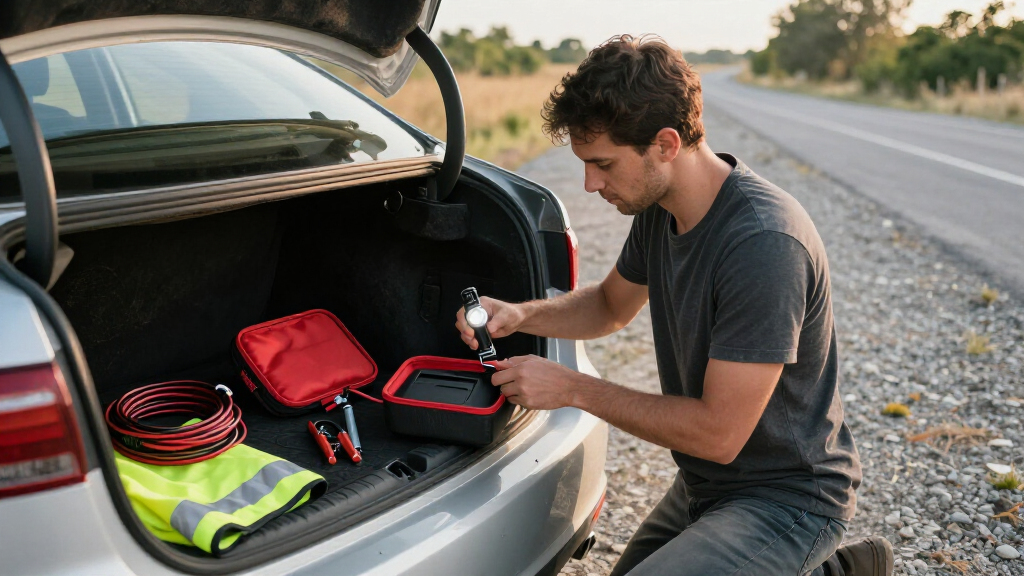
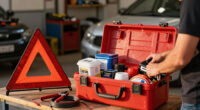
Choosing a car emergency kit is a choice between getting a ready-packed set quickly and building a collection around the problems you are most likely to face. A preassembled car emergency kit bundles common supplies in one purchase; a DIY car emergency kit lets you select each tool, first-aid item and weather supply yourself. The difference matters because kits vary widely: a low price or a long item list does not guarantee that a kit includes equipment suited to your vehicle or that every item meets your needs. Choose the preassembled option if convenience and a straightforward starting point matter most. Choose DIY if you want to check quality, fill gaps in an existing kit or prepare for particular routes and weather.

Get business pricing on garage and car supplies
- Business-only prices and quantity discounts
- Tax-exempt purchasing
- Multiple users, one account, clear invoices

Everlit Survival Car Emergency Kit with Tire Inflator, First Aid Kit, Jumper Cables and Roadside Tools
- ✔ Tire inflator: 12V digital air compressor with auto shutoff and LED light
- ✔ Jumper cables: 12 feet, 8 gauge, rated for 300 amps
- ✔ First aid kit: 108 pieces

AUTODECO Car Emergency Roadside Assistance Kit with Jumper Cables and Tire Inflator
- ✔ Brand: AUTODECO
- ✔ Manufacturer: AUTODECO
- ✔ Item weight: 5.3 pounds

Winter Car Emergency Kit with Jumper Cables and Detachable Snow Brush
- ✔ Snow brush length: 27 inches
- ✔ Snow brush design: Detachable brush and ice scraper
- ✔ Jumper cables: Included; length and wire gauge not specified
At a Glance
| Criteria | Preassembled car emergency kit | DIY car emergency kit | Winner |
|---|---|---|---|
| Setup and convenience | One purchase; items arrive gathered together, though contents still need checking. | Requires choosing, buying and organizing items; takes more time initially. | A |
| Control over contents | Fixed contents chosen by the seller; additions may be needed. | Full control to select tools, supplies and quantities. | B |
| Quality checking | Quality and suitability vary by brand and item; inspect specifications and contents. | You can compare specifications and choose trusted items, though research is required. | B |
| Coverage for likely emergencies | Provides a starting set, but may omit important items or include tools unsuitable for your needs. | Can be tailored to driving conditions, vehicle needs and gaps in supplies you already own. | B |
| Cost and value | Often costs less upfront than buying many items individually, but value depends on useful, usable contents. | Costs depend on choices; buying durable or specialized gear may raise the total, while reusing supplies may lower it. | Depends |
| Maintenance and replacement | A single package is easy to inspect, but dates, batteries and damaged items still need attention. | You track and replace each item yourself; simple inventory notes can help. | A |
| Fit for a specific vehicle or climate | General-purpose contents may not suit every vehicle, season or route. | Can reflect the vehicle, climate, passenger needs and trips you actually take. | B |
Everlit Survival Car Emergency Kit with Tire Inflator, First Aid Kit, Jumper Cables and Roadside Tools
Everlit makes the strongest case as a single kit for varied roadside problems. Along with a 12V digital inflator that stops at a preset pressure, it includes 12-foot, 8-gauge jumper cables rated for 300 amps, a 108-piece first aid kit, gloves, a warning triangle, tow rope, and flashlight. Those additions give it a wider role than the AUTODECO bundle, whose listing centers on cables and an inflator, and the winter kit, which concentrates on snow clearing and cold-weather supplies.The auto-shutoff feature is useful because it can stop inflation at the pressure we set, helping avoid continuous monitoring while we work. Still, the listing gives no inflator performance measurements, such as an inflation rate, so we cannot compare its speed or capacity. Everlit’s cable details are more transparent than those of the other two kits, but the product information specifies them for standard vehicles; owners of vehicles with different requirements should verify compatibility before relying on them.Everlit earns the top spot through breadth and clearer core specifications, not because every component is fully documented. It is the most sensible pick for drivers who want first aid and basic visibility or recovery supplies alongside jump-starting and inflation tools. If trunk space is the priority, AUTODECO is the more compactly described alternative. For regular snow and ice, the dedicated brush and blankets in the winter kit are more relevant than Everlit’s general-purpose mix.
Pros:
- Combines an inflator and jumper cables with first aid and roadside safety supplies.
- Digital inflator has preset-pressure auto shutoff and an LED light.
- Jumper cables are specified as 12 feet, 8 gauge, and 300 amps.
- Includes a warning triangle, tow rope, flashlight, and gloves.
Cons:
- No tire-inflator performance measurements are provided.
- Jumper cables are described for standard vehicles, so compatibility should be checked.
- The broad collection may be more than drivers seeking a compact essentials-only bag need.
Best for: Drivers seeking one general-purpose kit with jump-starting, tire inflation, first aid, and basic roadside safety supplies.
Not ideal for: Buyers who need measured inflator performance, or owners who have not confirmed that the stated standard-vehicle jumper cables suit their vehicle.
Bottom line: We rank Everlit first for the widest stated all-season roadside coverage, with the caveat that buyers must verify inflator performance expectations and cable compatibility.
“We rank Everlit first for the widest stated all-season roadside coverage, with the caveat that buyers must verify inflator performance expectations and cable compatibility.”
AUTODECO Car Emergency Roadside Assistance Kit with Jumper Cables and Tire Inflator
AUTODECO is the storage-conscious pick in this group. Its listed weight is 5.3 pounds, and its package dimensions are about 12.87 by 9.37 by 4.33 inches. The kit is supplied in a bag, giving buyers concrete information to consider when planning trunk space. By comparison, Everlit offers more clearly named categories of supplies but is framed as a broader collection, while the winter kit includes a 27-inch brush that serves a specific seasonal need.The core appeal is straightforward: AUTODECO pairs jumper cables and a tire inflator in a compact roadside bundle, with cables described as reinforced PVC designed to resist freezing, cracking, and tangling. That cable construction may be useful for a kit that stays in the car through changing conditions. However, the listing does not identify the inflator’s power source or pressure capacity, and it does not break down what the 69-piece count includes. Buyers therefore have less information to judge what they can actually do with it than they get from Everlit’s named first aid, safety, and recovery supplies.We place AUTODECO below Everlit because its coverage is harder to verify from the supplied details, even though its storage profile is clearer. It suits drivers who want a bagged kit with the two central electrical and tire-related tools and who are comfortable checking the complete contents and specifications before purchase. It is a weaker fit for someone assembling a kit around clearly stated medical, visibility, or recovery equipment. For winter-specific clearing and warmth, the dedicated snow kit provides more explicit seasonal tools.
Pros:
- Includes both jumper cables and a tire inflator.
- Bagged format and listed dimensions help with trunk-space planning.
- Listed weight is 5.3 pounds.
- Cable material is described as designed to resist freezing, cracking, and tangling.
Cons:
- The inflator’s power source and pressure capacity are not stated.
- The 69-piece contents are not itemized in the supplied description.
- Jumper-cable length and gauge are not provided.
Best for: Drivers who want a compact, bagged roadside kit for everyday trunk storage and prioritize jumper cables plus a tire inflator.
Not ideal for: Buyers who need a detailed inventory, a stated inflator power source and capacity, or clearly documented medical and safety supplies.
Bottom line: We recommend AUTODECO for buyers who value a compact bag and the two core tools, provided they first confirm the kit’s contents and equipment specifications.
“We recommend AUTODECO for buyers who value a compact bag and the two core tools, provided they first confirm the kit’s contents and equipment specifications.”
Winter Car Emergency Kit with Jumper Cables and Detachable Snow Brush
This kit earns its place by preparing for a narrower problem set: snow, ice, and cold-weather exposure. Its 27-inch brush detaches for smaller areas and pairs with an ice scraper, while two emergency blankets and grip work gloves address comfort and handling during a winter roadside stop. Those supplies are more season-specific than Everlit’s first aid and general roadside mix, and more explicit than AUTODECO’s broadly described 69-piece kit.The detachable design can help us clear larger vehicle surfaces with the full brush and reach smaller areas with the separated tool. The blankets and gloves also make the kit more than a snow-clearing set, particularly if a delay leaves occupants waiting in cold conditions. But it does not list an inflator, first aid kit, warning triangle, or tow rope, so it does not match Everlit’s breadth for general roadside preparedness. It is best understood as a seasonal kit, or as a complement to equipment the driver already keeps in the car.Our main reservation is that the jumper-cable length and wire gauge are unspecified. AUTODECO also omits cable measurements, but at least its listing describes a compact bag and cable material; Everlit provides the clearest cable figures in the lineup. The winter kit’s two-year warranty is the longest stated here, yet warranty length does not resolve uncertainty about cable suitability or storage dimensions. Choose it for the listed winter tools, then confirm the jump-start equipment fits your vehicle’s needs.
Pros:
- Combines a 27-inch snow brush and ice scraper in a detachable design.
- Includes two emergency blankets and grip work gloves.
- Adds jumper cables to the winter-specific supplies.
- Has a stated 2-year warranty.
Cons:
- Jumper-cable length and wire gauge are not specified.
- No tire inflator or first aid kit is listed.
- Storage bag dimensions are not provided.
Best for: Drivers in snowy or cold regions who want vehicle-clearing tools, emergency blankets, and gloves together with basic jump-start equipment.
Not ideal for: Drivers seeking a complete all-season kit with a tire inflator, clearly specified jumper cables, and a broad first aid or roadside safety assortment.
Bottom line: We choose this kit for winter clearing and cold-weather preparedness, while recommending that buyers verify the cable details and supplement its narrower roadside coverage as needed.
“We choose this kit for winter clearing and cold-weather preparedness, while recommending that buyers verify the cable details and supplement its narrower roadside coverage as needed.”
As an Amazon Associate we earn from qualifying purchases.
Key Differences
The main advantage of a preassembled kit is lower setup effort. A single purchase gives you a container and a group of commonly marketed emergency supplies, which can help if you have no kit at all and need a starting point. Its limitation is that the seller decides what goes inside. Check the actual item list before buying: a kit may emphasize small accessories while leaving out equipment you need, or its tools may not match your car. “Complete” is a marketing description, not a guarantee of suitability.
A DIY kit takes longer to assemble, but that time buys control. You can choose a tire inflator compatible with your vehicle, add supplies for cold or hot weather, account for passengers, and avoid buying duplicates. It can be better value when you already own useful items. The tradeoff is responsibility: you must research, organize and maintain the collection yourself. In practice, the best choice is the one you will keep accessible, check periodically and know how to use.
Detailed Comparison
Setup and convenience (Preassembled car emergency kit wins — moderate)
The preassembled kit wins by a moderate margin on convenience: you can buy one package and store it in the car with little initial planning. DIY requires selecting items, making separate purchases and organizing them. That extra work may be manageable if you enjoy preparation, but it can also leave a kit unfinished. For someone starting from nothing, the ready-made option is a practical shortcut—provided they review its contents and add missing essentials.
Control over contents (DIY car emergency kit wins — major)
DIY wins by a major margin for control. You decide which supplies to carry, how much to include and which gaps in your existing equipment to address. A preassembled kit locks in the seller’s selection; even a broad contents list may not match your priorities. This difference matters if you have specific tools in mind, already own some supplies, or want to account for regular passengers and particular travel conditions.
Quality checking (DIY car emergency kit wins — moderate)
DIY has the advantage, with a moderate gap, because each item can be compared and chosen separately. That takes research, and it does not automatically make every DIY choice better. A preassembled kit can contain useful gear, but the package label alone tells little about an individual tool’s build, compatibility or performance. Check product details either way; with a ready-made set, pay special attention to whether its tools suit your vehicle.
Coverage for likely emergencies (DIY car emergency kit wins — moderate)
DIY wins by a moderate margin when it is planned around real use. A commuter in a mild climate and a driver crossing remote winter roads do not face the same conditions. A general-purpose package gives a baseline, but it can include items you will not use and miss supplies that matter to you. Tailoring the kit helps close that gap, though no collection covers every emergency and supplies are useful only if you can use them safely.
Cost and value (moderate difference)
There is no fixed winner because prices, contents and existing supplies differ. A preassembled set may be cheaper upfront than purchasing many separate items, especially for a basic starting kit. DIY may offer better value if you already have some gear or prefer spending more on a few well-chosen tools. Compare the usable contents and the likely cost of filling gaps, rather than judging by the package price or number of listed items alone.
Maintenance and replacement (Preassembled car emergency kit wins — minor)
The preassembled kit has a minor convenience edge because its contents sit together in one package and can be checked as a group. That does not remove maintenance: inspect supplies, replace items that expire or are damaged, and check batteries according to their instructions. A DIY kit takes more effort to track because its contents come from separate sources, but an inventory makes the task manageable and can make replacements more targeted.
Fit for a specific vehicle or climate (DIY car emergency kit wins — major)
DIY wins by a major margin when the car or driving conditions call for particular choices. You can select equipment to match your vehicle, add seasonal supplies and account for the routes you take. Preassembled kits generally aim for broad appeal, which makes them simpler to shop for but less tailored. If your driving is ordinary and you want a basic starting point, that general fit may be sufficient; for demanding conditions, customization is more useful.
Preassembled car emergency kit: Pros and Cons
Pros:
- Quick to buy and store as a grouped set.
- Useful starting point for drivers who have no emergency supplies.
- May cost less upfront than assembling a large collection.
Cons:
- Fixed contents can leave gaps or include items you do not need.
- Quality and vehicle compatibility depend on the specific kit.
- You may need to spend more to replace or supplement unsuitable items.
DIY car emergency kit: Pros and Cons
Pros:
- Contents can match your vehicle, routes, climate and passengers.
- You can choose the quality and specifications of each item.
- Existing supplies can be reused, and spending can focus on actual gaps.
Cons:
- Takes time to research, buy and organize.
- Costs can rise when buying durable or specialized equipment.
- You are responsible for tracking, inspecting and replacing each item.
Who Should Choose What
Choose Preassembled car emergency kit if:
- You want a convenient starting point and do not yet own emergency supplies.
- You prefer one purchase and are willing to check the contents before relying on it.
- Your driving is mostly routine and a general-purpose selection covers your needs.
Choose DIY car emergency kit if:
- You want to choose each tool and supply based on your own vehicle and driving conditions.
- You already own some useful items and want to fill specific gaps.
- You drive in demanding weather or remote areas and want a more tailored setup.
Skip both if: Neither format is enough if you will not keep the kit accessible, check its contents or learn the safe use of its tools. Start with a smaller set of supplies you can maintain, then add items as your needs become clear.
Value for Money
Paying for a preassembled kit is worthwhile when it saves you time and its contents are genuinely useful. It can be a sensible entry point, especially if you have no supplies and would otherwise put off assembling them. Do not pay a premium just for a large item count or broad claims: inspect the list, confirm that tools suit your vehicle and account for anything you still need to buy. DIY can be better value when you can reuse gear and spend selectively. It may also cost more if you choose durable or specialized items, but that premium can make sense for drivers whose conditions call for them. The better value is the kit whose usable contents fit your needs at a reasonable total cost.
Final Verdict
For most drivers who need a kit quickly and have no supplies, choose a preassembled car emergency kit as a convenient starting point, then check its contents and fill any clear gaps. Choose DIY if you care about tailoring the equipment, already own some useful items or regularly drive in conditions a general-purpose package may not address. The biggest deciding factor is fit: pay more or invest extra time only when the added items solve a real problem for your vehicle and routes. A carefully selected basic kit is more useful than a larger collection you do not understand or maintain.
Frequently Asked Questions
Is a preassembled car emergency kit enough on its own?
It may be enough for some drivers, but check the actual contents against your vehicle and the conditions you face. Replace unsuitable items and add any important supplies it lacks.
Is a DIY car emergency kit cheaper?
Sometimes. Reusing items you already own can reduce the total, while choosing durable or specialized equipment can raise it. Compare the cost of useful, compatible contents rather than assuming either format is always cheaper.
Which option is better for winter driving?
A DIY kit gives you more control to choose supplies suited to your climate and routes. A ready-made kit can still be a starting point, but review its contents and add what your winter driving requires.
What should I check before buying a ready-made kit?
Read the item list, check whether tools are compatible with your vehicle, and look for clear product specifications. Think about whether the supplies suit your trips and what you would still need to add.
Halloween Picks
halloween
As an affiliate, we earn on qualifying purchases.