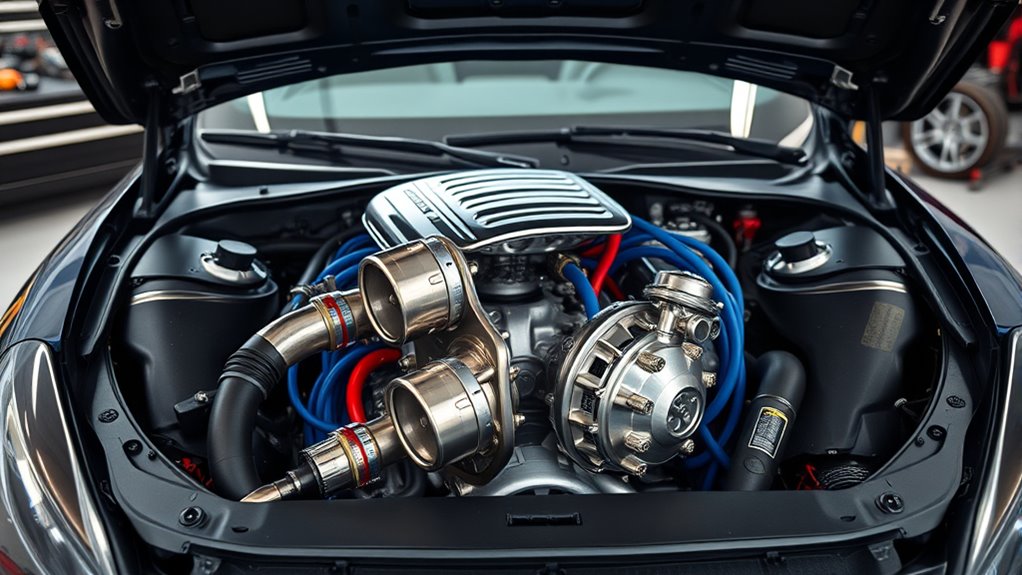

Premium supercharger kits range from street-focused, vehicle-specific systems to traditional Roots-style setups that demand more custom planning. My best overall pick is the Edelbrock 1551 E-Force Street Legal Supercharger Kit, which stands out for buyers who want a street-oriented system with a stated emissions-compliance focus. The VMP Performance Gen 6 3.0L kit is a notable choice for a 2024 Mustang GT, while the Whipple kit for the 7.3L F-250 targets drivers seeking a vehicle-specific truck upgrade. The main tradeoffs are fitment, installation complexity, intended driving use, and whether a kit’s legal status matches your location. Read on for how these eight options compare and which buyer each one suits.

Get business pricing on garage and car supplies
- Business-only prices and quantity discounts
- Tax-exempt purchasing
- Multiple users, one account, clear invoices
Complete the kit


Key Takeaways
- Vehicle-specific kits lead for predictable fitment: the Whipple F-250, Edelbrock Wrangler, VMP Mustang, and Chevrolet Performance ZL1 kits are tied to defined applications, unlike the three Speedmaster 6-71 kits, which require closer scrutiny of engine details and installation needs.
- Street legality is a distinct advantage, not a universal claim: the Edelbrock 1551 is identified as street legal, but buyers still need to verify local rules and exact vehicle eligibility before purchase.
- The Speedmaster kits share a Roots-style format but not a fitment target: GM LS, big-block Chevy, and small-block Chevy applications are separate choices, so engine family and supporting parts matter more than the shared 6-71 name.
- Newer, higher-output applications can bring added system demands: the VMP Mustang and Chevrolet Performance ZL1 upgrades suit buyers pursuing performance on specific platforms, but neither should be treated as a universal bolt-on for other cars.
- The ranking favors application clarity and buyer usability: a defined vehicle match and clear intended use rank ahead of a kit that may require more custom verification, even when the latter suits a specialized build.
| Speedmaster 6-71 Roots Supercharger Kit for GM LS Engines |  | Best LS V8 Roots Kit | Brand: Speedmaster | Model: PCE460.1015 | Compatible engines: GM LS1, LS2, LS3, LS6, LS7, 4.8L, 5.3L, 6.0L, and 6.2L | VIEW ON AMAZON | See Our Full Breakdown |
| Whipple Supercharger Kit for 2020-2022 Ford F-250 7.3L (Gloss Black) |  | Best for Heavy Towing | Brand: Whipple Superchargers | Model: WS-WK-2340-STG1-30 | Compatibility: 2020–2022 Ford F-250 7.3L | VIEW ON AMAZON | See Our Full Breakdown |
| Speedmaster 6-71 Roots Supercharger Kit for Big Block Chevy |  | Best for Big-Block Race Builds | Brand: Speedmaster | Model: PCE460.1010 | Compatible engines: Big Block Chevy 396, 402, 427, 454, 496, and 502 | VIEW ON AMAZON | See Our Full Breakdown |
| Speedmaster 6-71 Roots Supercharger Kit for Small Block Chevy |  | Best for Small-Block Chevy Projects | Brand: Speedmaster | Model: PCE460.1009 | Compatible engines: Small Block Chevy 265, 283, 305, 307, 327, 350, 383, and 400 | VIEW ON AMAZON | See Our Full Breakdown |
| Edelbrock E-Force Supercharger Kit for 2015–2017 Jeep Wrangler 3.6L |  | Best for Wrangler-Specific Fitment | Vehicle fitment: 2015–2017 Jeep Wrangler 3.6L | Rotor type: Eaton TVS 1320 | Maximum boost pressure: 8 psi | VIEW ON AMAZON | See Our Full Breakdown |
| Edelbrock 1551 E-Force Street Legal Supercharger Kit |  | Best for Conventional-Head Carbureted Builds | System type: Carbureted | Cylinder head compatibility: Conventional | Rotor type: Eaton H122 | VIEW ON AMAZON | See Our Full Breakdown |
| VMP Performance Gen 6 3.0L Supercharger Kit Stage 1 for 2024 Mustang GT |  | Best Complete Performance Package for a 2024 Mustang GT | Compatibility: 2024 Mustang GT 5.0L (S650) | Supercharger type: Gen 6 3.0L, front-inlet, blow-up style | Throttle body: 92mm | VIEW ON AMAZON | See Our Full Breakdown |
| Chevrolet Performance ZL1 Supercharger Upgrade Kit (12622236) |  | Best OEM-Sourced Upgrade for Specific LSA Cars | Brand: Chevrolet Performance | Manufacturer part number: 12622236 | Compatible vehicles: Camaro LSA engines; 2009–2014 Cadillac CTS-V | VIEW ON AMAZON | See Our Full Breakdown |
| premium supercharger kit | Brand | Supercharger type | Model |
|---|---|---|---|
| Speedmaster 6-71 Roots Superch | Speedmaster | 6-71 Roots-style | PCE460.1015 |
| Whipple Supercharger Kit for 2 | Whipple Superchargers | Gen 5 3.0L twin-screw | WS-WK-2340-STG1-30 |
| Speedmaster 6-71 Roots Superch | Speedmaster | 6-71 Roots-style, 3-lobe rotors | PCE460.1010 |
| Speedmaster 6-71 Roots Superch | Speedmaster | 6-71 Roots-style | PCE460.1009 |
| Edelbrock E-Force Supercharger | — | — | — |
| Edelbrock 1551 E-Force Street | — | — | — |
| VMP Performance Gen 6 3.0L Sup | — | Gen 6 3.0L, front-inlet, blow-up style | — |
| Chevrolet Performance ZL1 Supe | Chevrolet Performance | — | — |
More Details on Our Top Picks
Speedmaster 6-71 Roots Supercharger Kit for GM LS Engines
For a car build centered on a standard-deck GM LS engine, this Speedmaster kit bundles the major hardware needed for a classic 6-71 Roots setup: supercharger, intake manifold, drive components, dual-carb adapter, and gaskets. Its advertised 45–55% horsepower increase makes it a race-oriented choice, not a finished street-ready package. Compared with the Speedmaster Small Block Chevy kit, this version targets LS1 through LS7 and several common truck-displacement engines, so the engine family—not a different power-adder design—is the key distinction. Two included Gilmer pulley sizes provide some boost adjustment, but other sizes, carburetors, and a distributor are separate purchases. At 134.6 pounds, it also demands careful attention to fitment, engine strength, tuning, and local emissions rules.
Pros:- Broad fitment across listed GM LS1, LS2, LS3, LS6, LS7, and several 4.8L–6.2L engines
- Major supercharger drive and intake components are included
- Two Gilmer pulley sizes allow some boost adjustment
- Dual four-barrel adapter supports a range of typical carburetor sizes
Cons:- Carburetors and distributor must be sourced separately
- Race-oriented setup requires careful engine, tuning, and emissions verification
- Heavy assembly and separately sold pulley sizes add installation and setup demands
Best for: Builders of a standard-deck GM LS-powered car who want a complete Roots-style hardware foundation for a race-focused carbureted setup.
Not ideal for: Daily drivers seeking a turnkey, emissions-approved fuel-injected system, or LS owners who cannot verify engine strength and installation clearance.
- Brand:Speedmaster
- Model:PCE460.1015
- Compatible engines:GM LS1, LS2, LS3, LS6, LS7, 4.8L, 5.3L, 6.0L, and 6.2L
- Supercharger type:6-71 Roots-style
- Advertised horsepower increase:45–55%
- Included pulleys:50T and 55T Gilmer pulleys; V-belt crank pulley
- Carburetor adapter:Dual 4-barrel square-bore; 600–850 cfm typical
- Item weight:134.6 pounds
- Warranty:12 months
Our verdict“Choose this kit for a race-focused standard-deck LS car when you want a bundled 6-71 setup and can handle the separately sourced fueling and ignition parts.”
Whipple Supercharger Kit for 2020-2022 Ford F-250 7.3L (Gloss Black)
This Whipple kit earns its place for buyers who need a vehicle-specific power upgrade for a 2020–2022 F-250 with the 7.3L engine. Its Gen 5 3.0L twin-screw supercharger is paired with stated output of up to 700 flywheel horsepower and 750 lb-ft of torque, a combination aimed at moving a heavy truck under load. The claimed bolt-on installation, with no cutting or grinding, is a more integrated route than the Speedmaster 6-71 kits, which require separate carburetors and distributor and are described as race-oriented. That convenience comes with narrow fitment: it is not a general-purpose car kit and does not apply to other F-250 years or engines. Buyers should also confirm that the stated output and installation details match their truck configuration.
Pros:- Designed specifically for the 2020–2022 F-250 7.3L
- Gen 5 3.0L twin-screw system is rated for up to 700 hp and 750 lb-ft
- Bolt-on installation is described as requiring no cutting or grinding
- Gloss-black finish and upgrade potential suit a dedicated truck build
Cons:- Fitment is limited to a specific truck, engine, and model-year range
- Not a suitable choice for the car-focused builds addressed by the LS and Chevy Roots kits
- The stated output is a flywheel figure and should not be treated as a guaranteed result in every truck
Best for: Owners of a 2020–2022 Ford F-250 7.3L who want a vehicle-specific, high-output system for towing or daily truck use.
Not ideal for: Car owners, F-250 owners with a different model year or engine, and shoppers seeking broad engine-family fitment like the Speedmaster LS kit.
- Brand:Whipple Superchargers
- Model:WS-WK-2340-STG1-30
- Compatibility:2020–2022 Ford F-250 7.3L
- Supercharger type:Gen 5 3.0L twin-screw
- Horsepower:Up to 700 hp at the flywheel
- Torque:Up to 750 lb-ft
- Installation:Bolt-on; no cutting or grinding required
- Finish:Gloss black
Our verdict“Pick the Whipple for a compatible F-250 7.3L used for towing or daily truck duty, but skip it for a car or any other engine-year combination.”
Speedmaster 6-71 Roots Supercharger Kit for Big Block Chevy
Among these Speedmaster options, this is the one aimed at a standard-deck Big Block Chevy, covering listed displacements from 396 to 502 cubic inches. The 6-71 Roots unit uses three-lobe rotors and includes the intake, pulleys, belt, dual-carb adapter, idler bracket, and gaskets, giving a race builder a substantial hardware package. Its advertised 45–55% horsepower increase matches the LS and Small Block Chevy kits, so the choice between them rests on engine fitment rather than a distinct claimed gain. Compared with the Small Block version, this kit is heavier at 137 pounds and is intended for a larger engine family. Carburetors and distributor remain separate, and the racing focus means emissions status, engine capacity for boost, and final tuning need verification.
Pros:- Fits a wide listed range of standard-deck Big Block Chevy displacements
- Includes the supercharger, intake manifold, pulleys, belt, adapter, and gaskets
- Two Gilmer pulley sizes provide a choice in the drive setup
- Heavy-duty bearing plates and double-pinned rotors are specified for sustained boost
Cons:- Carburetors and distributor are sold separately
- Race-oriented use calls for careful engine preparation and emissions checks
- Additional pulley sizes are separate, and the 137-pound assembly adds installation demands
Best for: Big Block Chevy car or race-car builders with a standard-deck 396–502-cubic-inch engine who want a dual-carb Roots setup.
Not ideal for: Small Block Chevy or LS owners, and street-focused buyers who need included fuel and ignition parts or confirmed emissions compliance.
- Brand:Speedmaster
- Model:PCE460.1010
- Compatible engines:Big Block Chevy 396, 402, 427, 454, 496, and 502
- Supercharger type:6-71 Roots-style, 3-lobe rotors
- Advertised horsepower increase:45–55%
- Included pulleys:50T and 55T Gilmer pulleys; V-belt crank pulley
- Carburetor adapter:Dual 4-barrel square-bore
- Weight:137 pounds
- Warranty:12 months
Our verdict“Choose this kit for a prepared Big Block Chevy race build; the LS or Small Block version is the better fit when your car uses a different engine family.”
Speedmaster 6-71 Roots Supercharger Kit for Small Block Chevy
This kit is the most direct match here for a standard-deck Small Block Chevy car, with fitment listed across familiar 265–400-cubic-inch engines. It follows the same 6-71 Roots formula and advertised 45–55% horsepower increase as Speedmaster’s LS and Big Block kits, but its listed 120-pound weight is lower than either of those packages. That does not make it a light or simple installation; it is still a large assembly intended for racing. The included intake, snout, belt drive, dual-carb adapter, and gaskets provide a solid hardware base, while the two pulley sizes allow some setup choice. Unlike the Whipple F-250 system, it is not presented as a bolt-on daily-use solution, and buyers still need to supply carburetors and a distributor.
Pros:- Broad listed compatibility across Small Block Chevy 265–400 engines
- Includes the supercharger, intake, snout, drive hardware, adapter, and gaskets
- Two Gilmer pulley sizes offer some boost setup flexibility
- Lighter than the listed Speedmaster LS and Big Block kits
Cons:- Carburetors and distributor are not included
- Racing intent means fitment, tuning, engine suitability, and emissions need checking
- Further pulley options must be sourced separately
Best for: Builders of a standard-deck Small Block Chevy car who want a traditional carbureted 6-71 setup for racing or a project build.
Not ideal for: Owners of LS or Big Block engines, or drivers seeking a turnkey street system with included carburetion, ignition, and emissions documentation.
- Brand:Speedmaster
- Model:PCE460.1009
- Compatible engines:Small Block Chevy 265, 283, 305, 307, 327, 350, 383, and 400
- Supercharger type:6-71 Roots-style
- Advertised horsepower increase:45–55%
- Included pulleys:50T and 55T Gilmer pulleys
- Carburetor adapter:Dual 4-barrel square-bore
- Item weight:120 pounds
- Warranty:12 months
Our verdict“This is the Speedmaster pick for a Small Block Chevy race or project car, while LS and Big Block owners should choose their matching engine-specific kit.”
Edelbrock E-Force Supercharger Kit for 2015–2017 Jeep Wrangler 3.6L
The Edelbrock E-Force is the only option in this group specified for a 2015–2017 Jeep Wrangler 3.6L, making vehicle fitment its defining advantage. Its Eaton TVS 1320 rotor and stated maximum boost of 8 psi give Wrangler owners a more targeted alternative to adapting one of the Speedmaster universal-style, carbureted Roots packages. The published maximum output differs by transmission: 277 rear-wheel horsepower with a manual and 235 with an automatic, both with stock tires. That split matters when comparing expected results, and the figures should not be treated as identical across configurations. Unlike the Whipple kit, which is tailored to a specific heavy-duty truck and lists flywheel output, this listing gives Wrangler rear-wheel figures. Verify vehicle configuration and installation details before choosing it.
Pros:- Fitment is specified for the 2015–2017 Wrangler 3.6L
- Uses an Eaton TVS 1320 rotor
- Provides up to 8 psi of boost
- Lists separate rear-wheel horsepower figures for manual and automatic transmissions
Cons:- Compatibility is limited to the specified Wrangler years and 3.6L engine
- Maximum horsepower differs substantially by transmission
- Published figures are specified with stock tires and may not match other vehicle setups
Best for: Owners of a 2015–2017 Jeep Wrangler with the 3.6L engine who want a vehicle-specific supercharger rather than a carbureted universal-style kit.
Not ideal for: Owners of other Wrangler years or engines, and buyers seeking a broad-fit car kit or a single output figure that applies across transmissions.
- Vehicle fitment:2015–2017 Jeep Wrangler 3.6L
- Rotor type:Eaton TVS 1320
- Maximum boost pressure:8 psi
- Maximum horsepower, manual:277 RWHP with stock tires
- Maximum horsepower, automatic:235 RWHP with stock tires
- Pulley:6-rib, 2.625-inch
Our verdict“Choose this E-Force kit for a compatible Wrangler 3.6L when its transmission-specific output figures fit your expectations; skip it for other vehicles or engines.”
Edelbrock 1551 E-Force Street Legal Supercharger Kit
I’d place this Edelbrock E-Force on a shortlist for a car builder whose setup calls for conventional cylinder heads and a carbureted system. Its Eaton H122 rotor and 6-rib drive identify a different fit from the newer, vehicle-specific VMP kit, which targets a 2024 Mustang GT with electronic tuning and a listed power gain. The 3.75-inch pulley is useful fitment information, but the supplied details do not state a horsepower figure or name compatible vehicles, so I would verify application requirements before buying. Compared with the Speedmaster 6-71 kits in this roundup, this is a more specifically described choice for conventional-head compatibility, but the data here does not establish a broader fit range. I’d skip it if I needed a documented, complete modern car-specific package.
Pros:- Eaton H122 rotor is identified in the product data
- Designed for conventional cylinder head compatibility
- Carbureted system type is specified
- 3.75-inch pulley and 6-rib drive provide useful configuration details
Cons:- Compatible vehicle and engine applications are not specified in the supplied data
- No power-gain figure or tuning details are provided
- Included components and installation requirements are not detailed
Best for: Builders of carbureted car engines with conventional cylinder heads who have confirmed the kit matches their specific application.
Not ideal for: Buyers seeking a clearly documented, vehicle-specific modern kit, a stated power gain, or detailed installation and tuning information.
- System type:Carbureted
- Cylinder head compatibility:Conventional
- Rotor type:Eaton H122
- Drive:6-rib
- Pulley size:3.75 in.
- Product line:E-Force
Our verdict“Choose this Edelbrock if your carbureted car build uses compatible conventional heads and you can confirm fitment before purchase.”
VMP Performance Gen 6 3.0L Supercharger Kit Stage 1 for 2024 Mustang GT
For a 2024 Mustang GT 5.0L owner seeking a substantial power increase in a car-specific package, this VMP Stage 1 is the most clearly specified option among these three. The manufacturer lists over 300 rear-wheel horsepower in added output, plus a 92mm throttle body, 56-pound injectors, dual-core dual-pass intercooling and a Tomahawk Flash tuning device. That combination gives buyers more documented integration detail than the Edelbrock 1551, whose supplied information does not list a vehicle application or power gain. VMP also describes stock-like driving with its tuning, but professional installation is advised, and this kit is limited to the stated Mustang model year and engine. I’d rank its completeness and car-specific performance ahead of the Chevrolet cover-and-intercooler upgrade, which is aimed at different vehicles and does not list a power gain.
Pros:- Listed power gain exceeds 300 rear-wheel horsepower
- Includes Tomahawk Flash tuning device, injectors and throttle body
- Dual-core, dual-pass intercooler supports charge-air cooling
- Tuning is described as supporting stock-like driving
Cons:- Professional installation is advised, adding labor and planning requirements
- Compatibility is limited to the 2024 Mustang GT 5.0L application
- The substantial power increase may require the owner to account for broader vehicle demands
Best for: 2024 Mustang GT 5.0L owners who want a high-output supercharger package with included tuning and supporting fuel and cooling components.
Not ideal for: DIY buyers without supercharger installation experience, owners of other Mustang years, or drivers unwilling to budget for professional installation.
- Compatibility:2024 Mustang GT 5.0L (S650)
- Supercharger type:Gen 6 3.0L, front-inlet, blow-up style
- Throttle body:92mm
- Injectors:56-pound
- Pulley size:3.875 in.
- Intercooler:Dual-core, dual-pass
- Tuning device:Tomahawk Flash
- Power gain:Over 300 RWHP
- Installation:Professional installation advised
Our verdict“Pick the VMP kit if you own a 2024 Mustang GT 5.0L and want a documented, tuned package built around a major power increase.”
Chevrolet Performance ZL1 Supercharger Upgrade Kit (12622236)
This Chevrolet Performance upgrade is a targeted choice for Camaro LSA engines and 2009–2014 Cadillac CTS-V applications, not a general-purpose supercharger kit. Its stated contents focus on the supercharger cover and intercooler upgrade, making it distinct from the complete VMP Mustang package, which lists a blower, injectors, throttle body and tuning device. The OEM source and vehicle-specific fit are useful when the goal is an application-matched component upgrade, but the supplied description does not explain installation needs, performance change or exactly what “per item description” includes. That leaves more homework for the buyer than the VMP listing, while the Edelbrock 1551 is aimed at a different carbureted, conventional-head setup. I’d choose this only after confirming the part number and included pieces match the intended LSA car.
Pros:- Specified for Camaro LSA engines and 2009–2014 Cadillac CTS-V models
- Includes a supercharger cover and intercooler upgrade according to the description
- Chevrolet Performance part with an identified manufacturer part number
- Vehicle-specific fit helps narrow the intended applications
Cons:- Fitment is restricted to the listed LSA applications
- Installation requirements are not detailed in the supplied product data
- Power gain and the precise included contents are not specified
Best for: Camaro LSA or 2009–2014 Cadillac CTS-V owners seeking a Chevrolet Performance cover and intercooler upgrade for a confirmed compatible application.
Not ideal for: Buyers looking for a complete supercharger system, quantified power gains, broad vehicle compatibility, or clearly documented installation instructions.
- Brand:Chevrolet Performance
- Manufacturer part number:12622236
- Compatible vehicles:Camaro LSA engines; 2009–2014 Cadillac CTS-V
- Fit type:Vehicle specific
- Included upgrade components:Supercharger cover and intercooler upgrade
- Color:Black
- Dimensions:20.3 x 16.7 x 6.5 inches
- Weight:15.6 pounds
- Manufacturer warranty:30 days
Our verdict“Choose this Chevrolet Performance part if you have a compatible Camaro LSA or 2009–2014 CTS-V and have verified its included upgrade components.”

How We Picked
I ranked these kits by how clearly they match a buyer’s vehicle and use case, then weighed the practical implications of the supercharger format, stated street or emissions positioning, and likely installation planning. Vehicle-specific systems earned an advantage because they narrow fitment uncertainty, while the Speedmaster 6-71 options were judged as separate engine-family choices rather than interchangeable kits. I also considered whether the product information supports a clear recommendation without assuming unlisted power figures, included components, or emissions approvals.
The order reflects how broadly useful and straightforward each choice appears for its intended buyer—not a claim that every kit fits every car or produces the same result. A specialized truck or engine-swap buyer may reasonably put a lower-ranked option first. Before buying, confirm the exact year, engine, transmission, calibration requirements, included hardware, and local legal status with the manufacturer or installer.
| premium supercharger kit | Brand | Model |
|---|---|---|
| Speedmaster 6-71 Roots Superch | Speedmaster | PCE460.1015 |
| Whipple Supercharger Kit for 2 | Whipple Superchargers | WS-WK-2340-STG1-30 |
| Speedmaster 6-71 Roots Superch | Speedmaster | PCE460.1010 |
| Speedmaster 6-71 Roots Superch | Speedmaster | PCE460.1009 |
| Edelbrock E-Force Supercharger | — | — |
| Edelbrock 1551 E-Force Street | — | — |
| VMP Performance Gen 6 3.0L Sup | — | — |
| Chevrolet Performance ZL1 Supe | Chevrolet Performance | — |
Factors to Consider When Choosing Premium Supercharger Kits
Choosing a premium kit starts with fitment, but the purchase decision reaches beyond the blower itself. These checks can help prevent an expensive mismatch and clarify when a more complete, application-specific system is worth choosing over a setup that leaves more decisions to the installer.
Match the Kit to the Exact Engine and Vehicle
Start with the vehicle’s year, engine code, and any changes made since it left the factory. An engine family name alone may not establish compatibility with brackets, intake layout, accessories, or control systems. This matters especially when comparing the Speedmaster LS, big-block Chevy, and small-block Chevy kits: their shared 6-71 Roots description does not make them substitutes. Ask the seller for a written fitment confirmation and a list of required supporting parts. If the car has a swap, modified heads, or nonstandard accessories, budget for a specialist’s review before ordering.
Choose Power Delivery for the Way You Drive
Different supercharger designs and calibrations can change how power arrives, how the engine responds, and what supporting systems the build needs. A street-driven car may benefit more from a setup developed around its original vehicle systems than from a visually dramatic blower chosen by appearance alone. Track use, towing, and occasional cruising also place different demands on cooling, fueling, and drivability. Avoid comparing kits by displacement or product name alone when the manufacturer has not supplied directly comparable output data. Ask how the intended use affects calibration, heat management, and maintenance intervals before treating peak power as the deciding factor.
Check Emissions and Road-Legal Requirements
A product labeled street legal can simplify the decision, but that label does not automatically settle legality in every state or for every vehicle configuration. Confirm the exact vehicle application, emissions documentation, and any required inspection procedures with the seller and local authorities. Do not assume that a kit approved for one model year covers another year or an engine swap. If the car must pass regular emissions testing, make compliance a purchase requirement rather than a detail to sort out after installation. Buyers building a dedicated off-road or competition car may have different priorities, but should still check event and insurance rules.
Price the Complete Installation, Not Just the Kit
A premium kit can still require added labor, calibration, fuel-system changes, cooling upgrades, or replacement wear items. Ask for an itemized list of what comes in the box and what the installer expects you to supply. A vehicle-specific system may reduce fabrication work, while a more custom setup can make sense for a builder who already has compatible parts and fabrication skills. Get a labor estimate from a shop familiar with the exact platform before committing. This helps distinguish genuine value from a lower parts bill that grows once the car is apart.
Plan for Calibration, Heat, and Long-Term Ownership
Supercharging changes engine load, so calibration quality and thermal control belong in the decision from the start. Ask who supplies the calibration, whether it is matched to your fuel and vehicle configuration, and what support is available if the car has related modifications. Heat can affect repeat performance and component life, particularly in demanding street or track use. Check service guidance for belts, fluids, and inspection intervals rather than assuming maintenance matches a stock engine. A kit with a clear support path may suit a first-time buyer better than a less-defined system that depends on the owner to coordinate several specialists.
Frequently Asked Questions
Which kit makes the most sense for a street-driven car that must meet emissions rules?
The Edelbrock 1551 is the clearest match in this lineup because it is identified as a street-legal E-Force kit. That does not confirm approval for every vehicle, jurisdiction, or modified configuration, so verify the application-specific paperwork before purchase. The other kits should not be assumed to share the same status based only on their brand or intended vehicle. If emissions compliance is mandatory, ask for documentation tied to your exact model year and engine. Treat a seller’s verbal assurance as a starting point, not a substitute for checking local requirements.
Can I choose a Speedmaster 6-71 kit based mainly on the blower style?
No: the LS, big-block Chevy, and small-block Chevy versions serve different engine families and should be treated as distinct fitment choices. A shared Roots-style 6-71 format does not establish that brackets, intake parts, or accessory clearances will work across engines. Confirm your engine configuration and ask for the included-parts list before comparing these options. If your car has a swap or nonstandard components, have an experienced installer review the setup. Buyers seeking a more defined vehicle match may prefer one of the application-specific kits instead.
Are these kits suitable for a car that is used for both commuting and track days?
Some may suit dual-purpose use, but the product name alone does not establish track readiness or easy daily drivability. Ask the manufacturer or installer about calibration choices, cooling capacity, fuel requirements, and recommended service intervals for your intended use. Track sessions can raise thermal and mechanical demands well beyond ordinary commuting. A street-oriented or emissions-focused kit may be a better starting point for regular road use, while a performance-focused application may call for more supporting changes. Decide how much track use you expect before choosing parts and tuning.
What should I confirm before ordering a kit for a modified car?
Provide the seller with the exact year, engine, transmission, ECU details, and a list of relevant modifications. Ask whether the kit accommodates your intake, exhaust, accessory drive, fuel system, and any existing calibration changes. Confirm which parts are included and which must be sourced separately. A modified car can fall outside a kit’s standard fitment even when its engine family appears to match the listing. Written confirmation can help prevent delays, extra fabrication, and uncertainty about support after installation.
When is an application-specific kit worth choosing over a more customizable setup?
An application-specific kit is often the better fit when you want a system designed around a particular vehicle and prefer fewer fitment decisions. The Whipple F-250, Edelbrock Wrangler, VMP Mustang, and Chevrolet Performance ZL1 offerings each target defined platforms, though buyers still need to verify exact compatibility. A customizable setup can suit an experienced builder with a specialized engine combination, existing supporting parts, and access to skilled fabrication. Compare the full installation plan, not just the blower hardware. If you lack a trusted specialist, favor clearer application guidance and manufacturer support.
Conclusion
For a broad street-oriented recommendation, I’d start with the Edelbrock 1551 E-Force because its street-legal positioning gives road-focused buyers a clear point to verify. The best value depends on your exact vehicle and included hardware; among these choices, a well-matched vehicle-specific kit is usually a better value than a cheaper setup that needs extensive custom work. For a premium performance-focused Mustang build, the VMP Gen 6 kit is the dedicated choice, while the Whipple is the specific pick for the 2020–2022 7.3L F-250. Buyers new to supercharging should favor the kit with the clearest fitment and installer support for their car, rather than choosing by blower style alone. For specialized engine builds, select the matching Speedmaster LS, big-block Chevy, or small-block Chevy kit only after confirming components and installation needs; the Chevrolet Performance ZL1 upgrade is the platform-specific route for its intended application.