For an RV tire pressure monitoring system that balances useful coverage and practical setup, I recommend the Tymate TM2 with four sensors as the best overall starting point. The GUTA GT80 with 10 flow-through sensors suits larger rigs and frequent pressure adjustments, while the Tymate TM2 with six sensors and a booster kit offers added coverage and signal support. The main tradeoffs are how many tires you need to monitor, whether flow-through sensors matter to you, and how much setup complexity you can accept. A four-sensor kit may fit a smaller setup, but a long motorhome-and-towable combination can call for extra sensors or a booster. Read on for the full comparison and a guide to matching a system to your RV.

Get business pricing on garage and car supplies
- Business-only prices and quantity discounts
- Tax-exempt purchasing
- Multiple users, one account, clear invoices
Complete the kit


Key Takeaways
- Sensor count is a fit decision, not a quality score: four-sensor kits suit simpler layouts, while six- and 10-sensor options can cover more tires when the included configuration matches your rig.
- The GUTA GT80 flow-through version serves a distinct need: its 10 flow-through sensors are aimed at owners who want to adjust pressure without removing sensors, though that style may not suit every valve and wheel setup.
- Signal support matters on long combinations: the Tymate TM2 six-sensor bundle includes a booster kit, making it a more targeted pick for users concerned about communication across a longer rig.
- Several model families appear in multiple configurations: compare the sensor count and included accessories for each listing rather than assuming TM2, TM12, GT80, or Masoll kits are interchangeable.
- Display and alert preferences can outweigh extra sensors: the Flydew six-wheel model highlights custom alerts, while buyers who only need basic coverage may prefer a simpler four-sensor kit.
| Masoll RV Tire Pressure Monitoring System with 4 Sensors |  | Best for Higher-Pressure RV Tires | Included sensors: 4 | Pressure range: 0–145 psi | Transmission distance: Up to 120 ft | VIEW ON AMAZON | See Our Full Breakdown |
| Tymate TM2 RV Tire Pressure Monitoring System with 4 Sensors |  | Best for Expandable Tire Coverage | Sensors included: 4 external sensors | Maximum tires monitored: 10 | Pressure detection range: 0–87 psi | VIEW ON AMAZON | See Our Full Breakdown |
| Tymate TM7 RV Tire Pressure Monitoring System with 4 Sensors |  | Best for Accuracy and Simple Cab Setup | Sensors: 4 | Pressure detection range: 0–144 psi | Pressure accuracy: ±1.5 psi | VIEW ON AMAZON | See Our Full Breakdown |
| GUTA GT80 RV Tire Pressure Monitoring System with 10 Flow-Through Sensors | 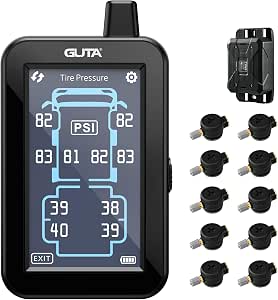 | Best for Large RV and Trailer Combinations | Sensors: 10 flow-through sensors | Maximum monitored tires: 22 | Pressure range: 0–188 psi | VIEW ON AMAZON | See Our Full Breakdown |
| LETOURWM RV Tire Pressure Monitoring System with 4 Sensors |  | Best for Solar and USB-C Charging | Sensor count: 4 | Display: 3.6-inch color LCD with auto brightness | Pressure range: 0–87 psi | VIEW ON AMAZON | See Our Full Breakdown |
| Flydew Tire Pressure Monitoring System with 4 Sensors | 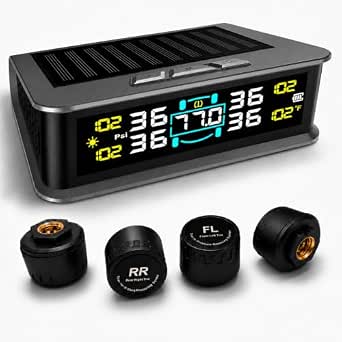 | Best for Simple Four-Tire Setup | Sensors: 4 external sensors | Monitoring range: 0–99 PSI | Display: Color LCD | VIEW ON AMAZON | See Our Full Breakdown |
| Tymate TM12 RV Tire Pressure Monitoring System with 6 Sensors |  | Best for Growing Multi-Axle Setups | Sensors included: 6 | Maximum supported sensors: 12 | Pressure range: 0–144 PSI | VIEW ON AMAZON | See Our Full Breakdown |
| Tymate TM2 RV Tire Pressure Monitoring System with 6 Sensors and Booster Kit |  | Best for Extended Signal Coverage | Sensors included: 6 external sensors | Maximum tires monitored: 10 | Display: Color LCD | VIEW ON AMAZON | See Our Full Breakdown |
| Tymate TM12 RV Tire Pressure Monitoring System with 4 Sensors |  | Best Expandable Four-Sensor Starter | Sensors included: 4 | Maximum sensors supported: 12 | Pressure range: 0–144 PSI | VIEW ON AMAZON | See Our Full Breakdown |
| Flydew 6-Wheel RV Tire Pressure Monitoring System with Custom Alerts |  | Best for Six-Wheel Alert Precision | Model: T15 | Tire capacity: 6 tires | Pressure range: 0–144 PSI | VIEW ON AMAZON | See Our Full Breakdown |
| GUTA GT80 RV Tire Pressure Monitoring System with 10 Sensors |  | Best for Large RV Tire Setups | Sensors included: 10 | Maximum tires monitored: 22 | Pressure range: 0–188 PSI | VIEW ON AMAZON | See Our Full Breakdown |
| Masoll RV Tire Pressure Monitoring System with 4 Sensors |  | Best for Straightforward Four-Tire Monitoring | Sensors included: 4 | Maximum tires monitored: 4 | Maximum tire pressure: 99 PSI | VIEW ON AMAZON | See Our Full Breakdown |
| GUTA GT30 RV Trailer Tire Pressure Monitoring System with 10 Sensors |  | Best for High-Capacity Fleet Monitoring | Sensors included: 10 | Maximum tires supported: 46 | Maximum tires displayed at once: 10 | VIEW ON AMAZON | See Our Full Breakdown |
| Tymate TM3 RV Tire Pressure Monitoring System with 4 Sensors |  | Best for Flexible Display Charging | Sensors included: 4 external sensors | Maximum tires monitored: 10 | Pressure range: 0–144 PSI | VIEW ON AMAZON | See Our Full Breakdown |
| Tymate TM8 RV Tire Pressure Monitoring System with 4 Sensors |  | Best for Short RVs and Four-Tire Setups | Sensors included: 4 | Tire capacity: Up to 4 tires | Pressure range: 0–87 PSI | VIEW ON AMAZON | See Our Full Breakdown |
| tire pressure monitoring system for rv | Pressure range | Sensors included | Display |
|---|---|---|---|
| Masoll RV Tire Pressure Monito | 0–145 psi | — | Color LCD with 4 brightness levels |
| Tymate TM2 RV Tire Pressure Mo | — | 4 external sensors | — |
| Tymate TM7 RV Tire Pressure Mo | — | — | Color LCD with adjustable backlight |
| GUTA GT80 RV Tire Pressure Mon | 0–188 psi | — | 4.3-inch color touchscreen |
| LETOURWM RV Tire Pressure Moni | 0–87 psi | — | 3.6-inch color LCD with auto brightness |
| Flydew Tire Pressure Monitorin | — | — | Color LCD |
| Tymate TM12 RV Tire Pressure M | 0–144 PSI | 6 | Shows up to 6 readings at once |
| Tymate TM2 RV Tire Pressure Mo | — | 6 external sensors | Color LCD |
| Tymate TM12 RV Tire Pressure M | 0–144 PSI | 4 | — |
| Flydew 6-Wheel RV Tire Pressur | 0–144 PSI | — | — |
| GUTA GT80 RV Tire Pressure Mon | 0–188 PSI | 10 | 4.3-inch full-color touchscreen |
| Masoll RV Tire Pressure Monito | — | 4 | — |
| GUTA GT30 RV Trailer Tire Pres | — | 10 | — |
| Tymate TM3 RV Tire Pressure Mo | 0–144 PSI | 4 external sensors | — |
| Tymate TM8 RV Tire Pressure Mo | 0–87 PSI | 4 | — |
More Details on Our Top Picks
Masoll RV Tire Pressure Monitoring System with 4 Sensors
The Masoll stands out for buyers who need more pressure headroom than many four-sensor RV systems offer: its stated range reaches 145 psi, compared with 87 psi for the Tymate TM2 and LETOURWM TPMS-610. Four sensors arrive factory paired, which keeps setup straightforward, while the included signal booster is useful when the monitor and tires are separated by an RV’s length. The color LCD has four brightness settings, and alerts cover tire conditions as well as sensor loss and low sensor voltage. The tradeoff is scale: this is a four-sensor setup with a stated transmission distance of up to 120 feet, not a match for a larger multi-axle rig that needs broad tire coverage. Check your pressure needs and installation distance against those limits before choosing it.
Pros:- 145 psi upper pressure range suits applications beyond the 87 psi ceiling of the Tymate TM2 and LETOURWM TPMS-610.
- Includes four sensors and a signal booster.
- Factory-paired sensors simplify initial setup.
- Color LCD offers four brightness settings and alerts for tire and sensor issues.
Cons:- Four included sensors limit coverage unless additional compatible sensors are available.
- The stated transmission distance is limited to up to 120 feet.
- The listed 1/8-inch NPT thread style should be checked against the intended installation.
Best for: RV owners with four monitored tires and higher-pressure requirements who want a paired sensor setup and included signal booster.
Not ideal for: Owners of large motorhomes or RV-and-trailer combinations needing more than four sensors, or setups that exceed the stated 120-foot transmission distance.
- Included sensors:4
- Pressure range:0–145 psi
- Transmission distance:Up to 120 ft
- Display:Color LCD with 4 brightness levels
- Alerts:High/low pressure, high temperature, rapid leak, sensor loss, low sensor voltage
- Thread style:1/8-inch NPT
- Warranty:1 year
Our verdict“Choose the Masoll if your four monitored tires need its higher 145 psi range and your installation fits within its stated signal distance.”
Tymate TM2 RV Tire Pressure Monitoring System with 4 Sensors
The TM2’s defining advantage is its expandable coverage: it can monitor up to 10 tires, even though this package includes four sensors. That makes it a more flexible starting point than the fixed four-tire focus of the LETOURWM TPMS-610, especially for an RV owner who may add a trailer or wants to monitor more wheel positions later. Its solar, USB, and 12V display-charging options give buyers more ways to keep the monitor powered, and pre-paired, labeled sensors make setup less fiddly. The main limitation is the 0–87 psi range, which rules it out for tires requiring more pressure than that; the Masoll supports up to 145 psi. The TM2’s accuracy is stated at approximately ±3 psi, and a repeater is recommended for trailers at least 36 feet long.
Pros:- Supports monitoring up to 10 tires as coverage needs grow.
- Display can charge by solar, USB, or a 12V socket.
- Four included sensors are pre-labeled and paired.
- Alerts cover leaks, pressure changes, temperature, sensor voltage, and signal loss.
Cons:- The 87 psi maximum is lower than the Masoll system’s 145 psi range.
- A repeater is recommended for towing trailers at least 36 feet long.
- Sensors use CR1632 batteries, and the 12V charging adapter is not included.
Best for: RV owners planning to monitor a combination of up to 10 tires who want multiple display-charging options and can work within an 87 psi limit.
Not ideal for: Owners whose tire pressure exceeds 87 psi, or those towing a trailer at least 36 feet long who do not want to add a repeater.
- Sensors included:4 external sensors
- Maximum tires monitored:10
- Pressure detection range:0–87 psi
- Sensor accuracy:Approximately ±3 psi
- Sensor battery:CR1632; up to 6 months per battery
- Display charging:Solar, USB, or 12V socket
- Recommended valve stem:Metal
Our verdict“Pick the TM2 if you value expansion to as many as 10 tires more than high-pressure capacity and have a plan for trailer signal range.”
Tymate TM7 RV Tire Pressure Monitoring System with 4 Sensors
For buyers who want a clear pressure reading without stepping up to a large multi-tire touchscreen system, the TM7 pairs a ±1.5 psi pressure accuracy claim with a compact, plug-in display. It also tracks temperature and has six alarm types, giving it a more measurement-focused case than the Tymate TM2, whose stated pressure accuracy is approximately ±3 psi. The TM7’s two USB ports add a practical bonus in the cab, while cigarette-lighter power avoids relying on solar charging. Its 0–144 psi range is broad enough for many RV applications, though the four included sensors suit a smaller monitored setup than the GUTA GT80’s ten-sensor package. The caveats are the recommended metal valve stems and a repeater recommendation for trailers at least 36 feet long.
Pros:- Stated pressure accuracy of ±1.5 psi and temperature accuracy of ±3°F.
- 0–144 psi detection range covers a wide range of RV tire pressures.
- Plugs into a cigarette lighter socket and includes two USB outlets.
- Six alert types include warnings for pressure, temperature, leaks, and signal issues.
Cons:- Display power depends on a cigarette lighter socket rather than solar charging.
- A repeater is recommended for trailers at least 36 feet long.
- Metal valve stems are recommended for sensor stability and safety.
Best for: RV drivers who want a compact powered display, more specified pressure accuracy, and USB ports alongside monitoring for four tires.
Not ideal for: Owners seeking a self-contained solar-powered display, coverage for many wheel positions, or a trailer setup where a repeater is undesirable.
- Sensors:4
- Pressure detection range:0–144 psi
- Pressure accuracy:±1.5 psi
- Temperature accuracy:±3°F
- Display:Color LCD with adjustable backlight
- Power:Cigarette lighter socket
- USB outlets:2
Our verdict“Choose the TM7 for a compact, plug-in setup with better stated pressure accuracy than the TM2, provided four sensors cover your needs.”
GUTA GT80 RV Tire Pressure Monitoring System with 10 Flow-Through Sensors
The GT80 is the lineup’s coverage-first choice: its 10 included flow-through sensors and support for up to 22 tires make it better suited to a large motorhome, trailer, or multi-vehicle setup than the four-sensor Masoll or TM7. Flow-through design lets you add air without removing a sensor, a useful difference when checking many tires during a trip. Its 4.3-inch color touchscreen, six alarm modes, and included signal booster give the driver a central view of a complex setup. That scale comes with real constraints: the sensors are specified for metal valve stems, user-replaceable batteries need ongoing attention, and the package weighs 2.31 pounds. For a four-tire RV, this is more system than needed; its strength matters most when broad coverage is the priority.
Pros:- Ten included sensors and capacity for up to 22 monitored tires suit complex RV setups.
- Flow-through sensors allow inflation without removing them.
- 4.3-inch color touchscreen provides a larger display for multiple readings.
- Includes a signal booster and six visual and audio alarm modes.
Cons:- Flow-through sensors are specified for metal valve stems.
- The 2.31-pound package is heavier than the four-sensor systems in this roundup.
- User-replaceable sensor batteries require maintenance.
Best for: Owners of large RVs, multi-axle rigs, or RV-and-trailer combinations who need to monitor many tires and want to inflate them without removing sensors.
Not ideal for: Drivers monitoring only four tires, or owners whose wheels use non-metal valve stems or who prefer a lighter, simpler monitor package.
- Sensors:10 flow-through sensors
- Maximum monitored tires:22
- Pressure range:0–188 psi
- Display:4.3-inch color touchscreen
- Vehicle types:5
- Alarm modes:6
- Signal booster:Included
- Sensor battery:User-replaceable CR2032
Our verdict“Choose the GT80 when monitoring many tires and inflating without sensor removal matter more than a light, minimal four-tire setup.”
LETOURWM RV Tire Pressure Monitoring System with 4 Sensors
The LETOURWM TPMS-610 is a straightforward four-tire pick for drivers who want a larger screen and flexible charging without moving to an expandable system. Its 3.6-inch color LCD adjusts brightness automatically, and solar plus USB Type-C charging gives it more power options than the cigarette-lighter-dependent Tymate TM7. The stated four-second update interval and six alarm modes offer frequent monitoring, while the IP68 screw-on sensors are specified for RVs, trailers, trucks, and cars. Its limits are just as relevant: pressure tops out at 87 psi, far below the Masoll’s 145 psi ceiling, and the product data does not state sensor battery life. A 100-foot signal range also calls for checking the distance in your own rig rather than assuming it suits every long trailer.
Pros:- Solar and USB Type-C charging provide alternatives to a 12V-powered display.
- 3.6-inch color LCD has automatic brightness adjustment.
- Four-second update interval and six alarm modes support frequent monitoring.
- IP68 screw-on sensors have a stated 100-foot signal range.
Cons:- The 87 psi maximum is lower than the Masoll and Tymate TM7 pressure ranges.
- Only four sensors are included, with no stated higher tire-count capacity.
- Sensor battery life is not specified in the product data.
Best for: RV and trailer owners monitoring four tires who want a larger auto-brightness screen with solar and USB-C charging.
Not ideal for: Owners needing pressure readings above 87 psi, monitoring more than four tires, or choosing a system with clearly stated sensor battery life.
- Sensor count:4
- Display:3.6-inch color LCD with auto brightness
- Pressure range:0–87 psi
- Update interval:4 seconds
- Accuracy:±0.1 bar
- Alarm modes:6
- Charging:Solar and USB Type-C
- Signal range:100 ft / 30 m
Our verdict“Pick the TPMS-610 for a four-tire RV setup if solar and USB-C charging appeal more than higher pressure capacity or expandable coverage.”
Flydew Tire Pressure Monitoring System with 4 Sensors
The Flydew four-sensor system suits an RV owner who wants basic coverage for four tires without planning an expanded sensor setup. Its color LCD tracks pressure and temperature, while adjustable 0–99 PSI thresholds and six alarm types can flag issues such as leaks, heat, low sensor battery, and lost signal. Pre-paired sensors reduce setup steps compared with configuring sensors individually. The key limitation is its 0–99 PSI range: unlike the Tymate TM12 four-sensor model, which reaches 144 PSI and supports up to 12 sensors, this Flydew is a narrower fit for higher-pressure tires or future expansion. Solar and USB-C charging give the display two power options, but the external sensors still rely on replaceable CR1632 batteries. I’d choose it for a straightforward four-tire installation, not for a larger or higher-pressure RV.
Pros:- Tracks pressure and temperature across four tires.
- Six alarm types include pressure, temperature, leak, battery, and signal alerts.
- Display supports both solar and USB-C charging.
- Pre-paired external sensors simplify initial setup.
Cons:- The 0–99 PSI range is more restrictive than the Tymate TM12’s 0–144 PSI range.
- External sensors require replaceable CR1632 batteries.
- Four-sensor coverage leaves no stated capacity for adding tires.
Best for: RV owners monitoring four tires within the 0–99 PSI range who want pre-paired sensors and straightforward alerts.
Not ideal for: Owners of higher-pressure tires or RVs likely to add more monitored wheels; the pressure range stops at 99 PSI and the system is specified for four sensors.
- Sensors:4 external sensors
- Monitoring range:0–99 PSI
- Display:Color LCD
- Alarm modes:6
- Monitor charging:Solar and USB-C
- Sensor battery:Replaceable CR1632
- Part number:T154
Our verdict“Choose this Flydew for a simple four-tire RV setup that stays below 99 PSI; look at the Tymate TM12 if you need a wider pressure range or room to expand.”
Tymate TM12 RV Tire Pressure Monitoring System with 6 Sensors
The Tymate TM12 with six sensors is the expansion-minded pick here: it arrives with more coverage than the four-sensor TM12 and can support up to 12 tires. Its 0–144 PSI range accommodates a broader set of RV tire pressures than the Flydew four-sensor system’s 0–99 PSI ceiling. The display can show six readings at once, so a six-wheel rig can see its supplied sensor set together rather than cycling through readings. Six alert types and IP67 waterproof sensors add useful coverage for road conditions and sensor faults. The tradeoff is signal planning: its stated range is 50 feet, and a repeater may be needed on a large RV or when the signal path is blocked. Solar charging also depends on available light, and metal valve stems are recommended for sensor stability. I’d pick this over the four-sensor TM12 when the extra sensors matter from day one.
Pros:- Includes six sensors and supports expansion to 12 tires.
- 0–144 PSI range covers a broader pressure span than the Flydew four-sensor model.
- Displays six readings at once and provides six alarm modes.
- IP67 waterproof sensors and solar or USB-C display charging.
Cons:- A repeater may be required for large RVs or blocked signal paths.
- Solar charging depends on available light.
- Metal valve stems are recommended for sensor stability.
Best for: Owners of medium RVs or mid-sized trailers with six tires who may later add sensors for a larger multi-wheel setup.
Not ideal for: Four-tire RV owners seeking a minimal kit, or buyers who cannot use recommended metal valve stems and need dependable signal coverage without a repeater.
- Sensors included:6
- Maximum supported sensors:12
- Pressure range:0–144 PSI
- Display:Shows up to 6 readings at once
- Transmission range:50 ft; extendable to 100+ ft with repeater
- Alarm modes:6
- Display charging:USB-C and solar
Our verdict“Pick the six-sensor TM12 when you need broad pressure coverage and room to monitor more wheels; choose a four-sensor kit if the extra capacity would go unused.”
Tymate TM2 RV Tire Pressure Monitoring System with 6 Sensors and Booster Kit
The Tymate TM2 six-sensor kit makes the most sense when signal reach is a larger concern than maximum sensor count. Its included repeater is a practical advantage over the TM12 configurations, where a repeater may need to be added if an RV’s size or layout blocks transmission. The TM2 monitors up to 10 tires, tracks pressure and temperature, and offers a color LCD with solar and USB-C charging. It also powers down into a saving mode when the vehicle is stationary, which suits RVs that spend time parked between trips. The tradeoff is that its stated sensor accuracy is within 3 PSI, so buyers wanting a tighter specified tolerance may prefer the Flydew T15’s ±1.5 PSI figure. Metal valve stems are recommended, and the TM2 supports fewer tires than the 12-sensor TM12. It is a reach-first choice, not the biggest-capacity option.
Pros:- Includes a repeater to extend sensor signal coverage.
- Monitors pressure and temperature for up to 10 tires.
- Color LCD and display support solar and USB-C charging.
- Power-saving mode activates when the vehicle is stationary.
Cons:- Specified sensor accuracy is within 3 PSI.
- Supports fewer tires than the 12-sensor Tymate TM12.
- Metal valve stems are recommended for sensor stability.
Best for: Owners of longer RVs or trailers who want an included repeater and need coverage for up to 10 tires.
Not ideal for: Buyers who need support beyond 10 tires or prioritize a tighter stated sensor accuracy; the TM12 supports 12 sensors and the Flydew T15 specifies ±1.5 PSI.
- Sensors included:6 external sensors
- Maximum tires monitored:10
- Display:Color LCD
- Sensor accuracy:Within 3 PSI
- Repeater:Included
- Sensor battery life:Up to 2 years
- Display charging:Solar and USB-C
- Dimensions:3.43 × 2.83 × 0.98 in
Our verdict“Choose the TM2 kit if an included repeater is more useful than the TM12’s higher sensor capacity or the Flydew T15’s tighter stated accuracy.”
Tymate TM12 RV Tire Pressure Monitoring System with 4 Sensors
This four-sensor TM12 keeps the initial setup lean while leaving a clear path to expand: it supports up to 12 sensors across four zones, more headroom than the Flydew four-sensor system offers. Its 0–144 PSI range also reaches beyond that Flydew’s 99 PSI limit. The monitor can show six readings at once, which becomes more useful as you add wheels, and the six alarms cover tire pressure, heat, rapid leaks, low sensor battery, and signal loss. Compared with the six-sensor TM12, this version includes fewer sensors, so it is a better match for a four-tire start than an immediate six-wheel setup. Its 50-foot transmission range may call for a repeater on large or obstructed RVs. One small operational wrinkle: manual shutoff is available only when the monitor is not charging by cable.
Pros:- Supports expansion from four included sensors to 12.
- 0–144 PSI range exceeds the Flydew four-sensor model’s stated range.
- Six alarm modes address tire, temperature, leak, battery, and signal problems.
- Monitor supports USB-C and solar charging.
Cons:- Only four sensors are included, unlike the six-sensor TM12 version.
- A repeater may be needed beyond its 50-foot transmission range or with blocked signals.
- Manual shutoff is available only when the monitor is not charging by cable.
Best for: Four-tire RV owners who want a higher pressure range now and the option to add sensors as their monitored setup grows.
Not ideal for: Owners who need six sensors included immediately or want extended signal coverage without potentially adding a repeater.
- Sensors included:4
- Maximum sensors supported:12
- Pressure range:0–144 PSI
- Readings displayed at once:Up to 6
- Transmission range:50 ft; extendable to 100+ ft with repeater
- Alarm modes:6
- Display power:USB-C or solar charging
- Dimensions:3.84 × 3.23 × 1.14 in
Our verdict“Choose this TM12 if you want four sensors today with room to grow; select the six-sensor version for immediate coverage of a six-wheel RV.”
Flydew 6-Wheel RV Tire Pressure Monitoring System with Custom Alerts
The Flydew T15 is a focused pick for six-wheel RV owners who value customized thresholds and a tighter stated pressure tolerance over a larger expansion ceiling. It covers six tires, updates sensor data every 0.3 seconds, and specifies ±1.5 PSI accuracy; that is a tighter figure than the Tymate TM2’s stated accuracy within 3 PSI. The 0–144 PSI range also avoids the ceiling of the smaller Flydew four-sensor system. A six-second display refresh, auto-brightness color LCD, solar and USB-C charging, and a three-year warranty round out the setup. The tradeoff is limited stated capacity: unlike either TM12, it is described as a six-tire system rather than one expandable to 12 sensors. Its external sensors need replaceable CR1632 batteries, and installation calls for tightening them and checking for leaks.
Pros:- Covers six tires with customizable pressure thresholds.
- Specifies ±1.5 PSI accuracy and a 0.3-second sensor update time.
- Color display supports solar and USB-C charging.
- Includes a three-year warranty.
Cons:- Replaceable CR1632 sensor batteries require eventual maintenance.
- Installation requires tightening sensors and checking for air leaks.
- Unlike the Tymate TM12 models, it has no stated capacity beyond six tires.
Best for: Six-wheel RV owners who want adjustable pressure thresholds, a stated ±1.5 PSI accuracy, and a three-year warranty.
Not ideal for: Owners who expect to monitor more than six tires or want sensor batteries that do not require replacement.
- Model:T15
- Tire capacity:6 tires
- Pressure range:0–144 PSI
- Pressure accuracy:±1.5 PSI
- Sensor update time:0.3 seconds
- Display refresh rate:6 seconds
- Monitor charging:Solar and USB-C
- Warranty:3 years
Our verdict“Choose the Flydew T15 for six-wheel monitoring with tighter stated accuracy and custom alerts; choose a TM12 if expansion beyond six tires matters more.”
GUTA GT80 RV Tire Pressure Monitoring System with 10 Sensors
For an RV with a towed vehicle, multiple axles, or room to grow, the GUTA GT80 offers more tire capacity than the four-sensor Masoll M14+MZS2. It supports up to 22 tires and includes 10 pre-paired sensors, so owners can cover more wheels without starting with a minimal kit. Its 0–188 PSI range and temperature alerts suit higher-pressure applications, while the 4.3-inch color touchscreen makes readings easier to scan from the cab. Six alert modes and a signal booster add useful coverage, but the stated range is up to 164 feet and a repeater is recommended for trailers 40 feet or longer. I’d choose it for a larger rig, not a simple four-tire vehicle; its bigger capacity is unnecessary if you only need basic monitoring.
Pros:- Includes 10 pre-labeled, pre-paired sensors and supports up to 22 tires.
- Pressure range up to 188 PSI accommodates high-pressure RV tires.
- Six alert modes cover pressure, temperature, leaks, and sensor issues.
- 4.3-inch color touchscreen and included signal booster aid in-cab monitoring.
Cons:- A repeater is recommended for trailers 40 feet or longer.
- Its large tire capacity is excessive for many four-tire RVs.
Best for: RV owners with multiple axles or a towed vehicle who want to monitor more than four tires from one display.
Not ideal for: Owners of short, four-tire RVs who want a basic setup; the 22-tire capacity and larger display may be more than they need.
- Sensors included:10
- Maximum tires monitored:22
- Pressure range:0–188 PSI
- Temperature range:Up to 185°F
- Display:4.3-inch full-color touchscreen
- Alarm modes:6
- Transmission range:Up to 164 feet
- Power-saving mode:Activates after 10 minutes without motion or vibration
Our verdict“Choose the GT80 if your RV setup needs broad tire coverage and high-pressure monitoring; skip it if four sensors are enough.”
Masoll RV Tire Pressure Monitoring System with 4 Sensors
The Masoll M14+MZS2 is a focused choice for RV owners who need readings from four tires rather than the wider coverage offered by the GUTA GT80. Its sensors arrive pre-paired and are waterproof, which reduces setup work, and the monitor can charge by solar or USB. Six alarm types include fast-leak and signal-loss warnings, while stated pressure accuracy of ±1.5 PSI gives buyers a concrete accuracy figure to compare against the Tymate TM3’s approximate ±3 PSI. The tradeoff is capacity: it monitors up to four tires and tops out at 99 PSI, so it is a poor fit for larger multi-axle rigs or high-pressure tires. Long trailers also need a signal booster, and solar charging may not remove the need for USB charging.
Pros:- Monitors pressure and temperature on four tires simultaneously.
- Six alarm types include fast-leak and signal-loss alerts.
- Monitor supports both solar and USB charging.
- Pre-paired, waterproof sensors simplify installation.
Cons:- Maximum pressure of 99 PSI may not suit higher-pressure RV tires.
- A signal booster is required for trailers longer than 38 feet.
- Solar charging may be insufficient, requiring USB charging.
Best for: Owners of four-wheel RVs, vans, or pickups who want a pre-paired system with solar and USB charging.
Not ideal for: Owners of multi-axle or high-pressure RVs; its four-tire limit and 99 PSI ceiling restrict coverage and fit.
- Sensors included:4
- Maximum tires monitored:4
- Maximum tire pressure:99 PSI
- Pressure accuracy:±1.5 PSI
- Alarm range:+25% to -15% of reference pressure
- Sensor battery:Replaceable CR1632; up to 2 years
- Monitor charging:Solar and USB
- Signal booster requirement:Required for trailers longer than 38 feet
Our verdict“Pick the Masoll for a four-tire RV that benefits from simple setup and flexible charging, but choose a higher-capacity system for larger rigs.”
GUTA GT30 RV Trailer Tire Pressure Monitoring System with 10 Sensors
The GT30 is the capacity specialist here: it supports up to 46 tires, well beyond the GUTA GT80’s 22-tire limit, though it displays only 10 tires at once. That split makes it more suitable for owners managing a large trailer, multiple axles, or a fleet than for someone who simply wants a glance at four wheels. Its 188 PSI ceiling and alerts for rapid leaks, high temperatures, lost signals, and low sensor batteries address the risks that matter on a heavy rig. The rechargeable monitor is rated for 12–14 days after a four-hour charge, and its replaceable CR2032 sensor batteries are specified for up to four years. The compromises are practical: metal valve stems are recommended, and a signal booster may be needed to improve reception.
Pros:- Supports monitoring of up to 46 tires, with 10 displayed at once.
- 188 PSI pressure ceiling suits higher-pressure tires.
- Visual and audio alerts cover leaks, temperature, signal, and sensor-battery issues.
- Monitor battery lasts 12–14 days after a four-hour charge; sensor batteries are replaceable.
Cons:- Only 10 tires can be displayed at once, despite support for up to 46.
- Metal valve stems are recommended rather than rubber stems.
- An additional signal booster may be needed for better reception.
Best for: Owners of large RVs, trailers, or multi-vehicle setups who need the system to support a high number of tires.
Not ideal for: Drivers seeking a simple four-tire monitor or those using rubber valve stems, which are not recommended.
- Sensors included:10
- Maximum tires supported:46
- Maximum tires displayed at once:10
- Maximum pressure:188 PSI
- Maximum tire temperature:185°F
- Monitor battery life:12–14 days after a 4-hour charge
- Sensor battery:Replaceable CR2032; up to 4 years
- Recommended valve stems:Metal
Our verdict“Choose the GT30 when tire capacity matters more than a compact four-wheel setup, and confirm your valve stems suit its sensors.”
Tymate TM3 RV Tire Pressure Monitoring System with 4 Sensors
The TM3 is a flexible mid-capacity pick for RV owners who want a four-sensor starter kit but may later monitor more wheels: the display supports up to 10 tires, compared with the Masoll’s four-tire limit. Its solar, USB-C, and cigarette-lighter charging options give more ways to keep the monitor powered than the GUTA GT30’s rechargeable-monitor setup. Pre-paired, IP67-rated sensors and six alarm modes make the system practical for regular towing, while the auto-adjusting color LCD helps keep readings visible as cabin light changes. There are limits to that flexibility: sensor accuracy is approximately ±3 PSI, and the sensors are rated for up to six months per CR1632 battery. A repeater is recommended for trailers at least 36 feet long, and metal valve stems are advised.
Pros:- Display supports monitoring up to 10 tires with four sensors included.
- Solar, USB-C, and cigarette-lighter charging provide multiple power options.
- IP67 waterproof sensors arrive pre-labeled and factory-paired.
- Six alarm modes cover pressure, temperature, leaks, and signal issues.
Cons:- Sensor accuracy is approximately ±3 PSI.
- A repeater is recommended for trailers at least 36 feet long.
- Sensor batteries are rated for up to six months per CR1632 battery.
Best for: RV owners who want several display power options and the ability to expand monitoring beyond the four included sensors.
Not ideal for: Owners who prioritize tighter stated pressure accuracy or tow trailers at least 36 feet without adding a repeater.
- Sensors included:4 external sensors
- Maximum tires monitored:10
- Pressure range:0–144 PSI
- Sensor accuracy:Approximately ±3 PSI
- Sensor battery:CR1632; up to 6 months per battery
- Display charging:Solar, USB-C, or cigarette lighter
- Operating frequency:433.92 MHz
- Recommended valve stems:Metal
Our verdict“The TM3 suits RV owners who value charging flexibility and future tire expansion, provided its accuracy and range limits fit their rig.”
Tymate TM8 RV Tire Pressure Monitoring System with 4 Sensors
Where the GUTA GT30 is built to scale across many tires, the TM8 keeps its job narrow: it monitors up to four tires and is recommended for vehicles under 20 feet. That makes it a better match for a short RV or compatible SUV than for a long travel trailer with additional axles. The color LCD mounts on the windshield, and solar, USB, and cigarette-lighter charging give drivers options for powering the display. Six alarm modes provide alerts for pressure loss, high temperature, and lost sensor signals. Its 0–87 PSI range is a key limitation beside the higher-pressure GUTA models, and stated accuracy is ±3 PSI. It also pairs only with Tymate TS3 sensors and cannot use the Tymate repeater, limiting expansion and signal-boosting options.
Pros:- Four included sensors match a straightforward four-tire setup.
- Color LCD mounts on the windshield for a visible driver display.
- Solar, USB, and cigarette-lighter charging support different power arrangements.
- Six alarm modes cover pressure, temperature, and signal problems.
Cons:- Recommended for vehicles under 20 feet and supports only four tires.
- 0–87 PSI pressure range is lower than the GUTA GT30 and GT80.
- Pairs only with Tymate TS3 sensors and is not compatible with the Tymate repeater.
Best for: Owners of RVs under 20 feet with four tires who want a windshield-mounted display and several monitor charging options.
Not ideal for: Owners of long or multi-axle RVs, high-pressure tires, or setups that need a repeater or broader sensor compatibility.
- Sensors included:4
- Tire capacity:Up to 4 tires
- Pressure range:0–87 PSI
- Measurement accuracy:±3 PSI
- Temperature accuracy:±3°F
- Sensing distance:36 feet
- Charging options:Solar, USB, or cigarette lighter
- Compatibility:Vehicles under 20 feet; pairs with Tymate TS3 sensors
Our verdict“Choose the TM8 for a short, four-tire RV with compatible pressure needs; look elsewhere if you need expansion or repeater support.”

How We Picked
I ranked these systems around how well their stated configuration fits common RV setups: sensor count, support for longer vehicle combinations, ease of checking readings, alert customization, and the practical value of included extras. I also weighed maintenance considerations, such as whether sensors must be removed to adjust pressure, and treated flow-through sensors as a specific convenience rather than an automatic upgrade. Since listings include several models in more than one sensor configuration, I judged each product by its named bundle instead of assuming all versions share the same coverage or accessories.
The order favors systems with a clear use case and a useful balance of coverage and usability, not simply the largest sensor count. The four-sensor Tymate TM2 earns the overall lead as a straightforward baseline; the GUTA GT80 flow-through kit ranks high for larger setups and pressure adjustment convenience; and the TM2 six-sensor kit with a booster is a stronger fit where added coverage and signal support matter. More specialized choices, including custom-alert and trailer-focused models, rank best for buyers whose setup matches their particular strengths.
Factors to Consider When Choosing Tire Pressure Monitoring System For Rv
Before choosing a kit, map the tires you actually need to monitor and check the system against your RV’s layout. A feature that sounds like an upgrade can add little value if it does not fit your valve stems, travel pattern, or preferred way of checking pressure.
Match Sensor Count to the Tires You Need Covered
Count every tire you want monitored, including a tow vehicle or towed unit if the system will cover both. Do not assume a “six-wheel” description means the kit fits your exact combination; confirm what the package includes and how many tire positions it can display. Leaving a spare unmonitored may be acceptable for some owners, while monitoring every road tire may be a priority for others. Buying too few sensors can force a later add-on purchase, but buying more than your layout needs adds setup and maintenance without improving coverage where it matters. I would sketch the tire positions before comparing sensor bundles.
Check Signal Needs for Your Full Rig
A long motorhome, trailer, or combination can place the farthest sensor well away from the cab display. Sensor count alone does not tell you how reliably a system will communicate across that distance, so check the maker’s stated range and whether a signal booster is included or supported. The TM2 six-sensor bundle is distinguished here by its booster kit, which may suit a longer arrangement better than a basic four-sensor package. Avoid assuming a booster solves every obstruction or installation issue; placement and the vehicle’s layout still matter. If your setup is short and simple, extra signal hardware may add complexity you do not need.
Choose Between Cap Sensors and Flow-Through Sensors
Flow-through sensors can make pressure adjustments more convenient because they are designed to remain in place while adding air. That benefit matters most to owners who check pressure often or want fewer sensor-removal steps during maintenance. Their shape and fit can be less suitable for some wheel designs or valve-stem arrangements, so verify compatibility before choosing them. Standard cap-style sensors may be easier to fit on some wheels, but you may need to remove them to inflate the tire. Treat convenience as a fit-and-routine question, not a universal reason to select one sensor style.
Set Alert Thresholds Around Your RV’s Requirements
Alerts help only when their thresholds make sense for the tires and conditions you use. Start with the tire and vehicle guidance for your specific load and setup rather than copying another owner’s numbers. Custom-alert support, as highlighted by the Flydew six-wheel model, can be useful when you want more control over warning settings. At the same time, a complex alert menu can create confusion if multiple users share the RV or settings are changed without a clear record. Learn how to set and verify thresholds before relying on alerts during a trip.
Think Through Power, Display, and Daily Use
A system is easier to rely on when its display is readable from the driver’s seat and its controls are simple to check before departure. Consider how the monitor receives power, where it can be mounted, and whether the screen remains useful in the lighting conditions you encounter. A compact or straightforward setup may be preferable if you want basic pressure checks without spending time managing menus. Conversely, a broader display or more configurable alerts can help owners monitoring a more involved rig. Compare the complete operating routine, not just the number of features listed.
Plan for Sensor Maintenance and Future Changes
External sensors need occasional attention: batteries may need replacement, sensors must stay secure, and readings should be checked against a dependable gauge. Ask whether replacement parts and extra sensors are available for the model you choose, especially if your rig may gain a trailer or change wheel positions. A kit that fits today’s setup can become limiting after a vehicle change, while buying for a hypothetical future rig can leave you with unnecessary hardware. Keep track of sensor locations so you can spot a missing or mismatched unit. Choose the configuration that works now while checking whether it can grow with your plans.
Frequently Asked Questions
Should I choose a four-sensor kit or a kit with six or 10 sensors?
Choose based on the number of tire positions you want monitored, not the largest bundle available. A four-sensor option may fit a basic setup, while six or 10 sensors can provide broader coverage for additional axles or a towable when the kit supports your arrangement. Check whether the stated sensor count includes every position you need and whether extra sensors can be paired with the display. More sensors also mean more components to install and maintain. Draw out your tire layout before deciding.
Is a signal booster necessary for an RV and trailer combination?
Not for every combination; the need depends on distance, obstructions, and how the system communicates with the farthest sensor. A longer rig is a stronger reason to look for a booster or clear range guidance than a short motorhome with sensors close to the monitor. The Tymate TM2 six-sensor bundle is a distinct choice in this roundup because it includes a booster kit. That does not guarantee trouble-free reception in every layout, so placement still matters. If you are unsure, favor a kit with a supported booster option rather than assuming sensor count alone solves signal reach.
Are flow-through sensors worth choosing for an RV?
They can be worthwhile if you regularly adjust tire pressure and want to avoid removing sensors during inflation. The GUTA GT80 flow-through configuration is the standout option here for that use. Before choosing it, check that the sensor style fits your valve stems and wheels, since convenience does not outweigh an incompatible fit. If you rarely adjust pressure or your wheels do not suit flow-through units, a standard sensor kit may be simpler. Your maintenance routine should decide the tradeoff.
Can I use one TPMS to monitor both my motorhome and towable?
Some systems can cover multiple tire positions across a combined rig, but do not assume every bundle supports your exact arrangement. Verify the sensor capacity, display configuration, and communication range for the motorhome and towable together. A six- or 10-sensor bundle may offer more coverage than a four-sensor kit, but the included sensor count still needs to match the tires you want monitored. A booster may be useful when the farthest sensors are distant from the display. Confirm the product’s compatibility details before buying.
What should I verify before ordering a replacement or extra sensor?
Check the exact system model and sensor type, since products within one model family can come in different configurations. Confirm that the additional sensor pairs with your display and that you can assign or identify its tire position. Also verify whether it is a standard or flow-through design and whether it fits your valve arrangement. A sensor that looks similar may not work with your particular kit. Keeping the model name and current sensor configuration handy can prevent a mismatch.
Conclusion
For most buyers seeking a balanced starting point, I would choose the Tymate TM2 with four sensors as the best overall. The GUTA GT80 with 10 flow-through sensors is my premium-style pick for larger setups where convenient inflation and broad coverage are priorities, while the Tymate TM2 six-sensor kit with booster makes sense for owners who need added coverage and signal support. For beginners with a simple layout, a four-sensor kit such as the TM2 keeps the setup more approachable; for value, compare the exact sensor count and included hardware across the basic Tymate and Masoll options rather than paying for unused capacity. Choose the Flydew six-wheel model if custom alerts are your main requirement, or the GUTA GT30 if a trailer-focused 10-sensor configuration better matches your needs. The best fit is the system whose sensors, signal support, and upkeep match your actual rig.